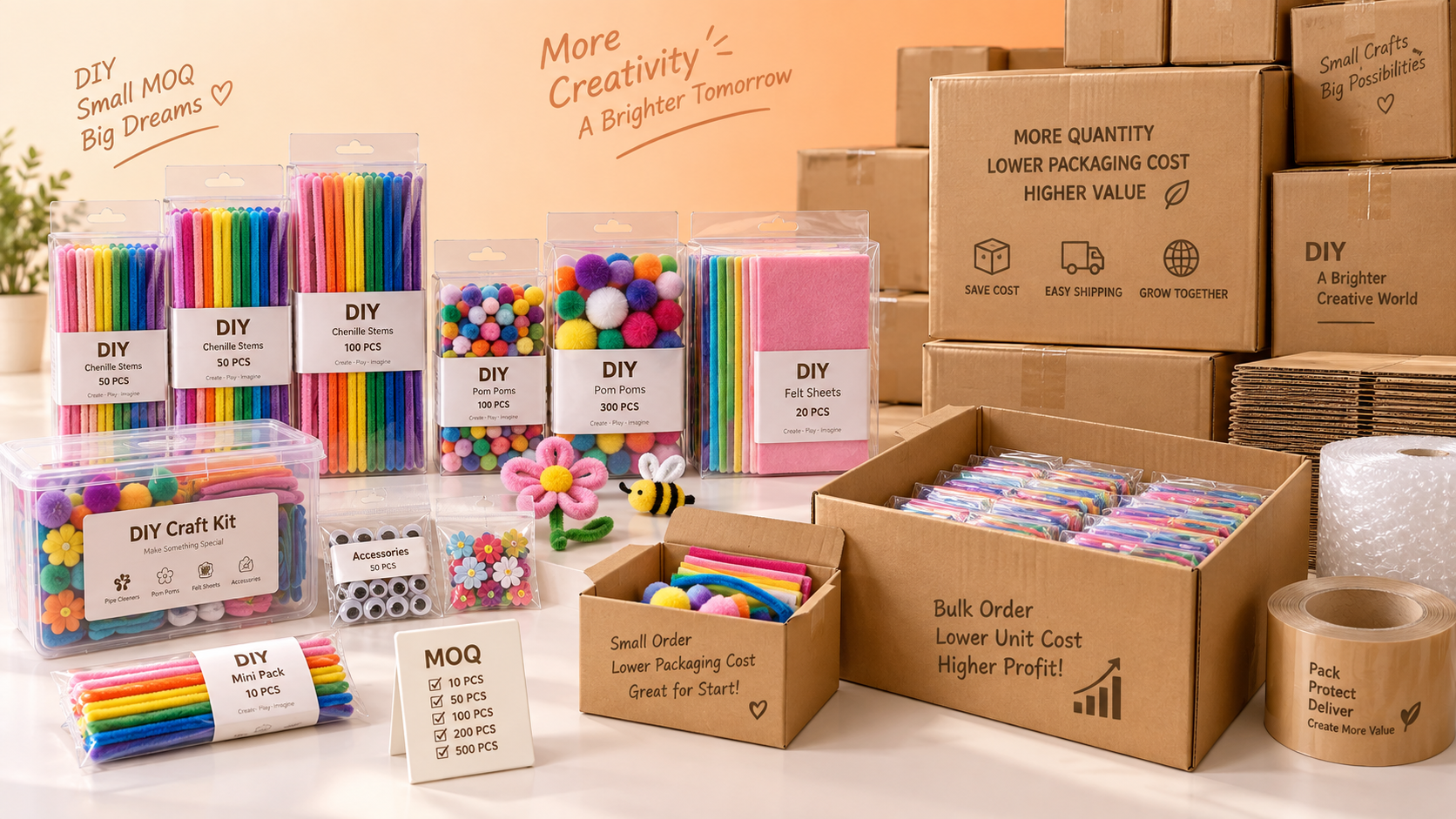
A buyer may receive two quotes for what appears to be the same pipe cleaner DIY kit and assume the lower unit price is the better deal. The difference often sits in the minimum order quantity (MOQ): one supplier may be spreading material purchasing, assembly setup, packaging work, and quality checks across a larger run, while the other is pricing a smaller, less efficient batch.
MOQ affects far more than the price printed beside each kit. It changes which colors can be included, whether retail-ready packaging is practical, how much inventory must be stored, and how much risk is tied to a seasonal design. The useful purchasing question is not simply “What is your MOQ?” but “What does each MOQ level change in the total cost and the product we can actually sell?”
Why a lower MOQ can carry a higher cost
A pipe cleaner craft kit typically combines several low-value components: chenille stems, pom-poms, eyes, felt shapes, glue dots or other accessories, printed instructions, bags, and outer cartons. Individually, these items may be inexpensive. However, each additional component creates purchasing, counting, picking, and packing work.
At a low MOQ, a supplier may need to buy materials in quantities that exceed the finished-kit order, especially for uncommon stem colors, special-cut felt pieces, or custom inserts. The unused portion is not always transferable to another design. This is why a small run with a distinctive color palette can cost disproportionately more than a larger run using standard materials.
Labor also becomes less efficient at low volumes. Workers still need to prepare component bins, verify the bill of materials, pack samples, adjust labeling, and complete final inspection even when the production batch is limited. These setup activities are not eliminated just because the order is smaller; they are simply allocated across fewer units.
For a pipe cleaner diy kit supplier, MOQ may therefore be stated in several ways: per design, per color assortment, per packaging format, or per total order. Buyers should confirm which one applies before comparing quotations.
MOQ structures that lead to very different buying decisions
A mixed-SKU arrangement can be more valuable than a low unit price. A buyer launching a spring craft display may need several project types to create visual variety, but may not want deep stock of each one. In that situation, a supplier that allows shared material colors, a common instruction format, and mixed carton packing can lower inventory risk even if its per-kit quote is not the absolute lowest.
Customization is where MOQ becomes most visible
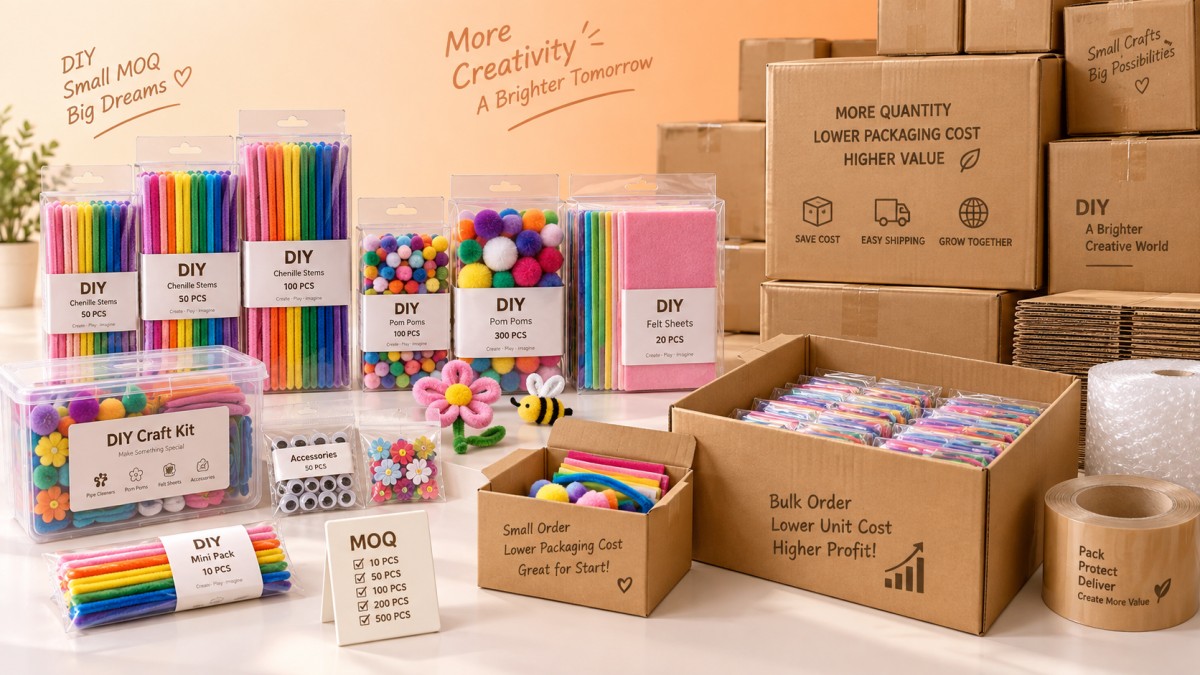
Standard kits generally use available pipe cleaner colors, ordinary component counts, and simple packaging. Customization introduces fixed work and, in some cases, material-specific constraints. A new instruction sheet requires layout and printing preparation. A branded sleeve, color box, or hang tag may require artwork confirmation, printing setup, and separate packing steps. A custom die-cut foam or felt element may require tooling or manual cutting processes that are not sensible for a very small quantity.
It helps to separate requested changes into three groups during quotation:
- Low-impact changes: assortment ratios, sticker application, or selecting from existing material colors.
- Moderate-impact changes: a new printed instruction insert, altered component quantities, or a custom outer label.
- High-impact changes: custom color matching, exclusive molds, bespoke die-cuts, fully printed boxes, or unique multi-part packaging.
The first group may be possible at a lower total MOQ. The latter groups often need a larger run because they create supplier commitments that cannot be recovered easily through other orders. Asking for an itemized explanation does not mean demanding confidential costing; it means identifying which change is driving the threshold.
Packaging deserves special attention. A kit packed in a plain polybag with a printed header card may support a lower starting quantity than the same contents in a retail color box. Neither option is inherently better. A compact bag can reduce dimensional shipping volume and make initial market testing easier, while a box may offer better shelf presentation and protection for a gift-oriented product. The decision should reflect the retail channel, replenishment pattern, and acceptable storage time.
Material choices can either protect or inflate the MOQ
Buyers sometimes focus on the number of stems included but overlook their specifications. Stem thickness, wire flexibility, fiber density, color consistency, and cut length all affect the kit’s usability. A project that needs pieces to hold a shape may require a firmer wire core; a design meant for younger users may need carefully finished ends and components appropriate to the intended age group. Changing these specifications can affect both cost and source availability.
Designs using common colors such as green, brown, white, red, or black are usually easier to consolidate with existing materials. A collection that relies on several uncommon shades may be attractive, but it should be reviewed against the supplier’s color availability and the volume needed per shade. Ordering a modest quantity of many colors can cause a hidden cost increase even when the final kit count seems reasonable.
The same principle applies to decorative components. A small set of widely usable pom-poms, felt leaves, or plastic eyes can often be shared across themes. Highly specific accessories limit that flexibility. Before approving an assortment, request a component list that identifies standard versus custom items and shows the quantity required per kit.
Calculate the landed-cost decision, not only the factory quote
A higher MOQ may reduce the factory unit price but raise the total cash commitment, warehouse burden, and markdown exposure. A lower MOQ can cost more per unit yet reduce the risk of holding a slow-moving design. The right comparison includes costs that are often discussed separately:
- Finished-kit unit price at each quoted volume
- Artwork, sample, setup, or packaging charges where applicable
- Inner-pack and carton configuration
- Freight implications of package size and carton volume
- Expected storage period and handling requirements
- Potential write-down risk for seasonal or trend-dependent themes
For example, a compact emotional-support or desk-gift range may justify a different inventory approach from a broad children’s activity kit. Products such as the Handmade Crochet Pumpkin Plush with Flowers, "Sometimes Life Can Be Tough" Inspirational Positive Crochet, Emotional Support Desk Decor Gift for Friends, Family, Coworkers, Self Care Encouragement Gift show why gift presentation, small-scale storage, and message-card details can influence buying decisions. Where a DIY kit is intended to complement a similar encouragement or desk-decor assortment, a buyer may prioritize flexible packaging and mixed themes over pursuing the lowest possible cost on a single large run.
Questions to resolve before accepting an MOQ
The best time to clarify MOQ is before artwork approval and sampling, not after a supplier has prepared custom materials. Start with the exact kit configuration: component quantities, color assortment, instruction language, age positioning, pack format, and carton requirements. Then ask the supplier to quote two or three realistic volume breaks rather than only the smallest possible order and one very large quantity.
Each quotation should answer practical questions: Can designs be mixed? Can colors be mixed? Is the MOQ based on one design or the combined order? Are packaging minimums separate? Which materials are stocked, and which must be sourced specifically? Is there a surcharge for hand counting, sorting, or individual bagging? These details reveal whether an apparently flexible MOQ still contains operational restrictions.
It is also useful to ask what can remain unchanged across future replenishments. Reusing a bag size, insert format, carton specification, and core component palette can make later orders easier to manage. By contrast, changing a kit’s colors, instruction format, and packaging at the same time may effectively turn a reorder into a new production setup.
When a higher MOQ is justified
A larger commitment is more defensible when the design has steady, non-seasonal demand; the components can be shared with other items; the packaging will remain unchanged; and the buyer has reliable storage and replenishment forecasts. It can also make sense for a core kit used across multiple retail locations or promotional periods.
Smaller quantities are usually safer for new themes, highly seasonal projects, unfamiliar retail channels, or designs with custom elements that may need revision after initial feedback. The goal is not to avoid MOQ altogether. It is to choose an MOQ that matches the certainty of demand and the level of customization.
When comparing suppliers, treat MOQ as a production design variable rather than a fixed obstacle. A clear component specification, realistic assortment plan, and transparent volume comparison give buyers more control over both cost and inventory exposure.
Leave A Message
If you are interested in our products and want to know more details, please leave a message here, we will reply you as soon as we can.

We specialize in supplying home decor, handicrafts, and daily necessities.


