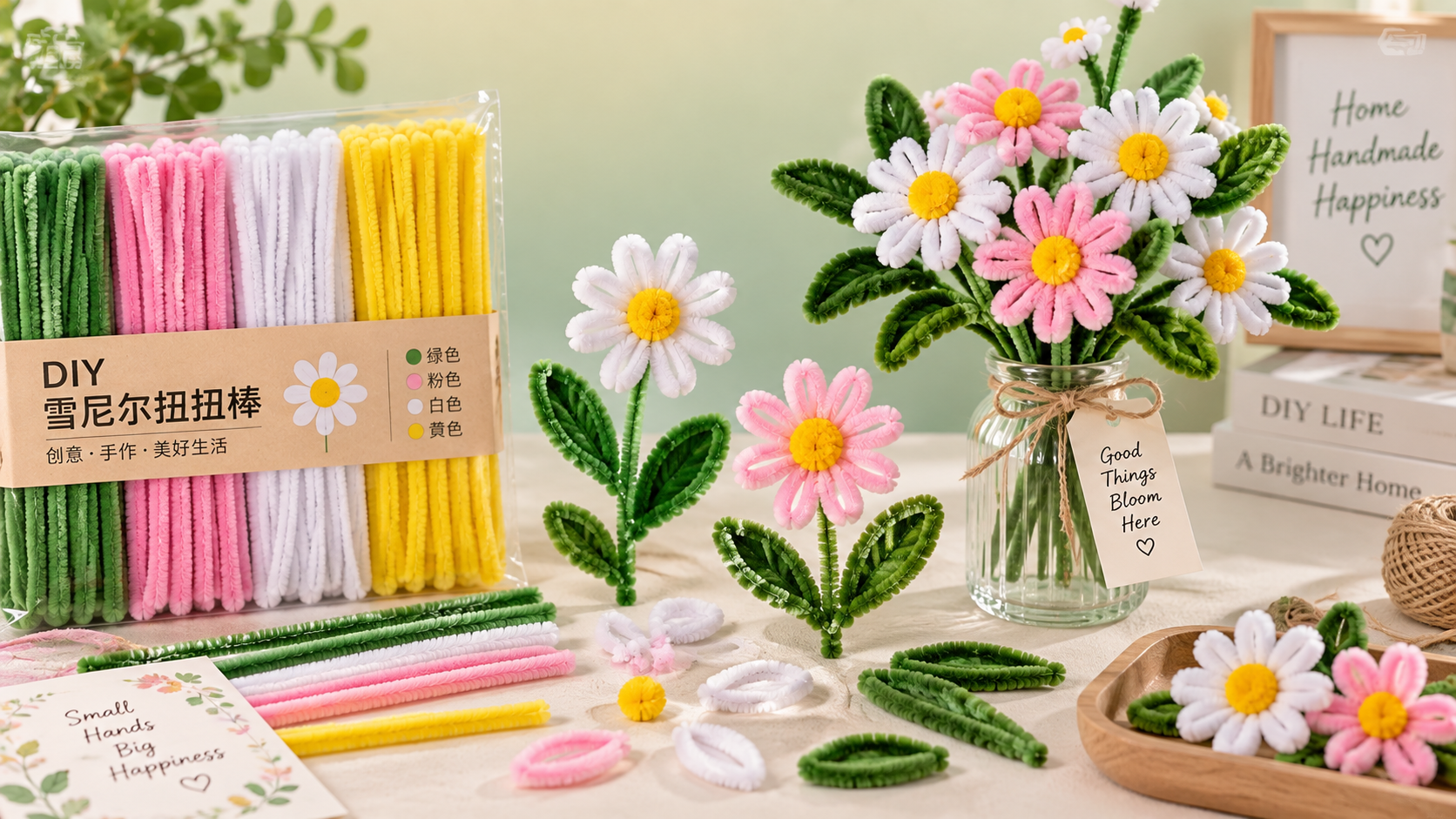
For easy floral crafts, choose chenille stems that bend smoothly, hold their shape after twisting, and feel securely wrapped around the wire. A good chenille stems DIY kit does not need every possible color or the thickest stems available. It needs the right balance of thickness, length, softness, and color selection for the flowers you plan to make.
Start with the project rather than the pack size. Small daisies, lavender sprigs, and loose leaf details need different stems from large roses, wreath accents, or freestanding bouquet flowers. Buying a mixed kit without checking these details often creates a familiar problem: the stems are either too soft to support the design or too bulky to make clean petals.
Match stem thickness to the flower structure
Chenille stems, often called pipe cleaners, are built from a wire core covered in soft fibers. Their thickness affects both the appearance of the flower and how easily it can be shaped.
For an easy first project, medium stems are usually the most forgiving choice. They are firm enough to make a simple loop petal, yet flexible enough to correct a shape when it is uneven. For a larger bloom, it is often better to combine two ordinary stems at the center than to use one very thick stem throughout. This keeps the petals lighter while adding support where it is needed.
Test flexibility before committing to a large kit
A stem should bend with light hand pressure, twist around itself without springing open, and stay in position after shaping. The wire should not feel so stiff that repeated bending becomes tiring, especially when making many petals. At the same time, overly soft wire can leave flower heads loose and drooping.
Look closely at the fiber wrap as well. A dense, even chenille covering gives petals a fuller edge and hides the wire core. Sparse fibers can expose metal when the stem is curved, while loose fibers shed onto the work surface and make finished flowers look worn quickly. Run two fingers along a sample stem: the surface should feel consistent rather than patchy or rough.
For children’s projects or group activities, avoid stems with noticeably sharp cut ends. A cleanly finished end is easier to handle and less likely to catch on fabric, ribbon, or fingers. If ends will be visible in the final design, fold them inward or cover them with a small center piece instead of leaving a bare wire tip exposed.
Length matters more than it seems
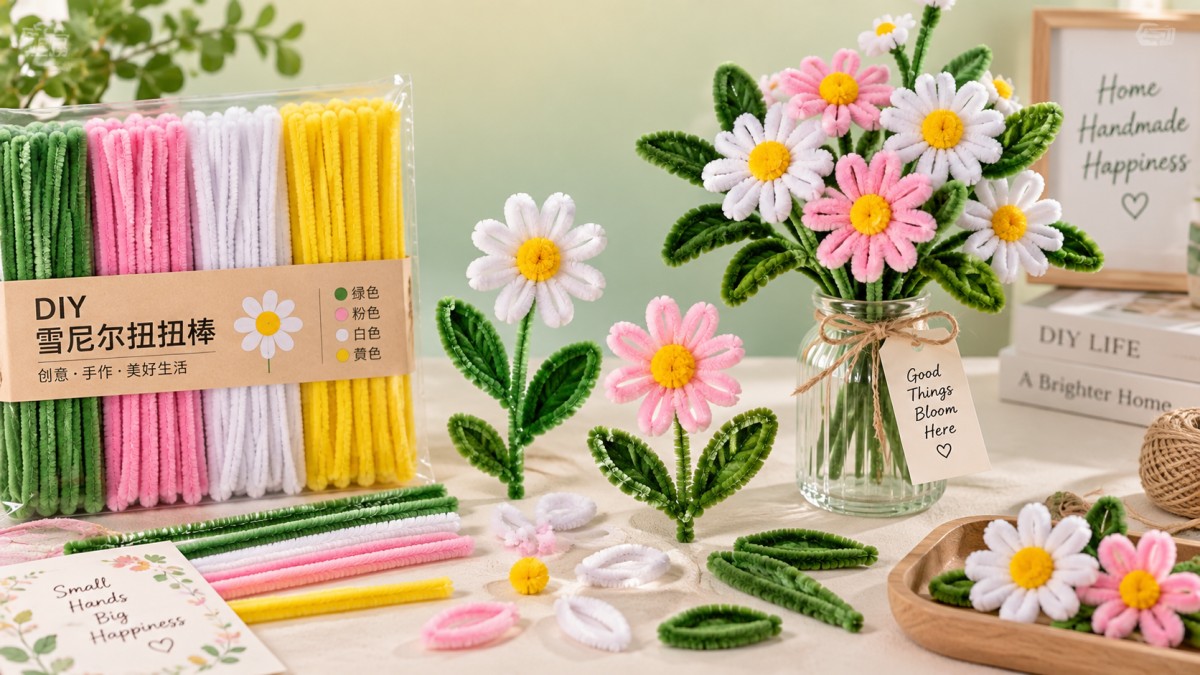
Long stems give you room to form petals and still create a stem or fastening point. Short stems reduce waste for small flowers, but they can make twisting difficult because there is little wire left to grip. When the final flower needs a visible stem for a jar arrangement, gift topper, or seasonal display, choose longer chenille stems and reserve the excess for leaves or tendrils.
For flowers attached to a card, frame, wreath, or wall decoration, shorter pieces are often easier to manage. Cut after planning the petal size, not before. Once a chenille stem is cut too short, joining it back together usually creates a lumpy point that shows through the flower.
Choose colors as a working palette, not a random assortment
A large rainbow pack can be useful for open-ended crafting, but floral work benefits from a more deliberate palette. Choose greens in at least two tones if leaves and stems are part of the design. Pair flower colors with a neutral or contrasting center color, such as yellow, cream, brown, or black, depending on the flower style.
For home decor, a restrained palette often looks more finished than using every bright shade in one arrangement. Soft pink, white, green, and muted yellow can suit a spring table piece; deeper red, green, and gold work well for a holiday wreath. Bright colors make sense for children’s crafts, party decorations, and classroom displays where the flowers are meant to be playful rather than realistic.
A mixed chenille stems DIY kit is most useful when its colors are supplied in usable quantities. One or two stems of each color may look varied in the package but will not complete a coordinated bouquet. Check whether the colors you need for leaves, flower centers, and repeated petals appear often enough to finish the project.
Packaging affects workflow and storage
Loose stems are fine for occasional use, but organized bundles or compartmented packs help when several people are working at once. They reduce tangling, make color selection faster, and keep unused stems clean. For repeated home decor projects, store stems flat or in a shallow box; crushing the fibers can make them look thin and uneven.
Consider the rest of the decoration before purchasing supplies. A flower craft used in a festive window display may need more than floral stems alone. Reusable decorations such as Christmas Gel Window Clings - Xmas Santa Claus Snowman Snowflake Penguin Christmas Tree Gift Window Stickers for Kids can add bright seasonal detail to smooth glass surfaces while chenille flowers provide texture on nearby tables, gift bags, or display boards. Keep the two materials in their suitable roles: gel clings are for smooth surfaces, while chenille stems are for dimensional shapes and lightweight floral forms.
Three purchasing mistakes to avoid
- Choosing by color alone: A beautiful color mix will not help if the wire cannot hold a petal shape or if the stems are too short for the intended flower.
- Using one thickness for every part: Petals, centers, leaves, and structural stems do not always need the same firmness. A simple mixed-thickness selection can make a project cleaner without making it harder.
- Ignoring the attachment method: Flowers intended for a wreath, fabric surface, or gift package need enough remaining wire to twist, wrap, or secure. Decide where the flower will go before cutting the stem.
Before ordering, write down the flower size, number of blooms, whether stems must stand upright, and the colors required for leaves and centers. That short check prevents most unsuitable purchases. For easy floral crafts, the best choice is usually a well-wrapped, medium-flexibility pack with practical stem lengths and enough repeated colors to complete a design rather than merely start one.
Leave A Message
If you are interested in our products and want to know more details, please leave a message here, we will reply you as soon as we can.

We specialize in supplying home decor, handicrafts, and daily necessities.


