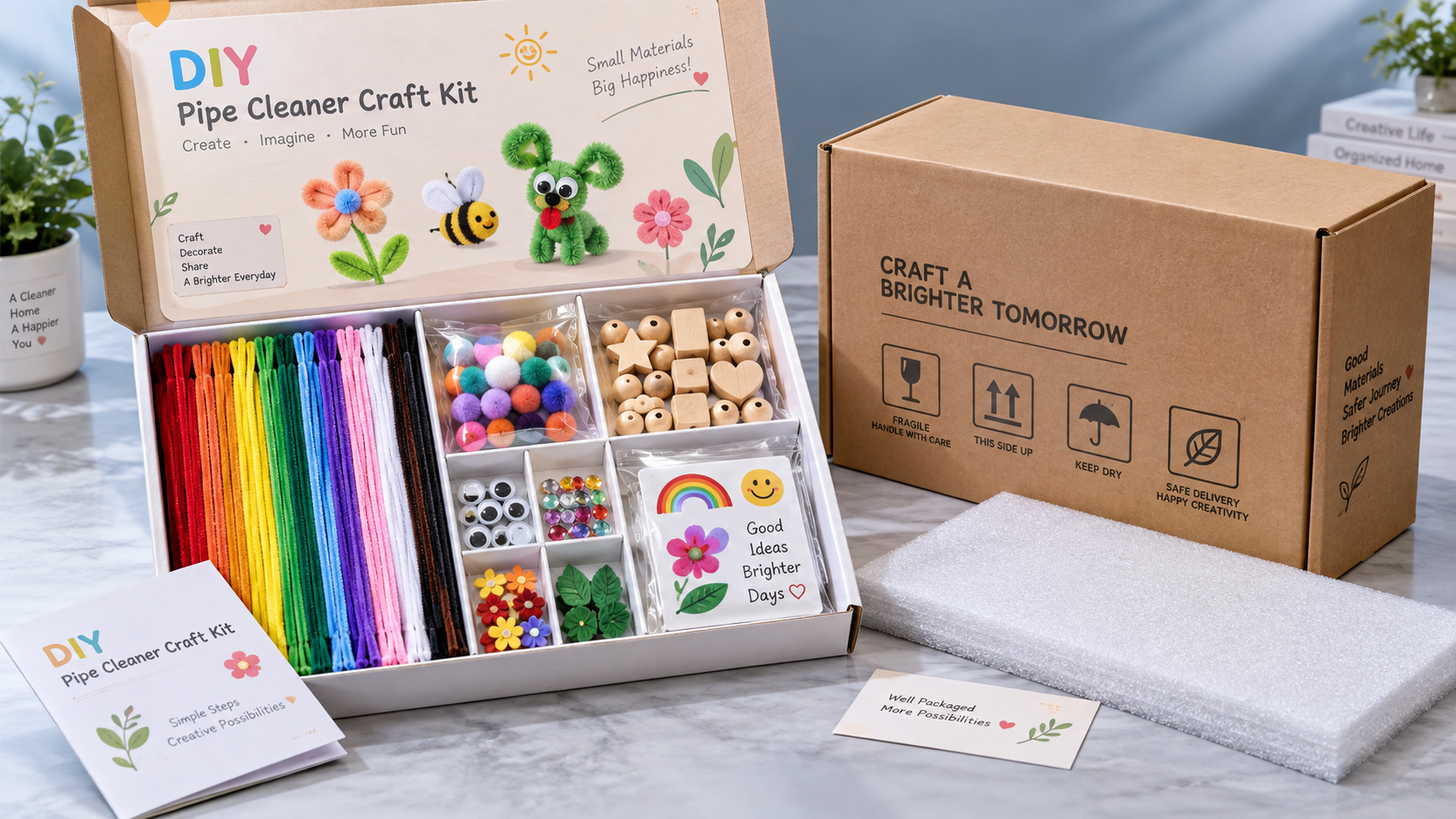
Prevent Damage by Designing for the Shipment, Not Just the Kit
Crushed pieces in a pipe cleaner DIY kit are rarely caused by one dramatic warehouse mistake. More often, the damage begins earlier: a kit is designed to look compact on a sample table, then packed into a carton that leaves too much void space, too little top-load resistance, or no protection for its most fragile components. By the time it reaches a retailer, school program, or fulfillment center, bent pipe cleaners, dented paperboard inserts, flattened pom-poms, and broken wooden parts can make the kit appear incomplete or poor quality.
For project managers sourcing bulk craft kits, prevention is worth addressing before purchase order approval. The cost of stronger packaging can be modest compared with the consequences of rework, claim handling, replacement shipments, or a seasonal launch delayed by customer complaints. A capable pipe cleaner diy kit supplier should be able to explain how the product is packed at unit, inner-carton, and master-carton level, rather than only providing a finished product photo.
The first practical rule is simple: identify which component defines the package. In many kits, pipe cleaners themselves can tolerate moderate compression and can often be reshaped. The weak point may instead be a folded display card, foam shape, lightweight wooden cutout, molded decorative piece, or a finished sample that is included to show the intended project. Packaging should be designed around that weak point.
Separate Flexible Parts From Parts That Can Be Permanently Deformed
A common packing error is placing every component loosely into one polybag. This is fast to assemble, but it lets heavier items migrate during transport. A bundle of wooden beads, clips, adhesive bottles, or small tools can press into softer decorative materials. If the kit contains paper flowers, felt figures, pom-poms, or pre-cut fabric shapes, they can arrive compressed against the bag seam or carton wall.
Components should be grouped by how they respond to pressure:
- Resilient components: standard pipe cleaners, cords, basic plastic pieces, and durable beads can usually be bundled together if their edges are smooth.
- Shape-sensitive components: pom-poms, foam pieces, folded paper decorations, and fabric forms need a protected pocket or tray space.
- Rigid components with edges: wooden pieces, wire cutters, clips, or shaped plastic accessories should be restrained so they cannot shift into softer parts.
- Surface-sensitive components: stickers, printed sheets, adhesive-backed items, and decorated panels need protection from rubbing, moisture, and bending.
Dividers do not need to be elaborate to work. A flat card insert, paper sleeve, small internal box, or shallow tray can stop hard items from moving across the kit. The right choice depends on the kit’s retail presentation, assembly labor, and storage conditions. For a large-volume order, even a simple die-cut insert can be more consistent than loose hand-packed filler.
When a kit contains long pipe cleaners, avoid forcing them into a package that is only slightly shorter than the component. A tight bend may not be obvious when the unit leaves the factory, but it can create a permanent kink after weeks under carton pressure. It is usually better to use a package sized for the component length, coil the pipe cleaners with a controlled diameter, or secure them to a backing card designed to prevent sharp bends.
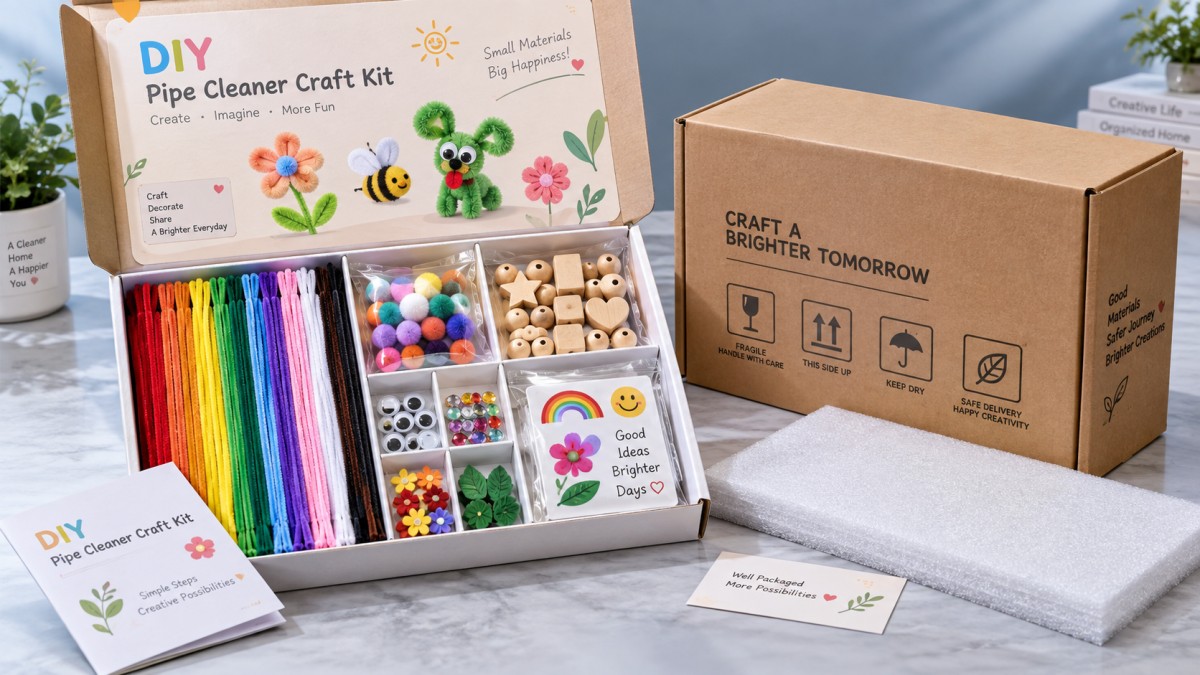
Control Empty Space Before Increasing Carton Strength
Buyers sometimes ask for a heavier master carton as the first solution to crushed goods. A stronger carton is useful, but it will not fully protect poorly packed units. If finished kits can slide or collapse within the carton, they will still strike one another when cartons are moved, tilted, or stacked.
Start with the unit pack. It should hold its form when lightly squeezed and should not allow the contents to gather at one end. Then review the inner pack and master carton. The objective is to create a stable block of product with limited movement, while avoiding excessive material that increases cube and freight expense.
Questions worth asking during packaging review include:
- Does the retail box retain its shape when several cartons are stacked?
- Is there clearance between the product and the outer carton walls?
- Can individual kits shift sideways, upward, or diagonally inside the master carton?
- Are top and bottom layers equally protected, or does the top layer carry all compression?
- Does the carton still close squarely after production variation in component quantity or thickness?
A carton that looks full is not always stable. Overpacking can be just as damaging as underpacking when soft kits are compressed beyond their designed load. The practical target is controlled fit: enough support to prevent movement, enough headspace to avoid crushing the highest point of the kit.
Use Carton Design That Matches the Distribution Route
Damage risk changes with the route. A direct container shipment to one distribution center is different from a small-parcel fulfillment program, where individual cartons may be handled repeatedly and placed under mixed loads. Seasonal craft kits often face additional pressure because they may be stored ahead of a holiday selling window and then moved quickly through multiple facilities.
For palletized transport, carton stacking strength and pallet pattern are especially important. Weak edges can collapse when cartons are stacked unevenly, particularly if pallet overhang leaves part of a carton unsupported. For parcel shipment, more attention should go to unit-pack rigidity, corner protection, and preventing components from rattling inside.
The shipment specification should state the intended route rather than assuming every carton will receive the same treatment. A packaging solution acceptable for full-carton retail replenishment may fail when the same kit is picked as an individual online order.
Review the Components That Change Shape With Humidity or Pressure
Pipe cleaner craft kits often combine several material types. That mixed-material format is attractive for consumers, but it creates packaging risks that are easy to miss when each component is evaluated separately.
Paperboard can soften in humid conditions. Fabric can pick up creases. Wooden pieces can create pressure points. Adhesive elements can shift or stick where they should not. A package that protects one material may create a problem for another if its dimensions or internal layout are poorly chosen.
Flat decorative items need particular attention. For example, a seasonal assortment that includes soft TPR window clings should be stored flat and protected from sharp accessories, excessive heat exposure, and folded inserts. The same principle applies to Halloween Window Gel Clings Ghost Pumpkin Bat Witch Cat Boo Blood Decal Stickers for Halloween Home Party Window Decorations: soft, reusable decorative pieces benefit from smooth flat support so they remain easy to remove, store, and apply to glass or other smooth surfaces. Mixing such items with rigid craft components without a separator can create avoidable impressions or edge damage.
Project teams should also distinguish between cosmetic deformation and functional damage. A lightly bent pipe cleaner may be acceptable if it can be reshaped during use. A creased instruction sheet, dented presentation card, or damaged adhesive surface can affect customer confidence even when the project remains technically usable. The inspection standard should reflect both conditions.
Make Packaging Approval Part of the Production Approval
Product samples alone do not show whether a kit will survive shipment. A well-made sample can still be packed in an unsuitable configuration. Before mass production, review a complete packed sample using the actual component counts, production materials, inserts, labels, inner packaging, and master carton intended for the order.
It is useful to approve packaging in layers. First confirm that every component is present and properly secured in the unit. Then check that the retail box or bag keeps its intended shape. Finally, inspect a filled master carton, including its dimensions, closure, internal fit, and handling marks. This process can reveal problems such as an insert that buckles under weight, a carton that is too tall for its contents, or an extra component that pushes the unit package out of square.
Written specifications should describe more than carton quantity. They should cover orientation, maximum components per bag where relevant, use of separators, packing sequence, carton sealing method, and any requirement that fragile pieces sit away from the carton edge. Photos of the approved packing arrangement are useful because they reduce interpretation differences between production shifts.
Build a Damage Check Around the Likely Failure Points
Final inspection should not rely only on opening one unit from the top layer of a carton. Compression damage can be concentrated at the bottom of a stack, along outer carton edges, or in cartons that have slightly more empty space than intended. Sampling units from different positions provides a more realistic view of packing consistency.
Inspectors should look for bent pipe cleaner bundles, crushed soft components, cracked wooden accessories, loose hard items, deformed retail packaging, and pressure marks on printed surfaces. They should also confirm that the master carton remains square and that taped closures have not opened under load. When a defect appears, the response should focus on its cause: insufficient separation, excess void space, poor component orientation, or inadequate external protection. Adding filler without identifying the cause can simply move the damage to another part of the kit.
The most reliable shipment protection comes from a packaging design that accepts normal logistics pressure as a design condition. When flexible materials, rigid accessories, unit packaging, and master-carton loading are considered together, crushed pieces become a controllable production issue rather than an expensive surprise at destination.
Leave A Message
If you are interested in our products and want to know more details, please leave a message here, we will reply you as soon as we can.

We specialize in supplying home decor, handicrafts, and daily necessities.


