When Mixed-Color Chenille Stems Make Sense for Craft Kit Ranges
For buyers building a craft assortment, a single-color pack is often the safe choice: simple to specify, easy to replenish, and familiar to customers. Yet safe is not always what earns attention on a crowded shelf or in a fast-scrolling online listing. Mixed-color chenille stems can make a chenille stems diy kit feel more complete before the customer even opens the box. The assortment suggests possibilities—flowers, animals, ornaments, letters, miniature décor, and seasonal characters—rather than asking the user to imagine them from one neutral bundle.
That does not mean mixed colors are right for every range. They work best when color variety supports the project, the price point, and the retailer’s intended customer experience. For category managers, private-label teams, and import buyers, the decision is less about adding “more colors” and more about whether the assortment turns basic craft material into a clearer, more sellable creative proposition.
Mixed colors work when the kit is selling an outcome, not just a material
Chenille stems are versatile wire-based craft components covered in soft fibers. Sold alone, they are usually a replenishment item for schools, hobby users, and experienced makers. In a kit, however, they become part of a guided activity. This distinction matters.
A mixed-color selection makes the strongest commercial sense when the finished result naturally needs contrast. Children’s animal-making kits, spring flower projects, holiday decorations, classroom craft packs, and party activities all benefit from several coordinated shades. A red, green, white, and metallic mix immediately points toward festive decoration. Bright primary colors suit playful creatures and early-learning activities. Softer pastel assortments are better aligned with nursery décor, Easter projects, or giftable handmade accessories.
By contrast, a broad rainbow mix may be unnecessary for a kit focused on one specific result, such as a white snowflake garland or a monochrome floral wreath. In these cases, too many colors can look like leftover stock rather than a considered design choice. Buyers should ask one practical question: Will each color have an obvious role in at least one project shown on the packaging or instruction sheet?
A quick decision framework
- Choose mixed-color chenille stems for open-ended creativity, multi-character projects, seasonal activity sets, and children’s craft ranges.
- Choose curated color stories when the kit targets a particular season, interior style, or gift occasion.
- Choose single-color or limited-color packs when customers need volume for a defined project or when visual consistency is the main requirement.
The most successful assortment is rarely the one with the highest number of colors. It is the one that makes the end project feel achievable and inviting.
Color planning affects perceived value more than buyers may expect
In home décor and gift-oriented crafts, color is part of the product’s emotional signal. A well-balanced mix can make a modest kit look thoughtful, while a poorly planned selection can make even good materials feel generic. This is especially relevant when kits are sold as gifts, weekend activities, or ready-to-make décor rather than as loose craft supplies.
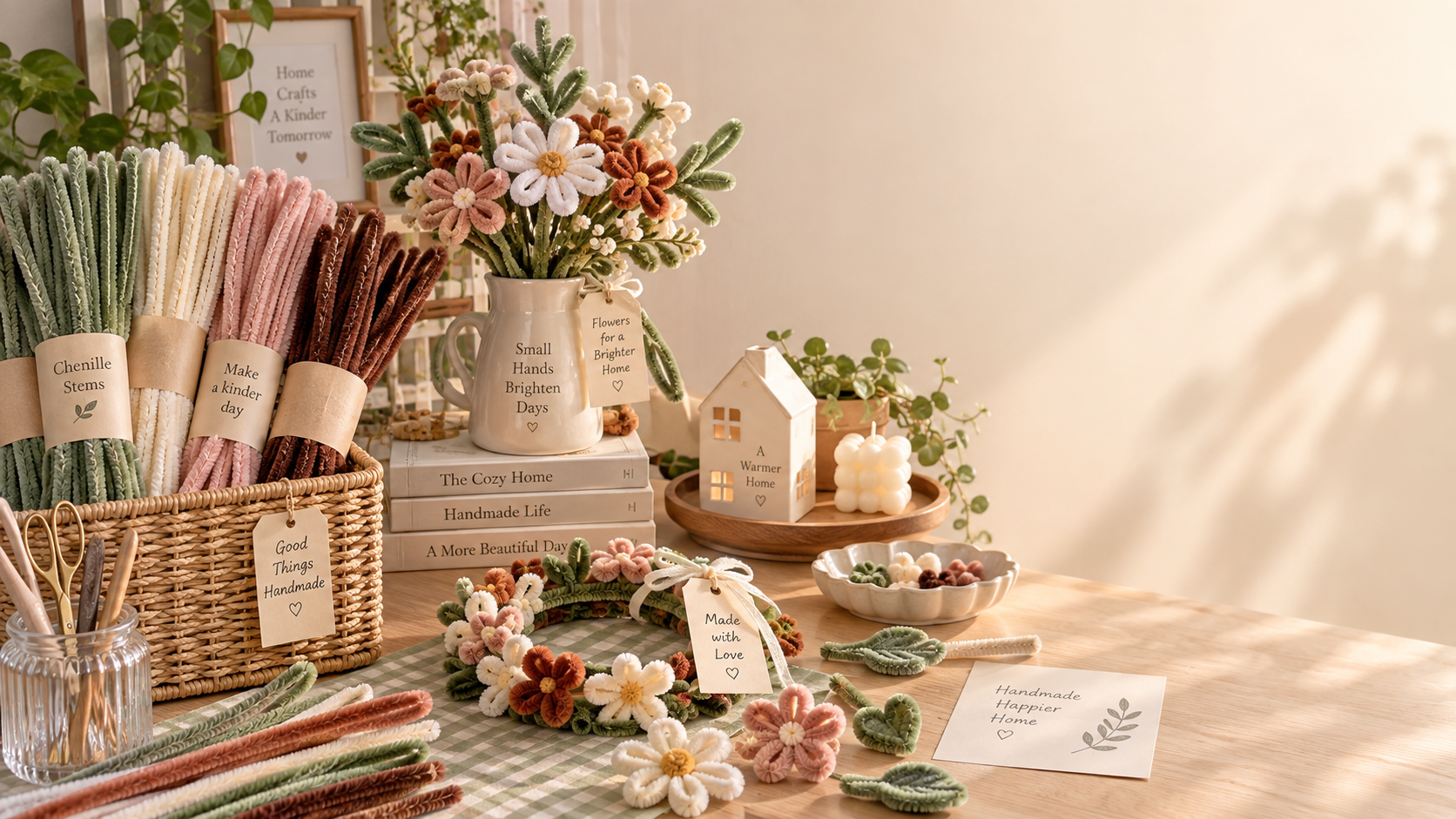
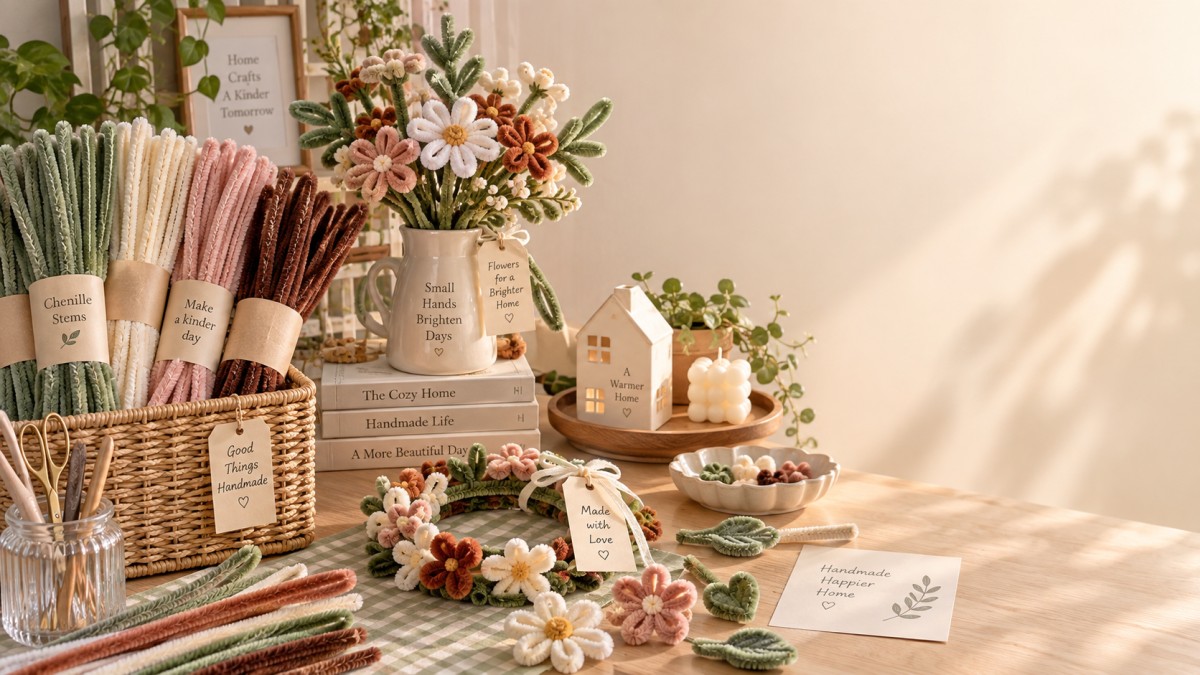
For example, a muted combination of cream, sage, terracotta, blush, and brown may support a modern handmade home décor collection. Brighter pink, yellow, turquoise, and purple can be appropriate for a child’s birthday activity range. Metallic gold, silver, red, and green are practical for Christmas projects, but including only one or two metallic stems may frustrate customers if the featured design requires several.
Buyers should therefore review color ratios, not only the color list. If the pack contains ten shades, how many stems are supplied in each shade? Are the hero colors sufficiently represented? Does the mix include versatile neutrals that can be used for animal bodies, stems, facial details, or structural elements? A kit that looks colorful in a product photo but lacks enough usable quantities can create avoidable disappointment.
Material consistency still matters behind the colorful presentation
Color variety should not distract from the functional requirements of chenille stems. The wire needs enough flexibility for children and casual makers to bend comfortably, while retaining enough shape to hold petals, ears, loops, and small sculptural forms. The fiber covering should feel even and soft, without visible bare wire, excessive shedding, or irregular thickness that changes from color to color.
This is where sourcing discipline becomes particularly important. Mixed packs may involve several dye lots and multiple production stages, creating more opportunities for variation than a plain single-color item. During product evaluation, it is useful to assess samples by twisting, bending, wrapping, and cutting stems in the way a customer would. Check whether darker colors rub off, whether metallic finishes remain attached during bending, and whether the wire ends are neatly finished for the intended user group.
For a children’s craft range, packaging and age guidance should also reflect the product’s wire component. For a home décor kit aimed at adults or teens, stiffness and stem length may deserve greater attention because users may be making larger flowers, wall hangings, table accents, or dimensional ornaments.
Where a chenille stems DIY kit can add breadth to a home décor assortment
Retailers and brands focused on home décor do not need to position chenille stems only as a children’s craft item. The material fits naturally into small-scale creative gifting and seasonal decorating, particularly when paired with clear inspiration. A compact “make your own” flower bunch, miniature wreath, place-card holder, or desk accessory can bridge the space between traditional craft supplies and impulse-friendly décor gifts.
The wider handmade-gift trend also creates useful cross-merchandising opportunities. A cheerful yarn-based desk gift such as the Positive Crochet Taco Plush, "Let’s Taco ‘Bout What a Marvelous Coworker You Are" Funny Punny Gift, Handmade Desk Decor for Coworkers, Colleagues, Work Besties, Appreciation Gift shows why compact, colorful handmade items resonate in office and gifting environments. Chenille stem kits can complement this mood with make-at-home desk décor projects: tiny flowers, message holders, playful characters, or seasonal cubicle accents. The connection is not that both products use identical materials; it is that both answer a demand for small, personal objects that make everyday spaces feel warmer.
For buyers, this can support a more coherent range architecture. Ready-made handmade-style gifts serve shoppers seeking convenience, while DIY kits appeal to those who want the satisfaction of making and giving something themselves.
Packaging should reduce decision friction
Mixed colors naturally create visual interest, but they can also create uncertainty. Customers may wonder what they are supposed to make, whether enough materials are included, or whether they need additional tools. Good kit packaging answers these questions quickly.
Rather than showing a loose pile of stems, present two or three achievable finished examples. State the stem count, color assortment, approximate length, included accessories, and whether scissors, glue, or other materials are required. If a project needs repeated colors, show the exact finished quantity so shoppers understand why certain shades appear more often in the pack.
For e-commerce listings, color representation deserves special care. Bright stems can look very different under warm or cool photography, and mixed packs may be interpreted as exact color promises. Describe the palette in a useful way—such as “pastel spring mix” or “bright assorted colors”—while noting that slight shade variation can occur between production batches where appropriate.
Supply-chain questions to settle before range approval
A mixed-color assortment adds complexity to purchasing, especially when the range will be replenished across several seasons. Before approving a supplier, buyers should clarify whether the color recipe can be maintained, how substitutions are handled, and whether packaging assembly is completed under controlled specifications. It is also worth confirming whether the supplier can adjust stem length, thickness, pack count, or palette for different channels without changing the basic product quality.
For import programs, a supply network with experience across handicrafts, wooden and fabric crafts, ceramics, plastics, and handwoven items can be useful when a kit requires more than chenille stems alone. A coordinated sourcing approach may simplify the development of add-ons such as wooden bases, fabric pouches, decorative containers, or display-ready gift packaging. The goal is not to overbuild every kit, but to make it easier to develop collections with a shared visual language.
The better choice is a purposeful mix
Mixed-color chenille stems make sense when they help customers create more, understand the project faster, or see the kit as a giftable experience rather than a bundle of supplies. They are particularly effective for seasonal activities, children’s creativity, small home décor projects, and cheerful desk-accessory concepts.
The strongest buying decision comes from matching palette, quantity, material performance, and packaging to a clear use case. When those elements are aligned, a chenille stems diy kit can become a flexible, visually appealing addition to a craft range—one that feels considered on the shelf and satisfying in the customer’s hands.
Leave A Message
If you are interested in our products and want to know more details, please leave a message here, we will reply you as soon as we can.

We specialize in supplying home decor, handicrafts, and daily necessities.


