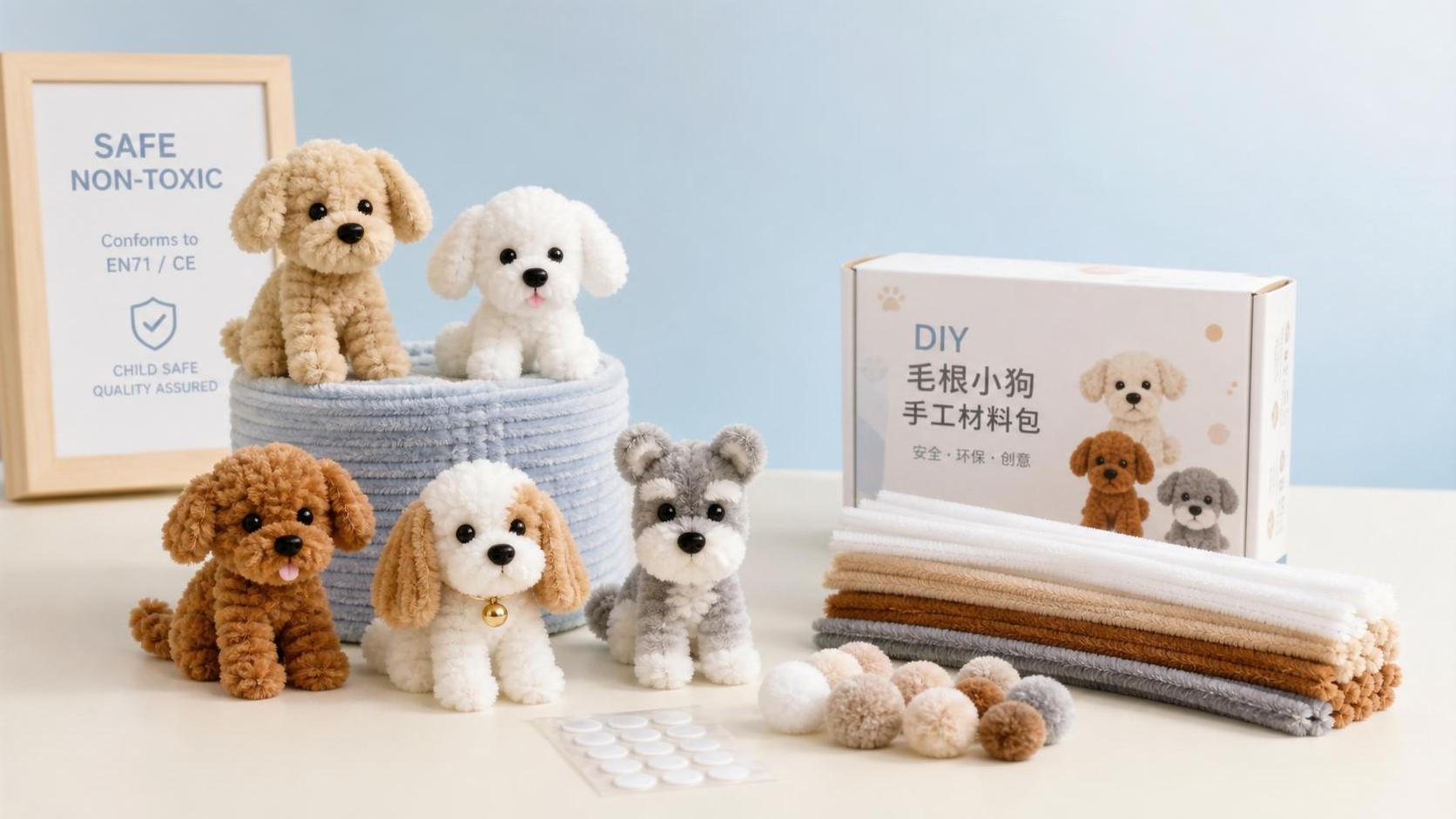
Are pipe cleaner puppies safe for children’s craft sets? In most cases, they can be, but only when material selection and component control are treated as part of product safety, not just design appeal.
For home decor crafts and children’s DIY assortments, the main concerns are usually simple: fiber composition, exposed wire ends, surface coatings, glue use, and any part that can detach during handling.
That matters even more in global sourcing. A stable supply chain with certified factories and qualified partner workshops helps reduce variation between samples, pilot runs, and final shipments.
Why this check matters in craft and home decor supply
Pipe cleaner puppies sit at the intersection of play, decoration, and handicraft assembly. They may appear in school kits, holiday ornaments, home leisure DIY packs, or mixed craft bundles.
Because they are soft, colorful, and easy to shape, buyers often focus on appearance first. Yet safety review starts deeper, at the raw material and structure level.
In practice, a chenille stem figure is a composite item. It combines fuzzy fibers, internal wire, dyes or coatings, and sometimes glued-on eyes, noses, bows, or fabric trims.
Any one of those elements can change the risk profile. A soft surface alone does not make pipe cleaner puppies suitable for every children’s craft set.
The first review starts with materials
Material safety begins with identifying what the fuzzy covering is made from and whether the supplier can document consistency from lot to lot.
For pipe cleaner puppies, the fiber should feel soft and stable, without shedding excessively during twisting, cutting, or repeated handling.
The internal wire also deserves close attention. It needs enough bendability for craft use, but not so little protection that sharp ends appear after shaping.
Surface treatments should be reviewed as well. Colorfastness, odor, and residue are practical warning signs during incoming inspection, especially for mixed-color assortments.
Core material questions worth documenting
- What fiber type covers the stem, and is it consistent across colors?
- Does the wire remain enclosed after bending and twisting?
- Are dyes, coatings, and finishes supported by test records?
- Does the item show fiber loss, odor, staining, or rough edges?
Small parts are often the real decision point
When reviewing pipe cleaner puppies, detachable accessories usually create the biggest compliance concern. Plastic eyes, pom-poms, beads, ribbons, and glued decorations may loosen in transit or use.
That is why the same puppy shape may be acceptable in one craft set but unsuitable in another. Age grading, assembly method, and intended use all influence the result.
For example, a decorative DIY pack for supervised crafting differs from a general children’s assortment meant for broad retail placement. The component review cannot be separated from the use scenario.
How sourcing quality affects safety consistency
A safe sample is not enough. The larger issue is whether production remains stable across vendors, colors, and seasonal orders.
This is where supply chain structure becomes important. In Ningbo, a strong export base supports faster coordination between handicraft factories and related material partners.
With two certified factories focused on handicrafts, wooden crafts, and fabric crafts, plus qualified partners in ceramics, plastics, and handwoven products, it becomes easier to control cross-category sourcing risks.
That network matters for pipe cleaner puppies because accessory parts often come from different production lines. Eyes, packaging inserts, decorative trims, and display components may not share the same source.
A robust and certified supply chain helps align specifications, testing records, and corrective actions before shipment problems appear at retail.
Useful checks for real product evaluations
In actual inspections, safety review should combine document control with physical validation. One without the other leaves gaps.
A practical reference can be seen in multi-use chenille kits such as Wholesale OEM ODM Custom Pipe Cleaners DIY Plant Craft Kit, Personalized Chenille Stem Flower Succulent Craft Starter Pack for Kindergarten Home Art Handicraft Decoration.
Products in this category often use soft fuzzy chenille stems with a non-toxic smooth surface, easy bendability, and multi-color options for flowers, succulents, and potted craft forms.
Those features support broad applications, from kindergarten art class use to home DIY and decorative handmade gifts, but they still need structured safety review when adapted into pipe cleaner puppies.
A practical review list
- Confirm the bill of materials for stems, accessories, glue, and packaging.
- Check bending performance after repeated shaping and recovery.
- Inspect both stem ends for sharp points or fiber gaps.
- Test whether eyes, pom-poms, or trims detach under light force.
- Review applicable testing documents for destination markets.
- Keep golden samples to compare future production lots.
How to judge suitability by scenario
Not every version of pipe cleaner puppies should be judged the same way. Intended use changes what matters most.
If the item is a home decor craft component, visual finish and stable assembly may be the priority. If it enters a children’s set, detachable parts and wire containment move to the front.
If customization is required, flexible OEM and ODM options are useful, but changes in color, decoration, or accessory style should trigger a new review, not a copied approval.
That is often the overlooked point. A puppy with embroidered details is not equivalent to one with glued plastic eyes, even if both share the same chenille base.
A practical next step
The safest approach is to evaluate pipe cleaner puppies as complete assemblies, not as simple craft novelties. Material files, attachment strength, age grading, and production consistency should be reviewed together.
From there, it becomes easier to compare suppliers, define acceptable construction methods, and decide whether a design belongs in a children’s craft set, a supervised DIY pack, or a decorative home craft range.
Clear standards at the sample stage usually prevent the most expensive problems later: failed inspections, retail claims, and avoidable product redesign.
Leave A Message
If you are interested in our products and want to know more details, please leave a message here, we will reply you as soon as we can.

We specialize in supplying home decor, handicrafts, and daily necessities.


