
A low unit price only makes a holiday window decorations bulk order economical if the goods arrive ready to sell, in usable condition, before the display season begins. Packaging, freight, customs charges, inspection, and warehouse handling can change which quotation offers the better deal.
Compare offers using the cost per accepted, saleable set delivered to your warehouse. Then assess seasonal exposure separately: late arrivals, emergency freight, and leftover stock can erase savings that looked attractive when the order was placed.
Start by defining what the quoted “unit” includes
Window decorations may be quoted per piece, sheet, set, retail pack, or master carton. A sheet containing several hearts is not directly comparable with a complete window display set. Even two similarly illustrated packs may have different dimensions, coverage, or accessory counts.
Before comparing prices, establish a common specification: material, dimensions, design assortment, pieces per pack, retail packaging, labeling, and carton quantity. For hanging decorations, include cords or hooks. For window clings, specify the backing sheet and protective packaging. Otherwise, the apparent saving may simply reflect missing components.
Separate one-time development charges from recurring production costs. Custom artwork, tooling, print setup, and sample delivery should be visible in the quotation. If these costs are included in the unit price, establish how repeat orders will be priced and whether existing tooling can be reused.
Build a landed-cost comparison with clear boundaries
Ask each supplier to quote the same named delivery location and Incoterms rule. An EXW price and an FOB price cover different responsibilities. Even a delivered quotation needs a clear statement of what is included, particularly unloading, customs clearance, duties, and taxes.
A useful working calculation is:
Cost per saleable set = total acquisition and delivery costs ÷ accepted saleable sets.
Keep recoverable import taxes separate from permanent expenses so that cash requirements and product margins remain distinct. Have the customs broker determine classification from the actual material, construction, and intended use; “holiday decoration” alone is too broad a description for reliable costing.
Record the currency and validity period of each offer, too. Exchange-rate movement, payment fees, and a larger deposit can affect the comparison. Early payment also ties up cash while goods are being produced and transported.
Packaging affects freight as well as product condition
Lightweight window decorations can take up considerable shipping space. Freight calculations may depend on package volume as well as weight, so a low product weight does not automatically mean inexpensive transport. Obtain packed carton dimensions, gross weight, and the number of saleable sets per carton before accepting a freight estimate.
Ask for photographs showing the retail pack inside the shipping carton. Oversized backing cards, unnecessary gaps, and inefficient assortments can increase transport and storage costs. However, reducing packaging too aggressively can create bent cards, scratched surfaces, tangled hanging pieces, or crushed presentation packs.
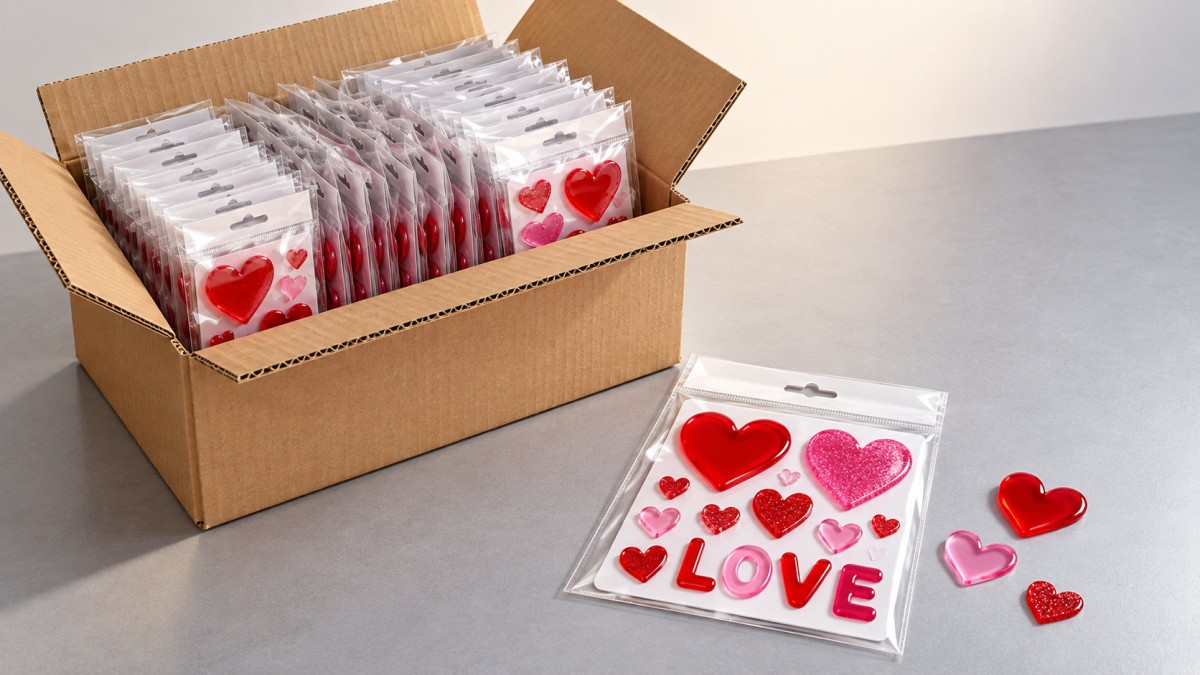
Gel-style clings need particular attention to separation and backing materials. The pack must keep pieces organized and removable without damage. An attractive display sleeve has little value if the contents stick together during storage or become difficult to remove.
Choose protection according to the sales channel. Packs shipped individually to consumers may need different protection from cartons delivered intact to stores. Ask for a production-representative packed sample, including the intended outer carton, before approving packaging changes.
Material suitability determines the cost of complaints
A decoration can arrive undamaged and still disappoint in use. Adhesion, removal, color transfer, and storage all affect the practical value of window clings. An approved appearance sample does not establish how the material behaves on every surface.
For example, Valentines Window Clings Gel, Happy Valentine's Day,Cupid,Heart Love Gnome Window Clings for Glass Windows,Valentines Window Stickers,Valentines Day Decorations uses soft TPR material with hearts, Cupid, and gnome motifs for homes, classrooms, and Valentine’s parties. Its removable, reusable format makes ease of peeling and storage relevant purchasing criteria alongside the design.
For this type of product, assess application and removal on representative glass, inspect for residue or color transfer, and review the storage instructions. Claims about use on walls or other smooth surfaces need defined boundaries: painted, coated, or porous finishes can behave differently from glass. Broad surface claims can create avoidable complaints.
Reusable products also need packaging that supports reuse. Keeping the backing sheet and protecting pieces from dust may matter more than adding decorative packaging. Where children may encounter the product, establish appropriate age guidance and safety documentation for the destination market. A general “non-toxic” claim does not replace product-specific evidence.
Factory credentials and product checks answer different questions
The Ningbo supplier described here owns two certified factories, covering handicrafts and wooden and fabric crafts, and maintains partnerships in ceramics, plastics, and handwoven goods. Its partner companies are certified by major European and American retail chains. This network can support sourcing across several decoration categories.
For costing purposes, establish which facility will make each item and which documents cover that facility and product. A factory credential helps assess the production operation; it does not automatically establish the performance or compliance of every seasonal design.
Include samples, relevant testing, and inspection in the budget before negotiating the final price. Define acceptance criteria around faults that affect saleability: missing pieces, incorrect assortments, visible contamination, damaged packaging, illegible labels, or clings that fail agreed application checks.
Put the remedy for rejected goods in writing. Replacement stock may be useful early in production but commercially ineffective once the holiday selling window has closed.
Work backward from the display date
The required warehouse date should leave time for receiving, checks, allocation, and store delivery. Work backward from that date through transport, customs clearance, production, packaging approval, and sample approval. A factory completion date alone is not a delivery plan.
Identify which milestone releases each stage. Production may depend on approved artwork, while packing may depend on final barcode files. Delayed decisions can consume the schedule even when manufacturing stays on track.
Agree on the response to slippage before it happens. Options could include shipping completed designs first or expediting a limited quantity. Price these options separately: emergency transport may protect a launch while making part of the order unprofitable.
Order quantity deserves the same scrutiny. A larger commitment can lower the unit price while increasing storage, markdowns, and cash tied up in seasonal stock. Ask whether minimum quantities apply to the total order, each design, or each packaging version. A mixed assortment may distribute demand risk more effectively than buying deeply into one motif.
Make the final decision from a complete quotation
Before committing, bring the comparison onto one sheet: approved specification, saleable quantity, packed dimensions, delivery term and location, payment schedule, quality requirements, and required arrival date. List exclusions beside each offer so that missing costs remain visible.
Choose the order that offers an acceptable delivered cost with credible quality controls and enough time to reach the display window. Any saving that depends on unpriced packaging, unresolved surface claims, or emergency freight is still an assumption—not a secured purchasing benefit.
Leave A Message
If you are interested in our products and want to know more details, please leave a message here, we will reply you as soon as we can.

We specialize in supplying home decor, handicrafts, and daily necessities.


