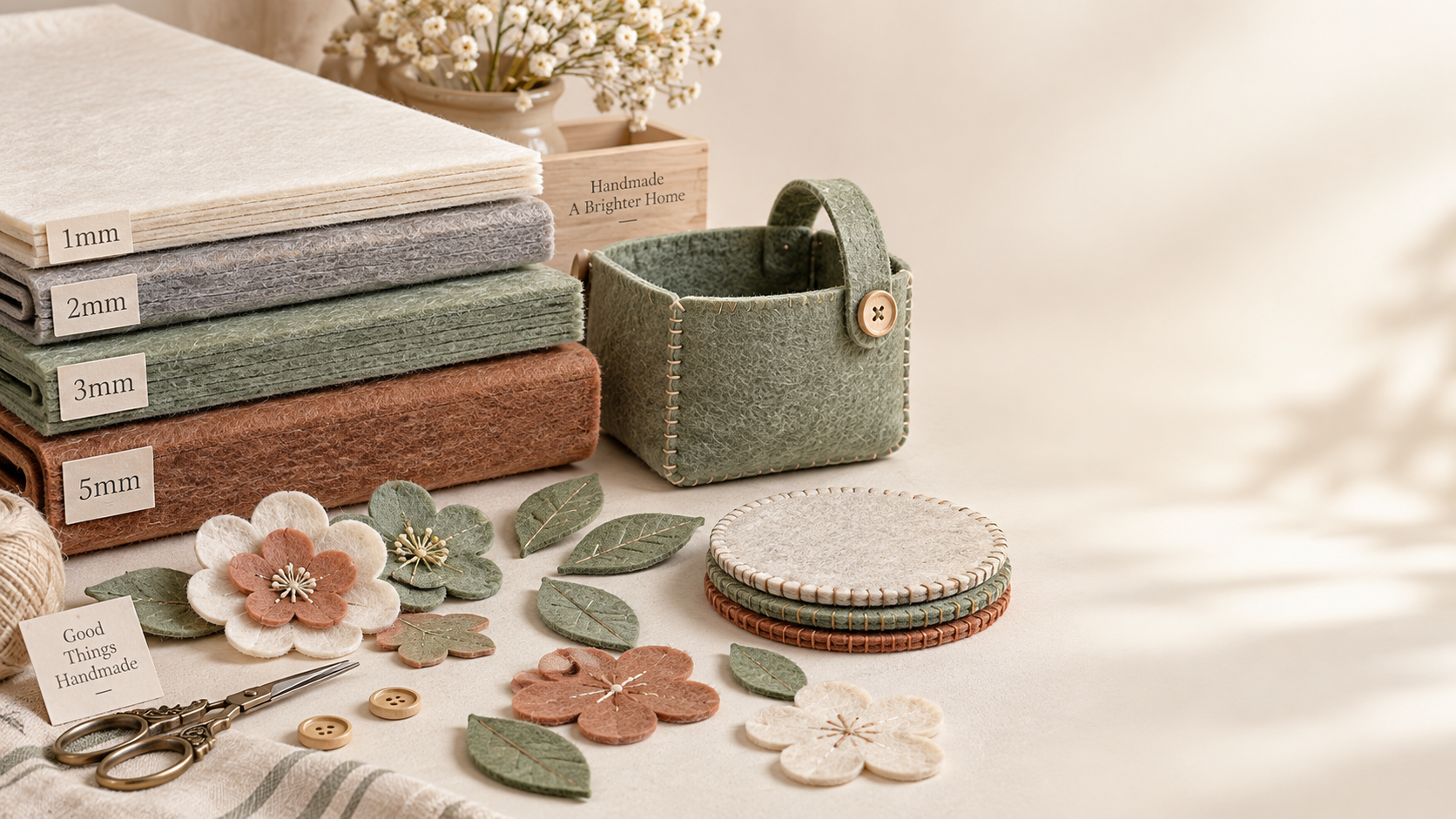
The best thickness for bulk wool felt craft supplies is not a single number. It depends on whether the felt must bend, hold a clean edge, support weight, survive repeated handling, or pass through a cutting machine efficiently. For most home décor and small craft production, 1–2 mm felt is the working range for detail and layering, 3 mm is the most versatile choice for structured decorative pieces, and 4–5 mm is better reserved for items that need body, insulation, or a substantial handmade feel.
Thickness alone, however, does not determine performance. Two sheets both described as “3 mm wool felt” can cut, stretch, pill, and hold shape very differently because fibre composition, density, finishing, and thickness tolerance vary. When selecting bulk wool felt craft supplies, operators should treat thickness as one part of a material specification rather than the entire specification.
Thin felt: 1 mm to 2 mm for detail, curves, and layered decoration
Felt in the 1–2 mm range is suited to projects where flexibility matters more than rigidity. It folds easily, follows curved surfaces, and creates neat layered motifs without adding excessive bulk. Small flowers, leaves, appliqué letters, garlands, miniature ornaments, gift tags, soft toys, and decorative patches are typical applications.
Around 1 mm, felt works well for fine cut-outs made with dies, laser cutters, or electronic cutting machines, provided the material is dense enough to avoid fuzzy or torn edges. It is also useful when several colours must be stacked into one design. A five-layer ornament made from 1 mm felt remains manageable; the same construction in 3 mm felt can become thick at seams and difficult to hang flat.
The trade-off is limited structural support. Thin felt can stretch during sewing, curl at narrow points, and show adhesive marks more readily. It is not a dependable base for freestanding bowls, firm baskets, or large wall pieces unless it is reinforced with backing, interfacing, stitching, or a rigid insert.
At 2 mm, the material gains noticeably more durability while remaining easy to cut and shape. This is often a practical thickness for seasonal hanging décor, layered table decorations, placemats with stitched borders, and children’s craft components. It is thick enough to feel more substantial in hand but still flexible enough for simple folds and curved forms.
Medium felt: 3 mm as the general-purpose structural option
For many home décor craft applications, 3 mm is the most balanced thickness. It has enough body to make coasters, pennants, decorative trays, table protectors, wall hangings, simple storage pockets, and shaped ornaments feel intentional rather than flimsy. At the same time, it can usually be cut with sharp manual tools, rotary cutters, die-cutting equipment, or appropriately configured digital cutters.
Its principal advantage is dimensional stability. A 3 mm felt shape is less likely than thin felt to collapse or show every irregularity beneath it. This matters for geometric forms, large letters, repeated-cut decorations, and designs where pieces must align consistently in assembly.
Yet 3 mm felt is not automatically stiff. A soft, low-density 3 mm wool blend may drape almost like a thinner sheet, while a tightly compressed 3 mm wool felt may resist folding and require stronger cutting pressure. Before committing to a bulk order, the material should be checked for:
- actual thickness at several points, especially near sheet edges;
- firmness and recovery after compression;
- edge quality after cutting small interior shapes;
- surface shedding or pilling after rubbing;
- colour consistency across sheets and production lots;
- compatibility with the intended adhesive, thread, needle, or cutting method.
A common error is choosing 3 mm simply because it appears “premium.” For delicate flowers, small lettering, and dense layered artwork, its extra bulk can reduce precision. The best material is the one that supports the finished object without making production unnecessarily slow.
Thick felt: 4 mm to 5 mm for weight, protection, and self-supporting forms
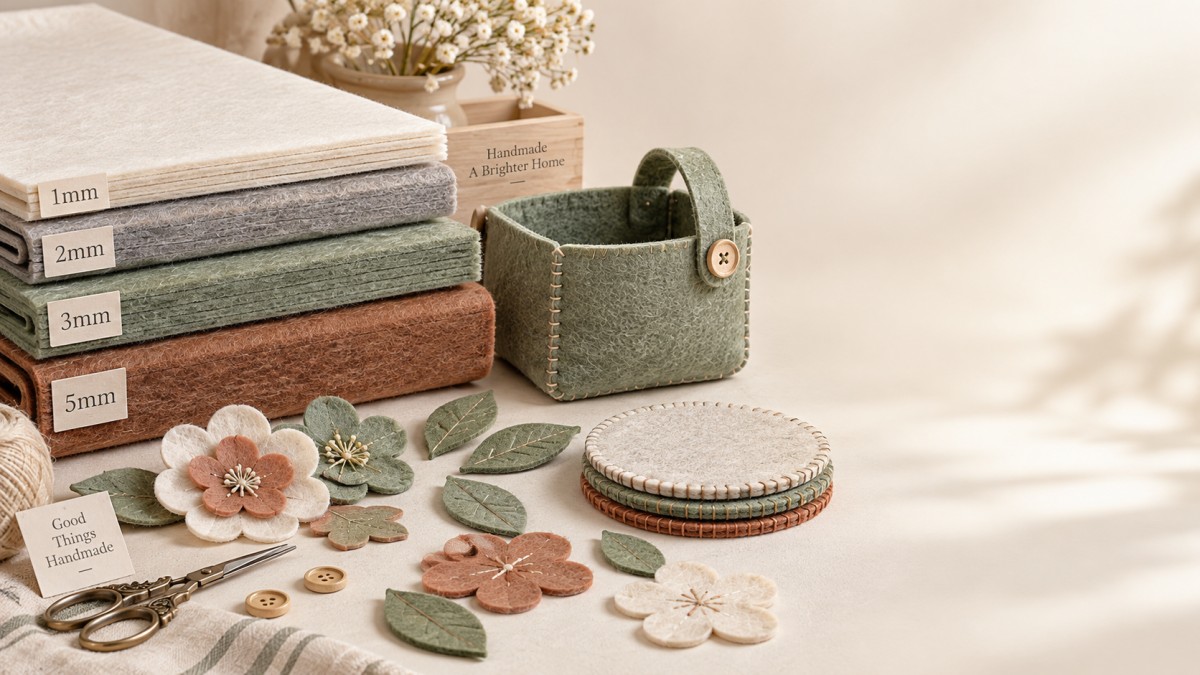
Felt from 4–5 mm is appropriate when the material itself must provide visible structure. It is commonly used for heavier coasters, trivets, chair-leg pads, sturdy baskets, thick placemats, desktop organisers, large freestanding décor, and protective inserts. The thickness produces a more tactile, substantial result and improves cushioning compared with thinner sheets.
For practical accessories, the gain in stability can justify the added material use. A 4 mm coaster, for example, better separates a tabletop from a cold glass or warm mug than a thin decorative layer. A thick felt basket can retain a simple shape if its walls are wide and the construction includes stitched seams, tabs, rivets, or a folded rim.
Thicker felt also introduces operational limits. Hand cutting requires more force, especially around tight curves. Fine details may compress, distort, or remain attached by fibres at the cut line. Sewing layers together can require a larger needle and longer stitch length. Where the final product is folded, thick felt may produce bulky corners or crease poorly.
For 5 mm material, a production sample is essential if the design contains narrow slots, tiny holes, sharp internal corners, or closely spaced cuts. It is generally better suited to bold silhouettes than intricate illustration-style motifs.
Density matters as much as thickness
Thickness describes the distance between the two surfaces; density describes how firmly the fibres are packed. This distinction explains why some felt feels soft and lofty while another sheet of the same thickness feels compact and crisp.
Dense felt generally delivers cleaner cut edges, better resistance to stretching, more accurate die-cut shapes, and improved durability in high-contact items. Softer or looser felt may be preferred for plush decorative work, children’s projects, and pieces that need to wrap around a form. Neither is universally better, but mixing them within one product line can create inconsistent cutting and assembly results.
Material composition also changes the decision. Wool-rich felt often has a warmer surface, better resilience, and a characteristic natural texture, but exact behaviour varies by fibre grade and manufacturing method. Wool-blend felt can be economical for large decorative volumes and may offer consistent colour options. Synthetic content can affect melt behaviour under laser cutting and the response to heat, so a heat-based cutting process should never be assumed suitable without sampling the actual material.
Choose thickness from the finished object, not from the sheet
A reliable selection starts with the role the felt plays after assembly. If it is a surface decoration attached to another substrate, use the thinnest grade that cuts cleanly and covers the base without showing through. If it is the visible body of an object, choose a thickness that holds the intended outline under normal handling. If it must protect a surface or carry light contents, assess compression and seam construction rather than increasing thickness automatically.
Consider a spring display as an example. Thin felt flowers or butterflies can be layered onto a banner, wreath, or classroom board because the base provides the needed support. For smooth glass surfaces, a separate reusable decorating medium may be more appropriate than trying to bond felt directly. Products such as Spring Window Clings Gel, Jelly Window Stickers for Glass Refrigerators Home, Welcome Spring Window Decorations - Flowers Butterflies Bird, Kids‘ Love use soft TPR material designed to adhere to smooth surfaces and be removed for storage. This distinction matters: felt thickness can improve a hanging decoration’s form, but it does not solve adhesion requirements on windows, refrigerators, or other non-porous surfaces.
Bulk production requires tolerance control
In small handmade work, a slight variation between felt sheets can be adjusted during assembly. In repeated production, variation becomes a source of waste. If a cutting tool is set for nominal 2 mm felt but receives sheets that vary materially in compression or thickness, cut-through performance and edge quality can change from batch to batch.
Bulk specifications should therefore define more than a nominal thickness. They should identify the acceptable thickness tolerance, sheet dimensions, colour reference, fibre composition, density or weight where available, surface finish, and packaging method. For projects involving several layers, it is useful to test the total stack thickness at seams and folded edges rather than evaluating each component in isolation.
Colour should also be reviewed under the lighting used for assembly and display. Wool-containing felt can show tonal variation that is visually attractive in rustic décor but unsuitable for designs requiring exact colour matching across repeated units.
A practical thickness decision
Select 1–2 mm felt for detailed cutting, layered motifs, flexible ornaments, and lightweight decorative work. Choose 3 mm when the product needs a clean, stable presence without becoming difficult to process. Move to 4–5 mm when the felt must cushion, protect, stand up, or create a deliberately substantial form.
The most dependable bulk choice is rarely the thickest available option. It is the grade that produces clean cuts, predictable assembly, adequate durability, and the intended visual weight with the least unnecessary material and processing difficulty. Sampling the exact colour, composition, and thickness before a full run remains the most effective way to avoid a material that looks right on specification but behaves poorly in production.
Leave A Message
If you are interested in our products and want to know more details, please leave a message here, we will reply you as soon as we can.

We specialize in supplying home decor, handicrafts, and daily necessities.


