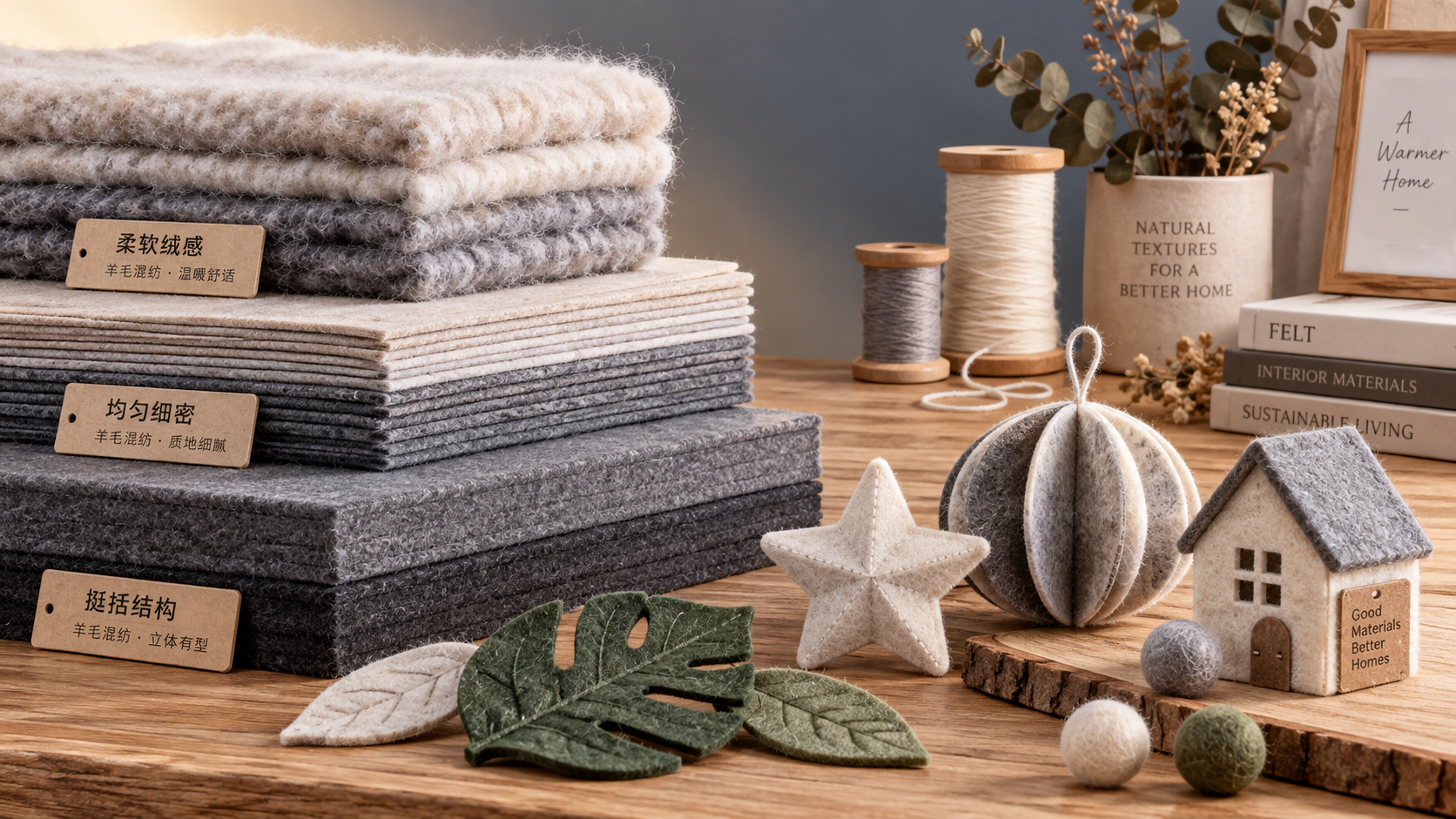
For bulk wool felt craft supplies, the blend ratio is only useful when it is evaluated alongside density, thickness, finishing method, and the intended fabrication process. A higher wool content usually brings a warmer hand feel, more natural surface character, and better shape recovery. It does not automatically mean the felt is the right material for every décor component. Technical evaluation should begin with the product requirement: clean die-cut edges, stitched appliqués, dimensional ornaments, padded panels, or decorative surfaces all place different demands on the sheet.
The practical question is not simply “How much wool is in it?” but “What does this fiber composition allow the finished item to do consistently at production scale?”
Read wool blend ratios as a performance indicator
Wool felt is commonly blended with synthetic fibers, often polyester, to balance natural texture with process stability and cost control. Wool fibers have a naturally crimped structure that helps them interlock during felting. This contributes to resilience, a softer visual finish, and the slightly irregular character valued in premium home décor. Polyester fibers tend to provide more uniformity, clearer color retention, and resistance to repeated handling.
A stated blend ratio should therefore be treated as a starting point, not a complete specification. Two felt sheets with the same wool-to-synthetic composition can cut, stretch, pill, or bond differently because their fiber length, needle-punch density, surface finish, and actual thickness differ.
Do not interpret “higher wool” as “higher density.” Density comes from both fiber composition and the amount of fiber compacted into a given area. A loosely made, wool-rich felt may still deform during cutting or show an uneven edge. A compact blended felt may perform better for a precise decorative silhouette even when its wool percentage is lower.
Start with the finished construction, not the supplier’s percentage
For technical evaluators, the intended process should determine which blend direction is appropriate. If the felt will be die-cut into small leaves, letters, stars, or layered motifs, edge definition matters more than a soft hand feel. Ask for samples in the exact thickness proposed for production and inspect both the first cut and a series of repeated cuts. A sheet that looks smooth before cutting can produce fuzzy or compressed edges once small shapes are removed.
For sewn home accessories, assess how the felt reacts to needle penetration and seam stress. Very dense felt can resist a needle but create visible puncture lines. Softer material may sew easily but stretch around curves or pull at hanging points. When a decorative piece has a loop, cord, or stitched attachment, test the attachment area rather than judging only the body of the material.
Three-dimensional ornaments need another kind of balance. Wool-rich blends can create an appealing tactile surface and better recover from light compression, but overly soft felt may not maintain crisp folds, cones, or standing forms without internal support. In those cases, a firmer blend, laminated backing, or structural insert may be more effective than increasing wool content.
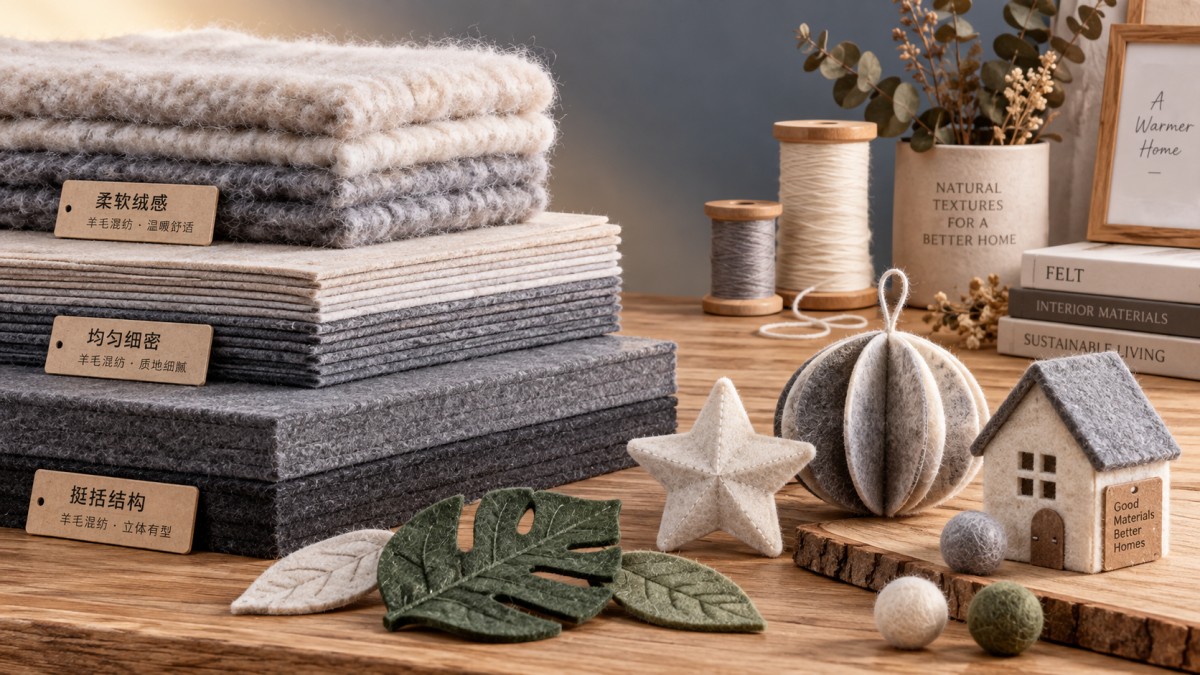
What to request from a bulk felt supplier
A composition claim without a controlled sample and a repeatable material description creates avoidable risk. The procurement file should connect the blend ratio to the characteristics that affect your line. At minimum, request material swatches or cut sheets from the intended production batch, the nominal thickness and permitted variation, color reference information, and the construction method, such as needle-punched or other felted construction.
- Fiber composition: Identify whether the stated ratio refers to total fiber content and whether the synthetic portion is specified.
- Thickness and mass consistency: These often have a stronger effect on cutting and assembly than the blend ratio alone.
- Surface and reverse-side condition: One side may be smoother, more compressed, or better suited to visible applications.
- Color matching: Natural fibers can accept dye differently from synthetic fibers. Check approved shades under the lighting used for inspection or display.
- Lot traceability: For a multi-color program or replenishment order, confirm how the supplier links production lots to approved samples.
- Packaging and storage condition: Felt can retain creases or compression from transport. Review flatness after unpacking and after a reasonable recovery period.
It is useful to convert these checks into a simple approval sequence: review the sample sheet, run the intended cutting or sewing operation, assemble a small representative component, then inspect the result after normal handling. This exposes problems that an isolated swatch cannot show, particularly delamination, edge shedding, distortion, and color mismatch between layered parts.
Common comparison errors
The first error is comparing quoted ratios across suppliers as though they describe identical materials. A “wool blend” label can cover materially different constructions. Treat the ratio as one column in a comparison sheet, alongside thickness, density, finishing, color, and processing results.
The second is approving a large sheet based only on visual appearance. Home décor often uses contrast: pale felt lettering on a dark base, felt shapes on wood, or colored fabric elements attached to MDF. Any haloing, frayed perimeter, or unstable color is more visible at that interface. Seasonal porch and entryway pieces are a good example. A product such as Halloween Sign Halloween Spooky Porch Sign Vertical Wooden Porch Sign for Door Decorations, Farmhouse Hanging Wall Sign for Home Outdoor Garden Decor uses wood or MDF as its main structure; if felt accents are added to a dark background or bold lettering, the evaluator should check adhesive compatibility, edge cleanliness, and whether the selected felt holds its intended shape during transport and display.
The third error is choosing a soft, wool-rich option for parts that need dimensional precision. A natural look may be desirable for broad appliqués and handmade-style décor, but small repeated pieces require controlled thickness and clean cutting. Conversely, a stiff synthetic-heavy felt may be technically efficient yet look flat or artificial in a tactile gift or tabletop decoration. The correct choice follows the visible role and manufacturing role of each component.
Evaluate consistency across a bulk order
Bulk sourcing introduces a problem that sample selection can hide: variation between rolls, colors, and production lots. The most useful comparison is not a single “best” swatch but a sample set showing multiple colors and, where possible, more than one lot. Check whether thickness, stiffness, surface fuzz, and shade remain close enough that the same cutting setting, sewing process, or assembly instruction can be used without adjustment.
This is especially relevant for coordinated home décor collections that combine fabric crafts with wooden, ceramic, plastic, or handwoven components. Material decisions affect downstream assembly. A reliable supply partner should be able to support the felt specification within a broader component program, rather than treating the textile layer in isolation. Manufacturing networks that cover wooden and fabric crafts can be useful where felt must be matched to hanging hardware, boards, packaging, or other décor materials.
Use a decision rule that matches the application
Choose the blend only after ranking the requirement that cannot fail. For a precision-cut, high-volume component, prioritize consistent density, stable thickness, and clean edges. For a tactile decorative layer, give greater weight to surface character and recovery after handling. For stitched construction, prioritize seam behavior and dimensional stability. For bonded felt on wood or MDF, test the complete material stack, including the adhesive and the expected display environment.
Before placing a bulk order, approve the finished construction rather than the composition statement alone. The blend ratio explains part of the material’s behavior; the production sample shows whether that behavior is suitable for the décor item being made.
Leave A Message
If you are interested in our products and want to know more details, please leave a message here, we will reply you as soon as we can.

We specialize in supplying home decor, handicrafts, and daily necessities.


