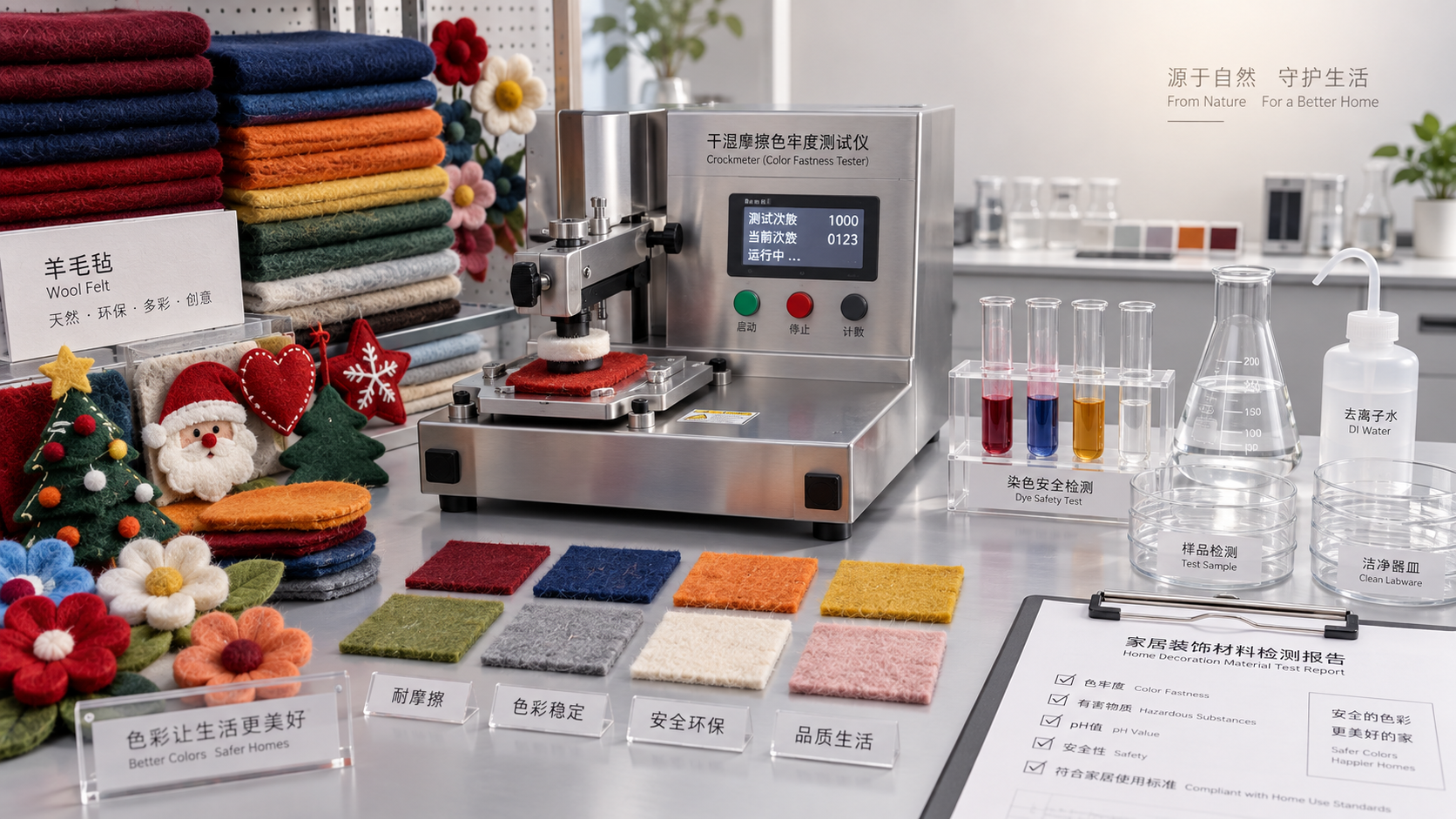
Dye safety control for bulk wool felt craft supplies is not satisfied by a single “non-toxic” declaration. The relevant checks depend on fibre composition, intended use, destination market, colour depth, whether the felt will contact skin or be used by children, and whether the product is sold as a finished item or further processed into décor components.
For wool felt, the core compliance question is usually whether the dyeing and finishing system introduces restricted aromatic amines, allergenic or otherwise restricted colorants, extractable metals, formaldehyde, or problematic auxiliary chemicals. A separate but commercially important question is whether the colour remains stable through the handling conditions the finished craft item will face. A felt sheet that passes a chemical screen but sheds colour onto hands, adjacent fabrics, or packaging can still create a retailer rejection or consumer-safety concern.
Start with the material and intended-use boundary
“Wool felt” is not always 100% wool. Bulk supply may include pure wool felt, wool-polyester blends, wool-viscose blends, recycled-fibre felt, adhesive-backed felt, glitter-coated felt, or felt with printing and surface treatments. This matters because wool is generally dyed with acid, metal-complex, reactive, or natural dyes, while polyester content may involve disperse dyes. The risk profile of a blended felt therefore cannot be inferred from the wool component alone.
The finished use also determines the appropriate compliance target. Decorative felt flowers, wall ornaments, seasonal garlands, and craft blanks do not automatically fall under toy requirements. However, felt supplied for children’s craft kits, costume accessories, nursery décor, or articles likely to be mouthed may be assessed against stricter retailer specifications or product-category rules. A supplier’s statement that a material is “for crafts” is not a reliable legal classification.
Before testing, the purchase specification should identify:
- fibre composition by percentage, including recycled content where claimed;
- all surface treatments, printing inks, adhesives, coatings, glitter, laminations, and backing materials;
- the destination market and retailer compliance manual, if applicable;
- the final product category and expected user group;
- whether the material is washable, likely to contact skin, or likely to be mouthed;
- the exact colourways and whether darker shades, fluorescent shades, or prints use separate dye systems.
A test report on an undyed base felt, or on one pale shade, does not establish compliance for a multi-colour assortment.
Restricted azo dyes: the principal dye-specific check for EU supply
For goods entering the European Union, the most recognised dye-specific control is the restriction on certain azo colourants under REACH Annex XVII. The restriction addresses azo dyes capable of releasing specified carcinogenic aromatic amines under reductive conditions. For textile articles that may come into direct and prolonged contact with human skin or the oral cavity, the regulated threshold is generally 30 mg/kg for each listed aromatic amine.
Testing is commonly performed using EN 14362-1 and, where appropriate, EN 14362-3. These methods address different chemical pathways by which regulated aromatic amines may be released. The laboratory should select the method scope based on the material and dye chemistry rather than simply issuing a generic “azo-free” statement.
The practical risk is not limited to bright red, orange, black, or navy felt, although deep shades deserve attention because of their higher colourant loading. A compliant dye name on a formulation sheet is not enough if substitutions, blending, or outsourced dyeing occur after approval. Batch-level traceability from dyed felt through cutting and packing remains essential.
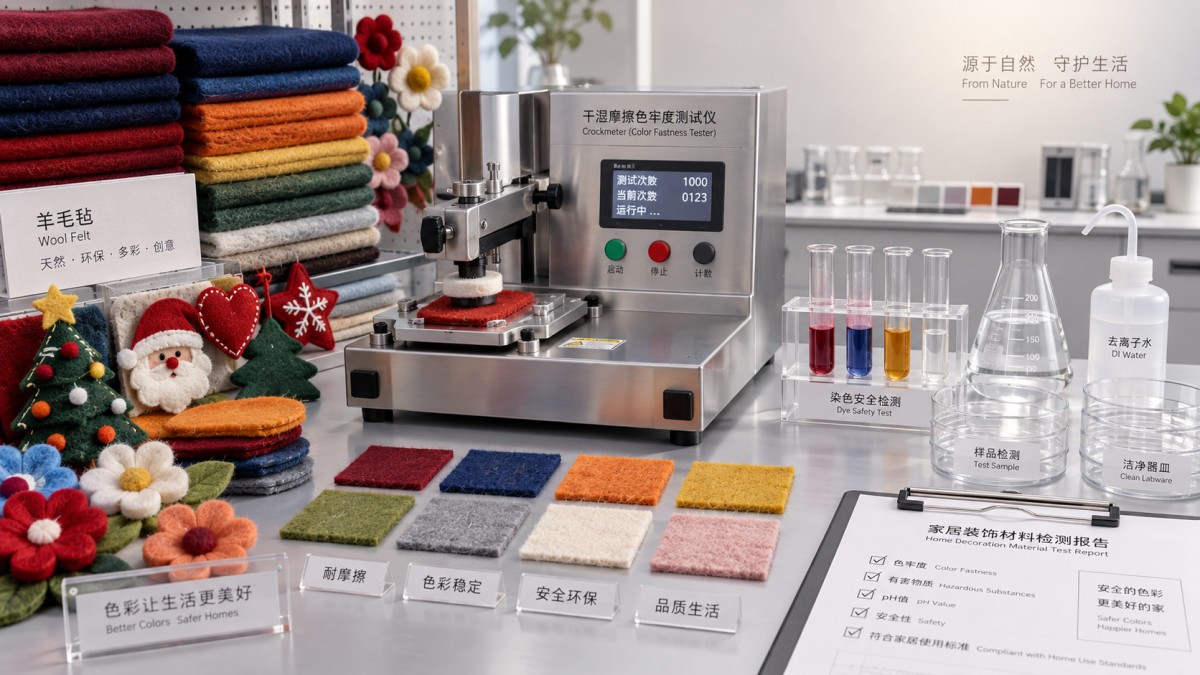
Colorants, metals, and chemical residues should be assessed as a system
Azo amine screening is necessary in relevant markets, but it is not a complete dye safety programme. The appropriate additional checks vary by buyer specification and product exposure.
Extractable heavy metals. Certain dye systems, pigments, mordants, and contamination sources can introduce metals. The concern is generally the amount that can be extracted under defined test conditions, not merely total metal content. Requirements differ substantially among retailer protocols, children’s-product rules, and voluntary textile standards. Wool felt using metal-complex dyes warrants particular formulation review, but the presence of a metal-complex dye does not by itself prove non-compliance; the relevant limit and test method must match the intended market.
Formaldehyde. Formaldehyde is more often associated with resin finishes, binders, crease-resistance treatments, and some processing auxiliaries than with the dye molecule itself. It should still be included when felt has been stiffened, bonded, coated, printed, or otherwise finished. ISO 14184-1 is a commonly used textile test method for free and hydrolysed formaldehyde.
Allergenic and carcinogenic dyes. Voluntary textile schemes and retailer restricted-substances lists may prohibit or limit named colourants beyond the statutory azo restriction. These requirements can include particular allergenic disperse dyes and designated carcinogenic dyes. Since disperse dyes are more closely associated with synthetic fibres, they are especially relevant where a “wool felt” product contains polyester or uses transfer printing. Testing should follow the buyer’s restricted substances list rather than assuming a wool-based item is outside that concern.
Chlorophenols, organotin compounds, and other processing residues. These are not necessarily dye ingredients, yet they can enter through preservatives, carriers, coatings, or supply-chain contamination. Their relevance rises for bonded, coated, mould-resistant, water-repellent, or printed felt. A broad chemical screen is useful only when it is tied to the article construction; indiscriminate testing can create cost without improving risk control.
APEO and NPEO controls. Alkylphenol ethoxylates may be used in wet processing as surfactants or detergents. EU REACH restrictions apply to nonylphenol ethoxylates in certain textile articles that can reasonably be expected to be washed in water during their normal life cycle. Even where a decorative felt item is not expected to be washed, retailer lists may still set their own limits. The finished product’s foreseeable use should be documented instead of relying on assumptions about whether a craft material is “washable.”
Colourfastness is both a quality and a safety-relevant control
Colourfastness testing does not replace chemical compliance testing, but it identifies dye migration and poor fixation that can create handling complaints. For bulk wool felt craft supplies, the relevant test selection should reflect the finished application rather than a generic apparel protocol.
Dry and wet rubbing fastness, commonly evaluated under ISO 105-X12, is useful for felt ornaments, cut shapes, and materials handled during crafting. Wet rubbing performance is particularly important for heavily dyed shades, since loose surface colour can transfer to hands or other components.
Water fastness under ISO 105-E01 can be relevant for seasonal décor exposed to condensation, humid storage, or accidental wetting. Perspiration fastness under ISO 105-E04 is more relevant where felt becomes part of wearable accessories, costumes, or articles with sustained skin contact. Wash fastness, often assessed through ISO 105-C06 conditions, should not be requested automatically for non-washable decorative felt; where washability is claimed, the selected procedure and grading requirement should be written into the product specification.
Light fastness may matter for window displays, shop displays, and home décor placed near sunlight. A colour can be chemically compliant but fade rapidly in use, leading to inconsistent appearance across a seasonal range. The suitable ISO 105-B02 exposure level should be agreed according to expected exposure, not copied from an unrelated textile category.
Colourfastness standards provide test methods and grading systems; they do not create one universal pass level for every felt product. An acceptance limit should be based on intended use, shade depth, contrasting materials, retailer rules, and the likelihood of direct handling.
Certification claims need to be read precisely
OEKO-TEX® STANDARD 100 is frequently requested for textile materials because it covers a broad list of harmful substances and classifies products according to contact intensity. It can provide useful evidence when the certificate is valid, covers the correct material, and includes the relevant product class. It is not a substitute for checking a retailer’s own restricted-substances list, confirming fibre composition, or verifying that the approved certificate holder is linked to the actual production chain.
GOTS certification is relevant only where an organic textile claim is being made and the supply chain is certified within the applicable scope. It is not a general shorthand for dye safety, and a certificate for one certified organic wool programme should not be applied to conventional wool felt without documentation.
For the United States, requirements may differ sharply according to whether a finished article is marketed for children. CPSIA controls, including lead and phthalate requirements, apply in defined children’s-product contexts rather than to every craft textile by default. California Proposition 65 is a warning law, not a product certification. These distinctions should prevent a common error: requesting a certificate label without confirming the legal category of the final item.
The same material-specific discipline applies across decorative ranges. A colourful soft-TPR window decoration such as Halloween Window Gel Clings Ghost Pumpkin Bat Witch Cat Boo Blood Decal Stickers for Halloween Home Party Window Decorations cannot be assessed through wool-felt dye criteria alone. TPR compounds, plasticisers, pigments, and migration behaviour require a different compliance review. Mixed-material seasonal assortments should therefore maintain separate test plans by component.
Control the approval process, not only the final report
Reliable control begins before bulk dyeing. The approved sample should identify the felt weight, fibre blend, shade code, dye house, finishing route, and any downstream treatment. Bulk production should be checked against that reference through shade continuity records, batch identification, and documented change control. A change in dye supplier, auxiliary, finishing agent, recycled-fibre source, or colour recipe can invalidate the relevance of earlier reports.
For a multi-shade order, risk-based sampling is more defensible than testing only a random colour. Include the darkest shades, high-pigment shades, fluorescent or neon shades, printed areas, and any felt carrying adhesive, glitter, coating, or laminate. When colourways are produced in separate lots, retain a lot-to-lot link between the test specimen and shipping records.
The most useful supplier file combines a current chemical test report, applicable certificates, material declarations, test-method references, production-lot traceability, and a written statement of conformity to the buyer’s restricted-substances list. That record set makes it possible to assess whether bulk wool felt craft supplies are compliant for the actual product route—not merely whether one laboratory sample passed a broad “safe dye” claim.
Leave A Message
If you are interested in our products and want to know more details, please leave a message here, we will reply you as soon as we can.

We specialize in supplying home decor, handicrafts, and daily necessities.


