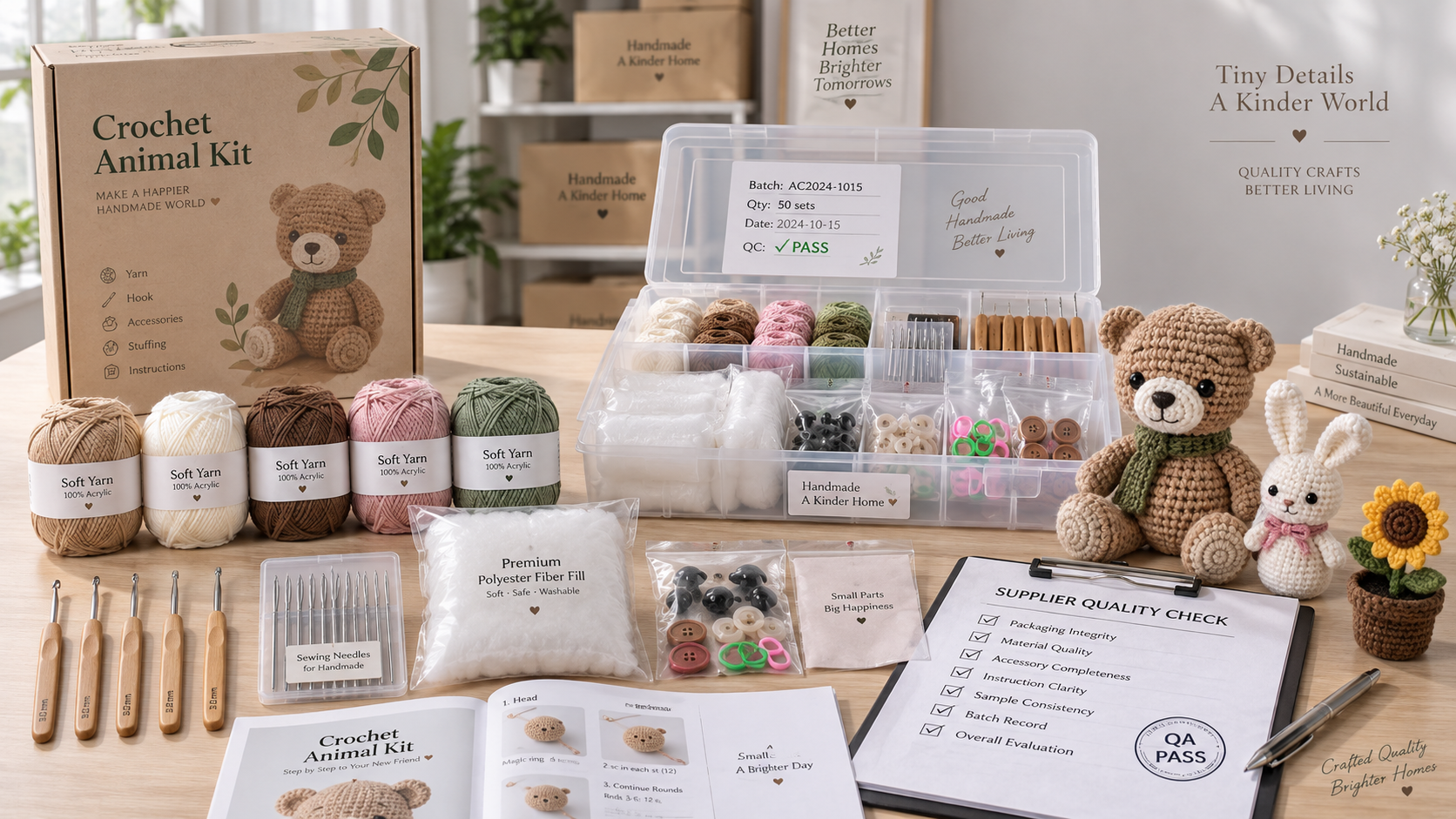
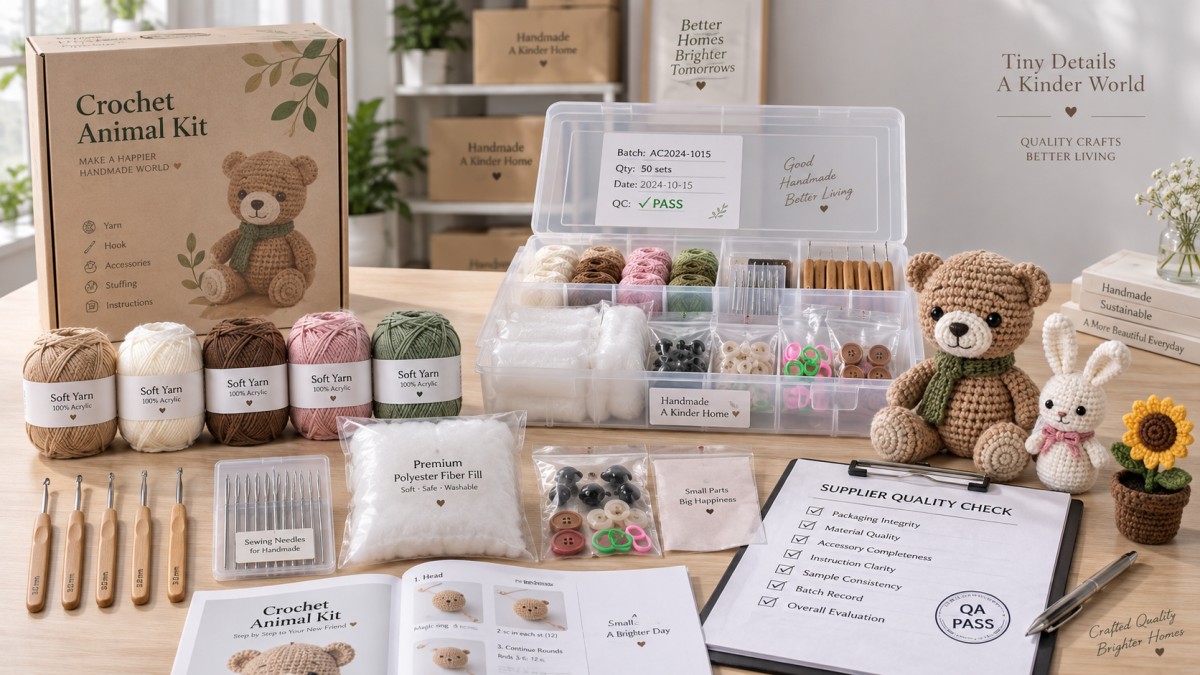
A crochet kit can look complete on a sample table and still fail once it reaches a retail shelf. The yarn shade may shift between batches, a hook may be missing from sealed packaging, a needle may have an exposed point, or the printed pattern may not match the actual yarn quantity. For quality and safety teams, these are not isolated packing errors; they show that the supplier’s controls were not verified at the right stages.
The most effective way to assess crochet kit suppliers is to audit the full product path: incoming materials, component preparation, kit assembly, final packaging, and release testing. Finished-sample approval is only one checkpoint. A supplier should be able to show how it prevents substitutions, identifies mixed components, controls restricted materials, and traces a complaint back to a specific production lot.
Start with the intended user and kit risk profile
Before visiting a factory or reviewing audit documents, define what the kit is expected to contain and who will use it. A beginner kit for children, a decorative amigurumi set for adults, and a household craft kit with metal tools do not carry the same risks. The audit depth should reflect the finished product rather than relying on a generic handicraft checklist.
Build a component specification that identifies every item by material, size, color, quantity, and required labeling. This should include yarn or thread, crochet hooks, stuffing, needles, stitch markers, eyes or other decorative parts, instructions, cartons, polybags, labels, and any adhesive or accessory packs. The specification becomes the baseline for assembly checks and incoming-material approval.
Pay particular attention to small components. Buttons, plastic safety eyes, beads, pins, and detachable decorations can create choking, sharp-point, or breakage concerns depending on the target market and age grading. The supplier should not decide independently that an accessory is “decorative only” and therefore exempt from review. Its presence inside the kit makes it part of the product safety assessment.
Material controls reveal whether consistency is real
The material audit should begin in the warehouse, not at the sewing or packing line. Ask how incoming yarn, fabric pieces, wooden tools, metal needles, plastic components, and printed inserts are checked before being released to production. A reliable process identifies the supplier lot, delivery date, internal stock code, inspection status, and storage location.
For yarn, visual matching alone is insufficient. Inspectors should review controls for fiber content, yarn weight, color reference, dye-lot separation, odor, visible contamination, knots, loose ends, and winding condition. A pattern that calls for a defined length of yarn becomes unreliable when the yarn thickness changes or when a substituted batch has lower usable length. The supplier should maintain approved samples or documented references for colors and textures that affect the completed design.
Where wood, plastic, metal, coatings, inks, or soft polymer accessories are used, verify that the supplier can identify the material source and keep supporting compliance records connected to the relevant lot. Documentation by itself is not enough. The actual components in the warehouse must match the listed description, including color, finish, and product code.
Soft decorative products illustrate why material identity matters. A seasonal item such as Christmas Gel Window Clings - Xmas Santa Claus Snowman Snowflake Penguin Christmas Tree Gift Window Stickers for Kids uses soft TPR material and depends on consistent non-toxic material selection, clean surface appearance, and packaging that supports reuse. Although this is not a crochet kit, the same audit principle applies: material claims must be linked to controlled incoming stock, not copied into artwork without verification.
Questions that expose weak incoming inspection
- Can the factory show a current approved-material list and distinguish approved stock from material awaiting inspection?
- What happens when a yarn color is close to, but not identical with, the approved reference?
- Are small accessories received and counted by piece, weight, or supplier pack quantity?
- How are needles, hooks, and sharp tools protected from rust, burrs, and handling damage during storage?
- Can warehouse staff trace an opened component pack back to its original delivery lot?
Audit assembly as a controlled operation, not a packing task
Kit assembly often appears simple because workers are placing preselected components into a bag or box. In practice, this is where mixed colors, incomplete sets, incorrect instructions, and cross-order contamination occur. The audit should follow the physical flow from picking through sealing.
First, assess whether the bill of materials is clear enough to use at the line. It should show each component, required quantity, approved revision, and any visual identifier needed by packers. Similar-looking yarn colors, hook sizes, and instruction sheets should be segregated or clearly labeled. Open bins without batch identity are a warning sign, especially when several designs are packed in the same area.
Second, review how quantities are verified. Some contents can be counted directly, while yarn may need to be controlled by pre-cut length, pre-weighed bundles, or standardized balls. The method should suit the component. A final weight check may identify a missing hook or stuffing pack, but it may not detect the wrong color yarn, an incorrect hook size, or a duplicated instruction leaflet.
Third, observe line clearance between product changes. Remaining components from the prior order should be removed, documented, and returned to controlled storage before the next kit begins. This is especially important for character kits with similar colors but different facial accessories or pattern versions.
Test the kit as a user would use it
Testing should not be limited to laboratory paperwork. A practical audit asks whether the supplier validates that the contents can actually produce the stated project. This does not require completing every kit during every production run, but the supplier should have a defined sample-build process when a design is launched, revised, or materially changed.
During a sample build, reviewers should check whether the yarn quantity is adequate for the pattern, whether hook sizes correspond to the instructions, whether abbreviations are explained, and whether the sequence is readable. A kit can be technically complete but still generate avoidable complaints if the pattern includes an outdated color name or omits a necessary finishing step.
Physical product checks should also cover packaging integrity, legibility of warnings, barcode accuracy where applicable, sharp-point protection, loose-part containment, odor, visible staining, and resistance of printed materials to rubbing or moisture exposure during normal handling. If age-related labeling or market-specific safety requirements apply, verify that the supplier uses the approved artwork revision rather than an older generic template.
Traceability should work under pressure
Ask the supplier to select one sealed carton and trace it backward. A useful traceability exercise should connect the finished carton to the production date, assembly line or shift, bill of materials revision, yarn lot, key accessory lots, inspection records, and packing record. Then reverse the exercise: choose an incoming yarn lot and ask which finished kit batches received it.
Gaps usually appear when materials are repacked into unlabeled containers, when handwritten records cannot be linked to a finished lot, or when several orders share the same staging area. A traceability system does not need to be complex, but it must allow the quality team to isolate affected stock if a material concern or assembly defect is identified after shipment.
Turn audit findings into release conditions
Not every finding should block production, but each finding needs an owner, due date, and verification method. Separate immediate product risks from process weaknesses. Missing sharp-tool protection, unverified material substitutions, or inconsistent age labeling should be treated as release-critical. Poorly organized sample storage or incomplete training records may be corrected through a defined corrective-action plan, provided the current product remains controlled.
For repeat orders, compare the new production file with the approved baseline before shipment. Confirm that no yarn source, color code, hook size, accessory material, pattern revision, packaging format, or warning artwork changed without review. This discipline is what turns a supplier audit from a one-time factory visit into a usable quality-control framework.
Leave A Message
If you are interested in our products and want to know more details, please leave a message here, we will reply you as soon as we can.

We specialize in supplying home decor, handicrafts, and daily necessities.


