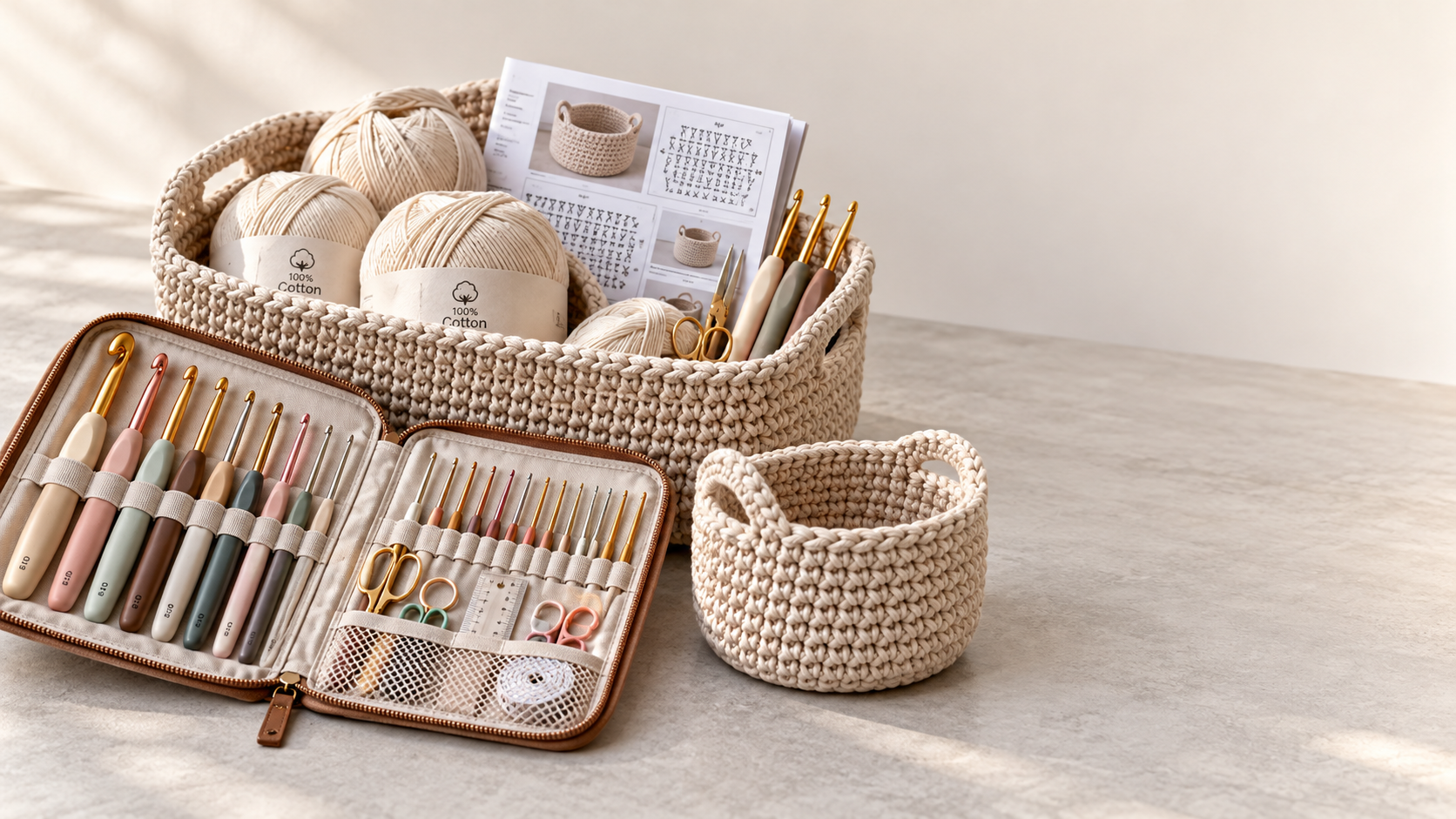
A hook-only set is the better choice when you want reusable tools and freedom to choose projects. A complete project kit makes more sense when you want to make one specific item without separately matching yarn, hook size, and instructions. Neither is automatically easier or better value: a large hook collection does not teach you to crochet, and a box labeled “complete” may still leave important supplies or skills uncovered.
The most useful distinction is what you are buying: equipment for future projects, or a coordinated route to one finished object. For a cushion cover, decorative basket, or handmade gift, that difference affects your total spending, learning experience, and ability to change the design.
Look at the contents, not the word “set”
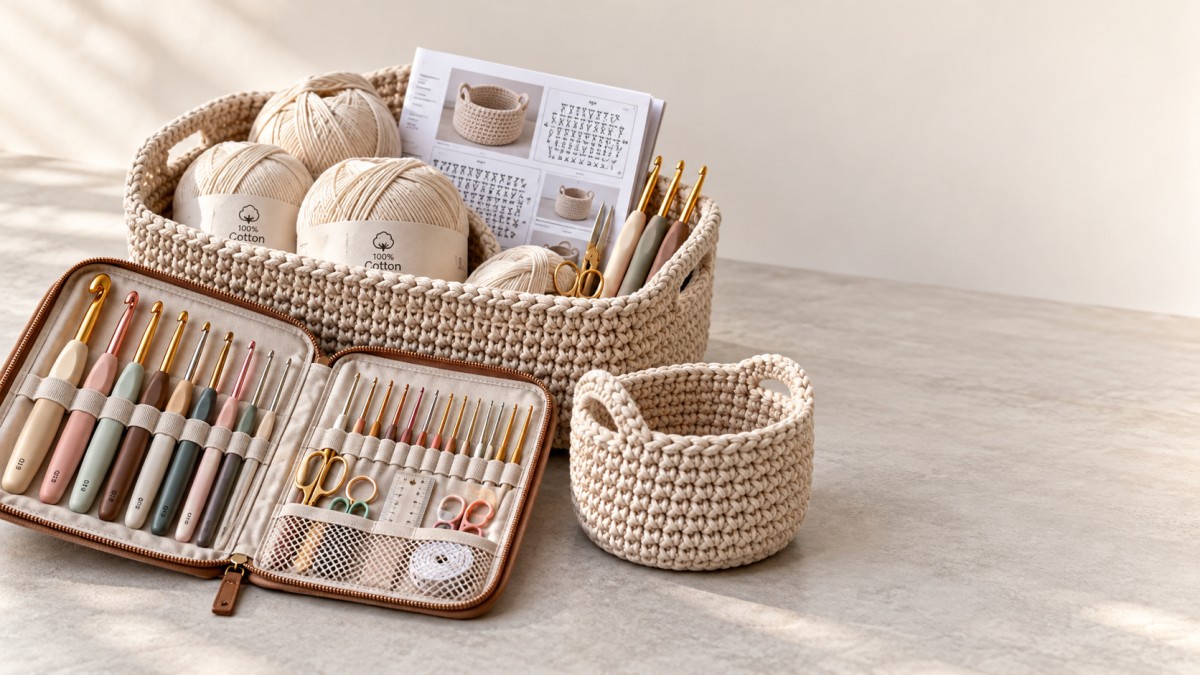
Product listings use “crochet sets” for several different packages. A hook-only set may contain multiple hook sizes and a case, with some versions adding stitch markers, scissors, or yarn needles. A project kit should connect its materials to a named pattern, but the included tools and instructional support vary.
Check the itemized contents rather than relying on the main photograph. A pictured cushion insert, basket handle, or decorative accessory may be a styling prop rather than an included component. Yarn weight in grams and length in meters or yards are more informative than a statement such as “several balls included.”
A beginner needs a manageable project more than a large collection
A well-designed project kit can reduce the decisions that make a first attempt difficult. It removes the need to interpret yarn recommendations, calculate quantities, and find a suitable pattern before learning the basic stitches. That convenience is valuable only if the instructions genuinely start at your level.
Look for a sample of the written pattern or tutorial. Does it explain how to hold the yarn, make the starting chain, count stitches, and finish the work? A video showing only the assembly stage will not help someone who cannot yet make the individual pieces. Check whether linked lessons require registration, expire, or depend on access to a particular platform.
The project itself matters just as much. A flat coaster or simple rectangular cushion panel presents fewer construction challenges than a small stuffed figure with tight rounds, shaping, and several sewn-on parts. “Small” describes dimensions, not difficulty.
Yarn also changes the learning experience. Smooth, light-colored yarn makes individual stitches easier to see than very dark, fuzzy, or heavily textured yarn. A kit can be coordinated correctly yet remain frustrating because its decorative effect hides the stitch structure.
A hook-only set is still a reasonable beginner purchase if you already have access to a clear course or simple pattern. However, buying many sizes does not remove the need to select suitable yarn. One comfortable hook matched to a straightforward project can be more useful than an extensive collection you do not yet know how to use.
For home decor, judge the finished fabric before the packaging
A kit photograph shows a design, but it cannot guarantee that your finished item will have the same size or firmness. Those depend on the yarn, stitch pattern, hook size, and your tension—the tightness or looseness of your stitches.
Gauge describes the number of stitches and rows within a measured area. If your stitches are larger than the pattern specifies, a cushion cover may come out oversized and use more yarn. Smaller stitches can produce a cover that will not fit the intended insert. A kit’s included hook is therefore a starting recommendation, not proof that everyone will achieve the stated dimensions.
A basket needs structure, not simply thick yarn
A decorative basket must form a sufficiently firm fabric to hold its intended shape. Yarn construction, stitch density, base design, and wall height all contribute. Thick yarn alone does not guarantee upright sides. Look for finished dimensions and information about whether the design depends on a liner, stiffening method, or additional support.
A coordinated basket kit reduces material-matching work. Separate tools and materials offer more control if you need a particular shelf size, but changing the diameter or height also changes yarn consumption.
A cushion cover needs dimensional and care compatibility
For a cushion cover, confirm the intended insert size, closure method, and whether the pattern includes both panels. Buttons, a zipper, backing fabric, and the insert itself may be separate purchases. Check the yarn’s care instructions against how the cushion will actually be used; appearance alone is a poor basis for choosing an everyday furnishing.
If you already own an insert and need an exact fit, a separate pattern-and-yarn purchase may offer more flexibility. A kit is convenient when its specified dimensions and care requirements already match your needs.
Hook quality matters more than the number of pieces
In a hook-only set, examine the size range in millimeters rather than counting the total pieces. Very fine steel hooks serve different work from the larger hooks used with many furnishing yarns. A broad assortment is not useful if it omits the sizes your planned patterns require.
The hook head should catch yarn without repeatedly splitting it, and the shaft should be smooth enough for loops to move freely. Handle shape, thickness, and grip texture affect comfort, but an “ergonomic” label cannot guarantee a good fit for every hand or holding style.
If you have not established a preference, trying one hook before buying a large matching collection reduces the risk of owning many tools you dislike. Also check whether a thick handle leaves enough exposed shaft for your stitches and technique.
Compare the cost of a usable project, not two box prices
A hook-only set can look inexpensive because it excludes consumable materials. A project kit can appear costly because it bundles them. To compare fairly, price the same finished item with the same material requirements.
For the separate-purchase route, include the hooks you actually need, sufficient yarn, the pattern if paid, and finishing supplies. For the kit, add every excluded component. Include delivery costs where separate orders would be necessary, and consider whether you would otherwise buy full packs of accessories for a single use.
Reusable tools create value only when you use them again. An established collection makes another bundled hook less valuable; starting from nothing makes that same inclusion more useful. Likewise, surplus yarn is beneficial if you can use it, but it is still part of the initial expense.
Ask whether the kit allows enough yarn for the instructed gauge check and a reasonable amount of reworking. There is no universal spare-yarn allowance. If the margin is unclear, check whether matching yarn is available separately. Buying more later can introduce dye-lot differences, which may be visible in a large, single-color panel.
Choose according to the uncertainty you want to remove
Choose a complete project kit when you like the supplied design as it is, want to avoid sourcing compatible materials, and can confirm that the teaching matches your experience. It is particularly useful for trying crochet without first building a broad supply collection.
Choose a hook-only set when you already have patterns or yarn, expect to make different projects, or need control over dimensions, color, fiber, and care requirements. Favor a relevant size range and comfortable construction over the highest piece count.
If neither package fits, buy a suitable pattern, its recommended yarn, and one matching hook. That middle route avoids both an oversized tool collection and a kit tied to the wrong project. The better purchase is the one that leaves you with fewer unresolved obstacles between opening the package and finishing something you actually want to use.
Leave A Message
If you are interested in our products and want to know more details, please leave a message here, we will reply you as soon as we can.

We specialize in supplying home decor, handicrafts, and daily necessities.


