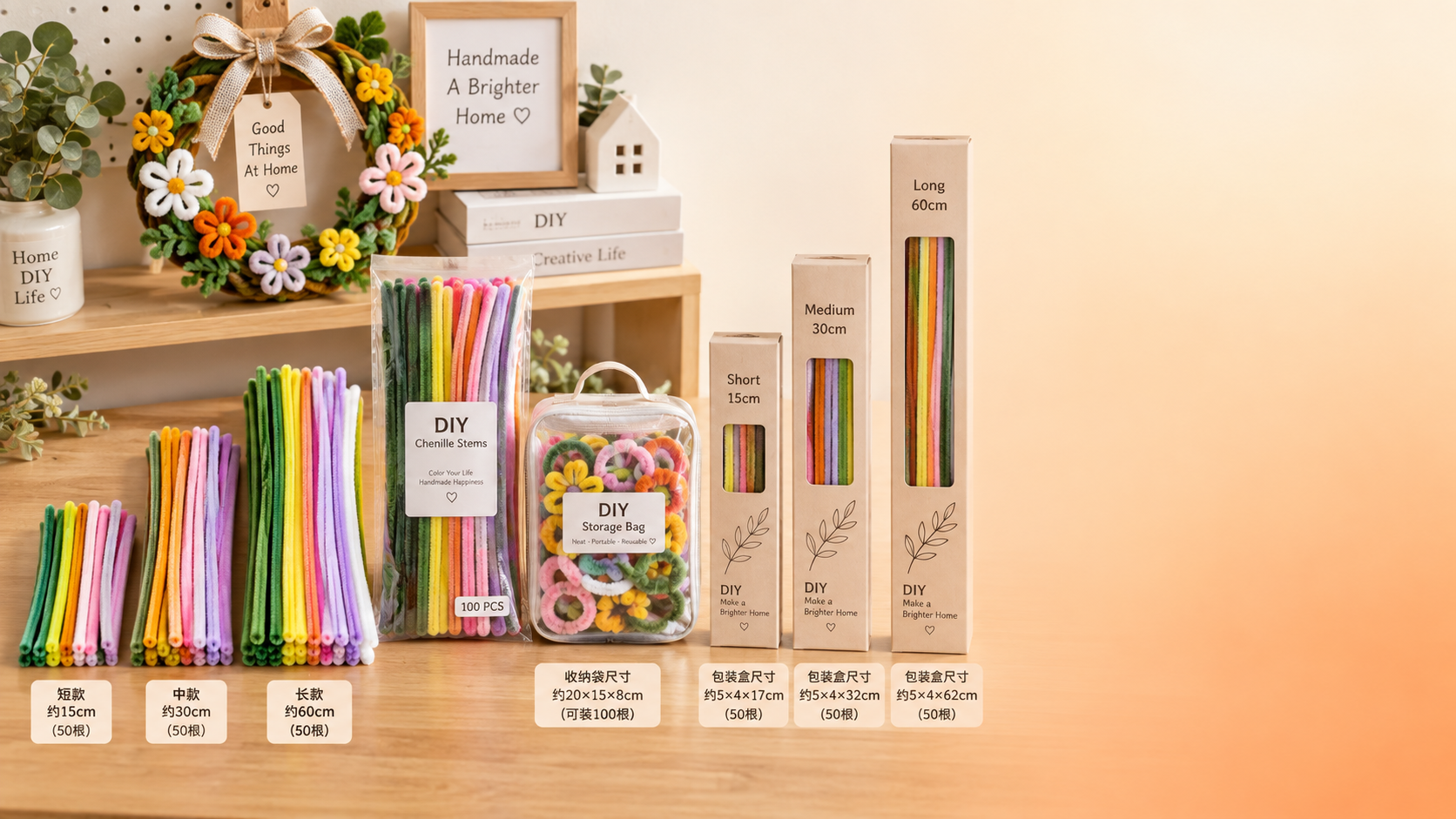
Stem length changes the cost of a chenille stems DIY kit at several points at once: wire and pile consumption, cutting loss, pack dimensions, assembly time, and the number of stems required to complete each project. A longer stem has a higher material cost per piece, yet it can reduce the total stem count and simplify instructions. A shorter stem is cheaper to produce and pack, but a kit may need many more pieces, more sorting, and more individual actions during assembly.
The useful comparison is therefore not the price of one chenille stem. It is the delivered cost of a finished kit that produces the intended decoration with consistent results.
Length affects material cost before anything reaches the kit line
A chenille stem consists of a wire core with fibers twisted around it. When length increases, both components are consumed in greater quantity. This sounds straightforward, but the relationship is not always linear at kit level. A design that uses two short lengths joined together may require extra twisting, overlap, or a connector piece. Replacing those two pieces with one longer stem can reduce the amount of usable material lost at the joint.
Cut length also matters. Stems supplied in a standard production length may be cut down for a project. Each cut creates an offcut. If the remaining segment cannot be used in the same kit or another scheduled product, the apparent saving from specifying a shorter piece is partly lost as production waste. A design based on lengths that divide efficiently from the factory's standard stem format normally gives a cleaner material yield than a design using irregular cuts.
Wire gauge and pile density must be reviewed beside length. A long stem with a light wire core can cost less than a shorter, heavily wired version, but it may bend under the weight of attached pom-poms, felt shapes, wooden beads, or fabric components. Conversely, increasing the gauge simply to make an extra-long stem hold a rigid shape raises cost beyond the added length alone. The specification should state the intended finished form: loose wrapping, standing legs, flower stems, structural loops, or a frame that must retain its shape.
Count per project can reverse the apparent price advantage
Short stems are often efficient for small details such as antennae, fingers, petal accents, or decorative twists. They become less efficient when the project needs long continuous lines. A wreath outline, animal body, garland base, or freestanding seasonal figure built from many short pieces can consume more wire overall because sections must overlap to stay connected.
A kit with fewer long stems can look less generous than one with many short stems, even where its usable craft value is higher. Clear instructions prevent this perception problem. When a long piece must be divided at home, the guide needs to show where to cut and whether the resulting lengths are interchangeable. Unplanned cutting is a common source of inconsistent finished results and unnecessary leftovers.
Packaging costs are driven by bulk, orientation, and handling
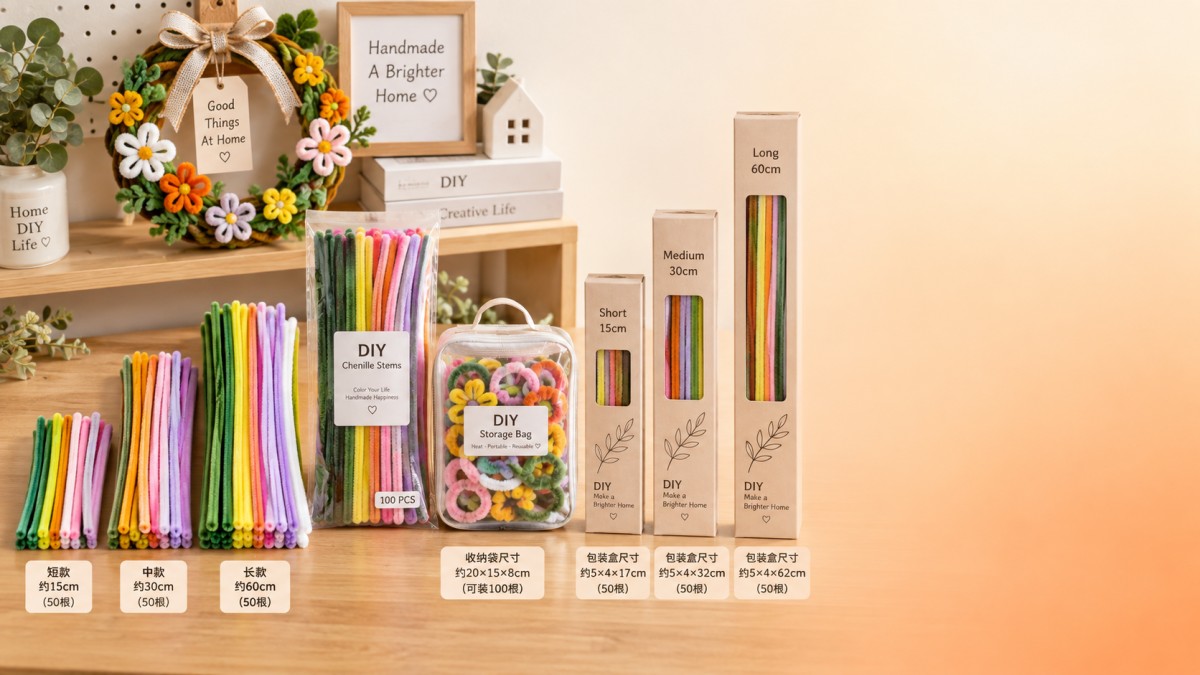
Stem length influences the physical footprint of the kit. Long stems may require a longer carton, header card, polybag, or insert. A package designed around a compact square craft project can become awkward when a single component must remain straight across the full pack. Folding the stems can reduce pack length, but the bend may remain visible or create an unwanted weak point in the wire.
Bundling is also different. Short stems can be grouped in small color assortments and placed in separate compartments. That improves counting accuracy but adds bags, labels, sealing steps, and pack-line touches. Long stems are often easier to bundle as one group, although they can shift inside a package and tangle with ribbon, yarn, paper shapes, or instruction sheets.
Transport should be assessed by carton utilization rather than unit weight alone. Chenille stems are lightweight, so freight is frequently affected by volume and carton dimensions. A small increase in length may force a different carton orientation or leave unusable void space. The outcome varies with the rest of the kit: a flat craft set with stickers and paper components behaves differently from one containing molded pieces, glue, fabric, or a display-ready backing card.
Labor cost appears in the small operations
Length selection changes the number of times materials must be counted, sorted, cut, and inspected. A project requiring twelve short pieces in four colors has a larger picking burden than one requiring four longer pieces, even if the total fiber and wire usage is similar. Counting mistakes are especially likely where individual pieces look alike but differ slightly in length.
Pre-cutting can move work from the end user to the packing stage. This is appropriate when the project depends on precise symmetry or when loose cutting tools are unsuitable for the intended activity. It also introduces dimensional tolerances. If a short component is cut slightly under length, there may be too little material to make the required bend or twist. For a flexible decorative loop, the same variation may have no visible effect.
Instructions and sample assembly should be reviewed before locking the length specification. A stem that is technically long enough may still be difficult to manipulate if several bends must occur close together. Dense fiber pile can obscure the wire core, making accurate folding slower. A modestly longer piece may reduce frustration because it leaves a handling tail that is trimmed or tucked away at the final stage.
Use the finished object to set the length range
Length should be assigned by function rather than selected as a single universal specification. Structural elements need enough spare length for wraps, joins, and anchoring. Decorative elements need enough coverage without leaving bulky tails. Where multiple colors form a pattern, equal nominal length does not always create equal visual length after twisting; tightly wound sections consume more usable stem than simple bends.
Seasonal craft kits illustrate this difference clearly. A project that combines chenille stems with removable window decor may use short, color-specific pieces for a character or hanging accent, while the display item itself needs no wire structure. For example, a Halloween activity set could pair a simple stem-made shape with Halloween Window Gel Clings Ghost Pumpkin Bat Witch Cat Boo Blood Decal Stickers for Halloween Home Party Window Decorations. The reusable TPR clings attach to smooth surfaces separately, so their inclusion should not be used to justify longer stems unless the craft component actually needs a larger frame or hanging loop.
A practical quotation request should identify the cut length, permitted tolerance, wire stiffness expectation, pile coverage, color mix, pieces per kit, and whether stems arrive straight, bundled, or pre-bent. It should also show the completed craft dimensions and specify which stems are structural. Without those details, two quotations with the same stated stem length can describe materially different kits.
The lowest per-piece stem price is meaningful only when it aligns with material yield, pack geometry, assembly effort, and the finished design. Selecting the shortest workable length often controls raw-material usage, while selecting the most efficient length for the construction can control the total kit cost.
Leave A Message
If you are interested in our products and want to know more details, please leave a message here, we will reply you as soon as we can.

We specialize in supplying home decor, handicrafts, and daily necessities.


