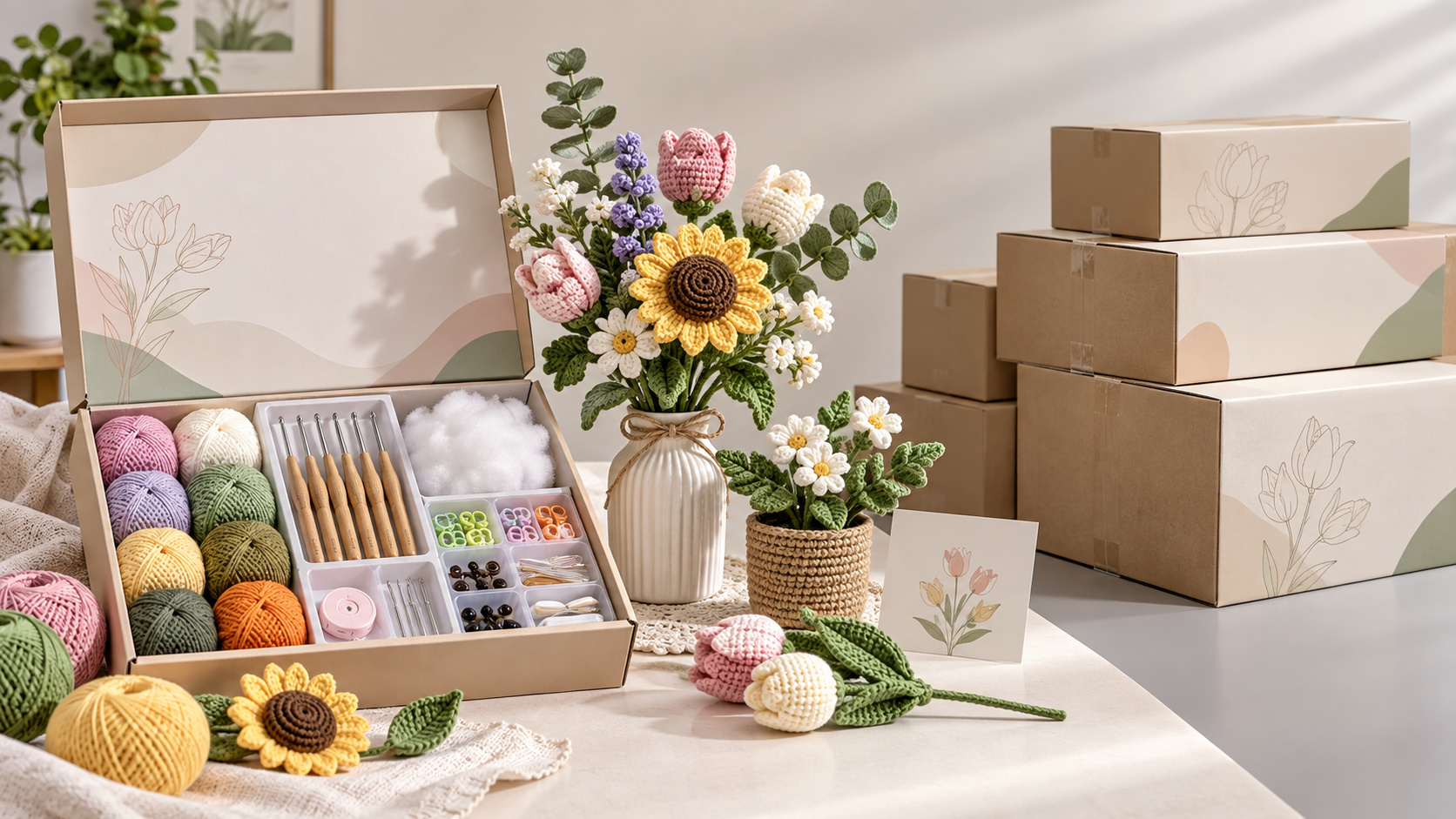
A private label crochet kit succeeds or fails on repeatability. Retailers need a product that looks appealing on a shelf, but the commercial result depends on whether every batch contains the correct materials, gives customers a workable project, and arrives in time for the intended selling season. When evaluating crochet kit wholesalers, the most useful question is not “Can this supplier make a nice sample?” It is “Can this supplier reproduce this kit accurately at the required volume, with clear controls over cost, packaging, and replenishment?”
That distinction matters because a crochet kit is a bundled product. Yarn, hooks, stuffing, accessories, printed instructions, labels, and outer packaging must work together. A problem with any one component can create returns, poor reviews, or costly rework. The wholesale partner should therefore be assessed as a kit assembler and supply-chain manager, not only as a source of individual craft materials.
Start with the retail proposition, not the design catalog
Private label programs often begin with a supplier’s existing animal, flower, or beginner craft designs. That can be a practical starting point, especially for a seasonal test or a retailer entering the DIY category for the first time. However, buying an existing kit and putting a new label on it is different from building a product range that supports a distinct retail position.
Before requesting quotations, define what the kit needs to do on the shelf. Is it a low-commitment beginner project for gift shoppers? A compact travel-friendly craft item? A more detailed home decor project aimed at experienced makers? The answer determines the appropriate yarn type, number of colors, hook size, instruction format, packaging dimensions, and acceptable retail price range.
A supplier can offer extensive customization yet still be the wrong partner if it cannot translate this product brief into a controlled bill of materials. The brief should identify the finished item, target skill level, required contents, packaging concept, language needs, safety considerations, and expected order pattern. It does not need to contain every production detail at the start, but it must establish the commercial boundaries before design work begins.
What determines the real landed cost
The factory price for a crochet kit is only one part of the buying decision. The lowest quoted unit price can become the most expensive option when it leads to poor packing efficiency, high defect rates, late delivery, or a product that needs extensive local relabeling. Buyers should compare quotations on a like-for-like basis and ask exactly what is included.
For an initial order, it is usually wiser to limit variables. A custom sleeve, label, insert, and curated color selection can create a differentiated kit without immediately requiring an entirely new pattern, custom component, and complex presentation box. Once sell-through is established, the retailer has a better basis for funding deeper customization.
Buyers should also consider the cost of assortment complexity. A range of many designs may appear attractive, but each SKU can require separate yarn allocation, component picking, artwork control, and inventory management. A focused collection with shared yarn colors or common accessories is often easier to replenish and less exposed to leftover materials.
Samples should test production control, not only appearance
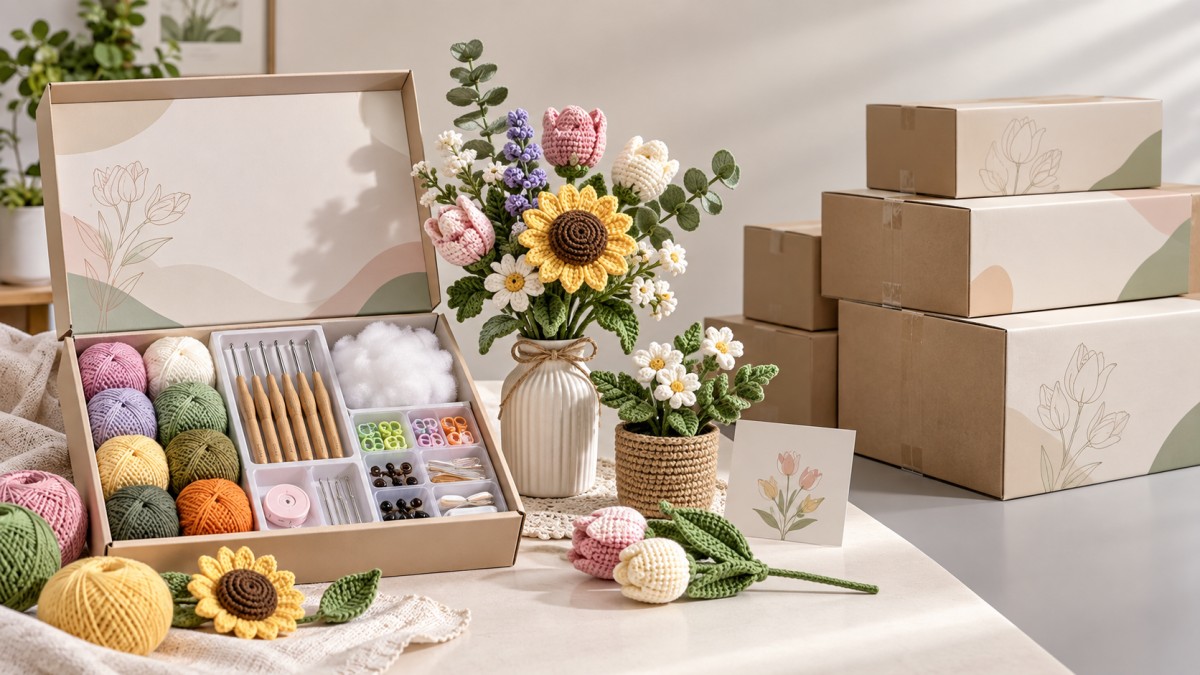
A pre-production sample needs to answer more than whether the finished crochet figure is attractive. It should let the buyer check whether the kit is intuitive to use and whether the proposed specification can be maintained from one order to the next.
Open the sample as a customer would. Count the contents, assess whether yarn quantities appear sufficient, inspect how the components are separated, and read the instructions without relying on outside help. Instructions should match the exact materials provided. If a pattern specifies a hook size or yarn thickness that does not match the kit, the customer may not achieve the pictured result even when every component is technically present.
For beginner kits, clarity is part of product quality. The instructions should define abbreviations, explain the sequence in a logical order, and use images where they resolve a difficult step. Advanced makers may accept concise pattern language, while casual gift buyers usually need more guidance. A wholesale partner that asks about the intended user is more likely to build the right format than one that treats every crochet kit as interchangeable.
Once the sample is approved, convert the approval into a usable production reference. This may include approved artwork, a contents list, color references, packaging dimensions, assembly order, and acceptable substitutions. Without that reference, later batches can drift even when the supplier has good intentions. “Same as sample” is too vague for a multi-component private label item.
Material consistency and compliance need practical questions
Retail buyers should ask how yarn colors, hook materials, stuffing, and small accessories are sourced and controlled. This is particularly important when the kit is positioned for children, beginners, or gifting, where the user may expect a complete and safe-to-handle set rather than loose craft supplies.
The required material documentation and testing approach will depend on the destination market, product positioning, age grading, and retail channel. A capable partner should be able to identify the relevant materials, provide traceable component information, and support the documentation process requested by the buyer. The aim is not to collect paperwork without purpose; it is to make sure the product specification, labels, and claims match the actual kit.
Do not assume that a craft kit can use the same labeling approach as a decorative accessory. Needles, small parts, adhesives, or age-related claims may change the review needed for a particular range. It is more efficient to settle these questions before final packaging artwork is printed.
Lead time is a planning issue, not a shipping promise
Seasonal and gift-led DIY products are vulnerable to late arrival. A supplier may quote an efficient assembly time, but the full calendar also includes yarn sourcing, sample approval, artwork confirmation, packaging production, component delivery, quality inspection, and export preparation. Any late change to colors or instructions can move the shipment date.
Ask potential crochet kit wholesalers to separate these stages in their schedule. That makes it easier to identify which decisions the retailer must make early and which elements can remain flexible. It also exposes whether the supplier relies on readily available materials or needs to source several special components for each order.
Replenishment deserves the same attention as the first launch. A design that can be assembled once is not automatically easy to repeat. Confirm whether the core materials will remain available, what happens if a shade or accessory is discontinued, and whether alternatives need buyer approval before use. A stable program depends on controlled substitution rather than unexpected substitution.
Assess the partner’s wider home decor capability
A crochet kit can sit naturally beside seasonal ornaments, fabric crafts, small storage items, decorative textiles, and other giftable home products. For retailers building a broader craft and decor assortment, a partner with related sourcing capability can simplify coordination across categories. It may allow packaging concepts, seasonal color stories, and shipment consolidation to be managed with fewer suppliers.
Manufacturing depth matters here. A sourcing partner with certified handicraft production as well as wooden and fabric craft resources can support projects that combine different materials or move from a simple kit into adjacent decor items. Established relationships with ceramics, plastics, and handwoven producers can also be useful when a collection requires mixed-material packaging, display pieces, or coordinated seasonal accessories.
This does not mean every category should be bundled under one supplier. Specialist suppliers may still be preferable for technically demanding items or established bestsellers. The advantage of a broader network is operational: it gives the buyer more options when matching a product concept to the right manufacturing process and shipment plan.
Questions that reveal whether a supplier is ready
A supplier evaluation should lead to concrete operating answers. Ask how the factory checks kit contents before sealing, how color and component substitutions are approved, and what reference is used during final inspection. Request carton dimensions and packing quantity early enough to model freight and warehouse handling. For private label work, also establish who owns artwork files, pattern edits, and product-specific packaging elements.
It is useful to ask for a proposed path from briefing to shipment rather than a generic capability presentation. The response should show who manages development, when samples are reviewed, how quality issues are recorded, and how changes are communicated. This is especially important when the project includes multiple designs or a launch tied to a seasonal retail window.
The right partner is not necessarily the one offering the widest catalog or the lowest opening quote. It is the one that can make the commercial tradeoffs visible: where customization raises cost, where a simpler specification protects timing, and where a packaging decision affects both shelf appeal and freight. That level of transparency gives the retailer a stronger basis for pricing the range, planning inventory, and scaling the program after the first order.
Leave A Message
If you are interested in our products and want to know more details, please leave a message here, we will reply you as soon as we can.

We specialize in supplying home decor, handicrafts, and daily necessities.


