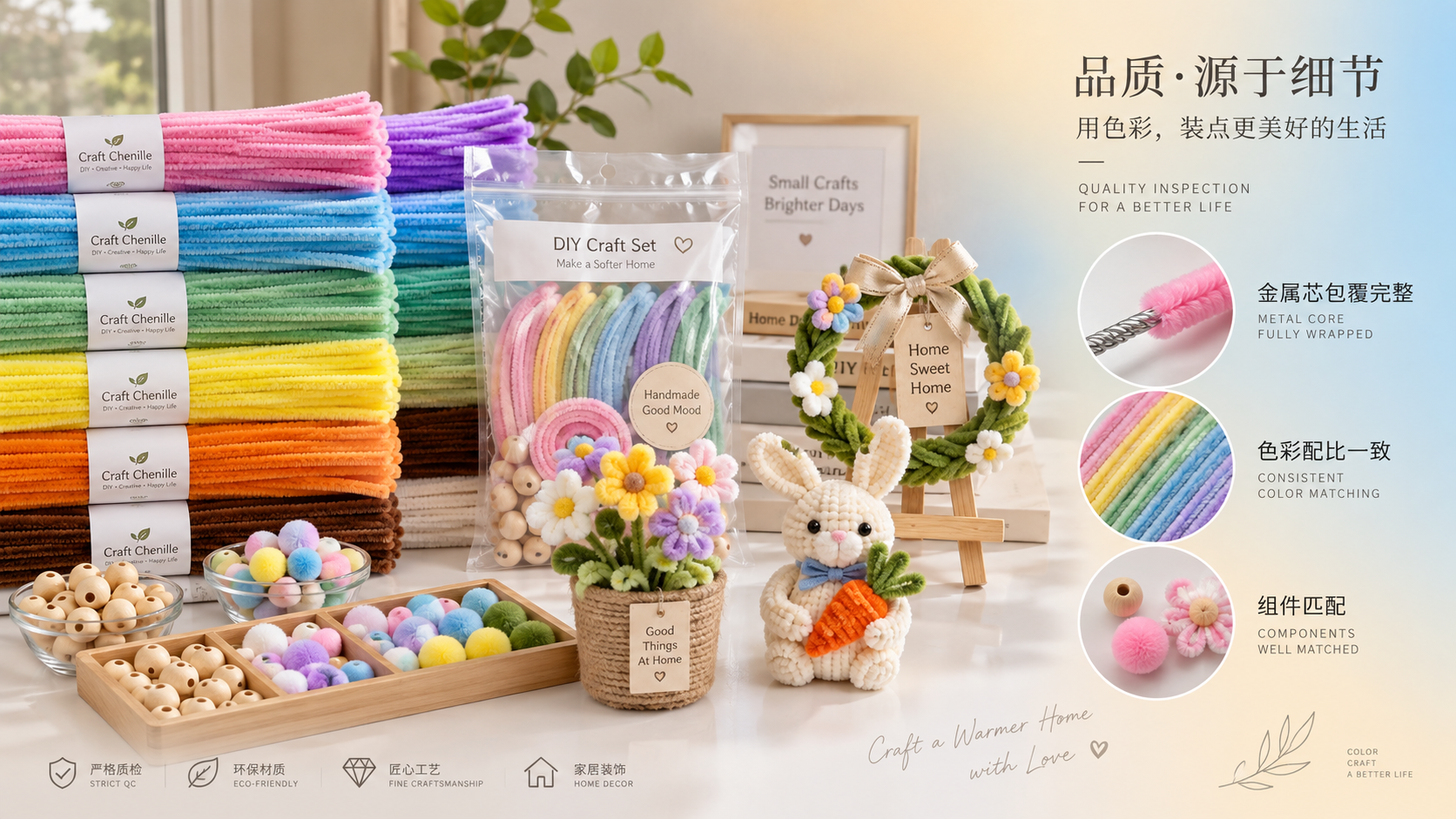
A pipe cleaner craft kit can look consistent while still performing inconsistently. Color assortment, retail packaging, and apparent fullness are only surface indicators. The production variables that determine whether repeated orders remain usable are less visible: wire construction, chenille coverage, cut-end treatment, component fit, color-control method, count accuracy, and the discipline used to lock each production lot to an approved reference.
For a pipe cleaner craft kit producer, the central quality question is not whether one pre-production sample looks acceptable. It is whether the same kit can be assembled months later using replenished wire, yarn, accessories, printed instructions, and packaging without changing the user experience or creating a safety concern. This requires controls at material, process, and packing stages rather than a final visual inspection alone.
Wire construction determines the kit’s functional baseline
Pipe cleaners are generally built around twisted metal wire with chenille yarn trapped between the strands. Small changes in the wire system can alter bendability, shape retention, and end safety at the same time.
Wire diameter, material grade, strand count, and twist tension should be defined as controlled specifications rather than informal sample characteristics. A softer core may make a stem easier for a child to twist into loops, but it may not hold a standing structure or a three-dimensional animal shape. A stiffer core improves retention but can make repeated bending more difficult and increases the importance of secure chenille coverage at both ends.
Cut length needs its own tolerance. A short deviation may appear unimportant on a single stem, yet it affects whether paired stems align in instruction-led projects and whether a fixed quantity provides enough usable material. Where kits contain pre-cut lengths for particular models, dimensional consistency is more important than for bulk assortments intended for open-ended craft use.
End treatment deserves direct inspection. The metal core must not project through the chenille after cutting, twisting, or normal handling. This is not solved merely by checking a newly opened bag: handling during filling, transport compression, and repeated bending can displace fibers and expose a sharp wire tip. Functional checks should therefore include bends representative of the illustrated project rather than relying exclusively on flat-sample appearance.
Chenille density is a performance specification, not just a visual one
Buyers often describe a requirement as “fluffy” or “full,” but those descriptions need to be translated into measurable approval criteria. Chenille density is influenced by yarn linear mass, pile length, winding pitch, fiber composition, and the stability of the yarn-to-core twist. Two stems with the same nominal diameter can have very different surface coverage and feel.
Low coverage exposes the metal twist, produces uneven color bands, and makes a finished figure look sparse. Excessively loose pile can shed during sorting and assembly, especially when stems are packed tightly in a sealed pouch. Dense material may look premium but can also resist tight twisting or create oversized joints in projects designed around a thinner stem.
A useful control approach combines an approved physical reference with defined checks for overall diameter, visible-core frequency, pile uniformity, and fiber shedding after a specified handling method. The handling method matters. Brushing, bending, or rubbing without a shared procedure can produce subjective and non-comparable inspection results.
Material substitutions require particular caution. A change in polyester fiber source, wire coating, or yarn winding method can preserve the product’s broad appearance while changing odour, friction, resilience, or color response. These changes should be handled through formal change notification and sample approval, not treated as routine purchasing variation.
Color consistency requires a defined reference under controlled viewing conditions
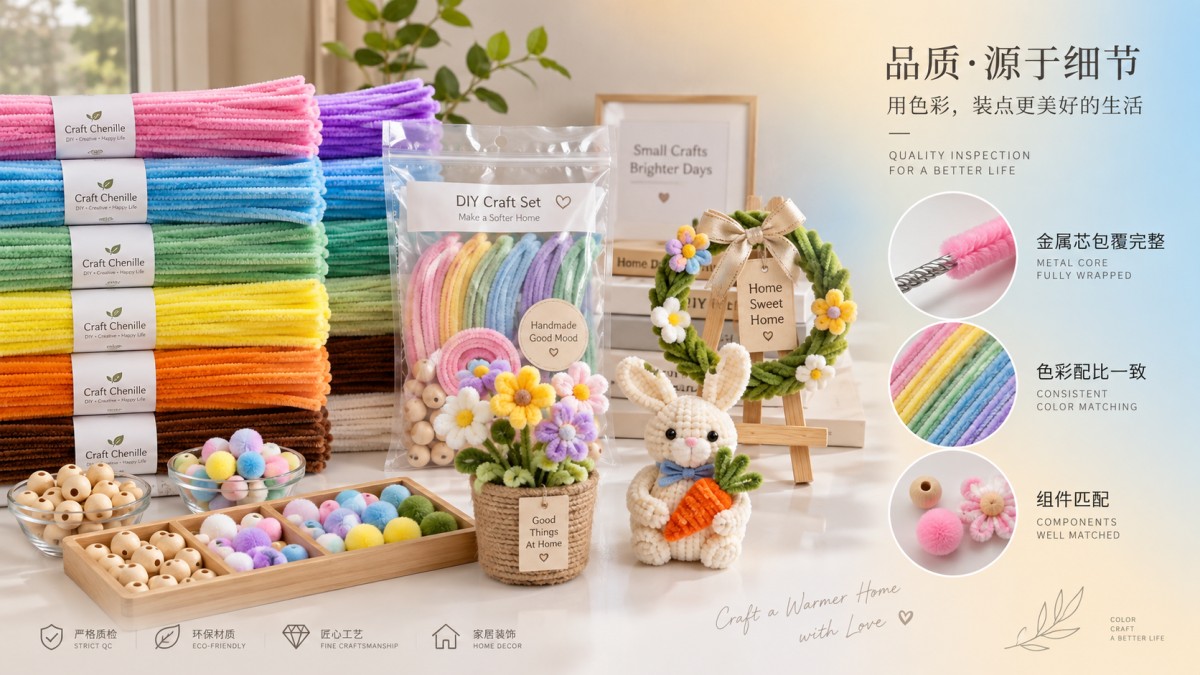
Multi-color kits are exposed to more color variation than single-color packs because each shade can come from a different dye lot or supplier run. “Red,” “light blue,” or “natural” are not sufficient production specifications. A physical master swatch or approved retained stem should identify the target, while the inspection process should state the lighting condition and acceptance method.
Instrumental color measurement can be useful where a supplier and buyer agree on the color space, illuminant, sample preparation, and allowable difference. It should not replace visual review in all cases. Chenille’s directional pile, gloss variation, and uneven fiber surface can affect readings. Visual comparison under standardized lighting remains important, particularly for coordinated sets where closely related shades must be distinguishable but harmonious.
Color assortment control also includes ratio accuracy. A package advertised as an assorted set can become functionally different if a factory substitutes a high proportion of one shade for another. The bill of materials should identify not only total stem count but also the count by color, length, and type. This is especially important when instructions require specific colors to complete a pictured project.
Accessory tolerances affect whether the project can actually be built
Many craft kits combine pipe cleaners with pom-poms, wooden shapes, beads, wiggle eyes, adhesive dots, card stock, or pre-cut felt. The project’s success depends on interface compatibility. A bead hole that is too narrow for the stated pipe cleaner diameter, or a pom-pom that varies significantly from the illustrated size, can make an otherwise compliant kit unusable.
Technical evaluation should focus on the interfaces rather than reviewing each component in isolation. Representative assemblies should verify that stems pass through beads, twist around formers, attach to intended surfaces, and remain stable at the scale shown in the instructions. When adhesive is included, its performance must be assessed against the actual materials and storage conditions. Adhesive that bonds well to a smooth sample board may perform poorly on chenille, textured wood, or low-energy plastic.
Catalogue breadth is not evidence that these interfaces have been engineered. A supplier offering adjacent decor products, such as a Wooden Large Vertical Love Grows Here Porch Decor, Garden Welcome Standding Sign Garden Decor Sign, Welcome Wall Sign for Yard Porch Farmhouse Door Decoration, should be evaluated according to the relevant material controls for that product family. Wood moisture, print adhesion, hanging-rope attachment, and outdoor finish are separate considerations; they do not demonstrate pipe cleaner kit consistency unless the supplier can show equivalent control over the specific kit bill of materials.
Packaging accuracy is part of product conformity
For kits with many low-cost pieces, packing is often the highest source of repeat-order complaints. A missing pair of eyes, an incorrect instruction sheet, or a short count of stems may not be visible through an outer carton check. Manual counting alone is vulnerable to fatigue and component similarity.
Reliable packing control begins with a version-controlled bill of materials. Every saleable SKU should be tied to a defined component list, artwork revision, age grade where applicable, language set, and packing sequence. Distinctive component bins, barcode or scan verification, weight checks, and periodic pack audits can reduce error, but none is sufficient in isolation. A weight check can detect a missing bundle of stems but may not identify a substituted instruction leaflet or an incorrect color mix.
Outer packaging must also protect the pile and prevent deformation. Compression can flatten chenille, crease printed cards, or force metal ends against a pouch. Transit testing should reflect the actual master-carton configuration and fill level rather than an idealized sample carton. If retail presentation depends on volume and color separation, the package design needs enough internal control to preserve those characteristics after shipment.
Batch consistency depends on traceability and change control
A stable kit programme needs a meaningful lot definition. Finished-goods lot records should connect to incoming wire, chenille yarn, accessories, printed materials, and packing components. Without this link, a recurring defect such as fiber shedding or incorrect color tone cannot be isolated efficiently.
Retained samples are valuable when they represent the finished kit, not only individual materials. They allow later comparison of color assortment, instruction revision, pack density, and the condition of components after storage. The approval sample should be protected from informal changes: a replacement factory sample is not automatically equivalent to the original approved reference.
Sampling can be structured using an agreed inspection plan, including methods derived from ISO 2859-1 where appropriate. The standard does not itself define what is acceptable for a craft kit; defect definitions still need to be agreed. Exposed wire, missing mandatory warning text, a wrong component count, and minor pile variation should not be treated as the same severity. Clear classification prevents disputes caused by a pass/fail result with no shared interpretation.
Safety and regulatory review starts with correct product classification
A pipe cleaner craft kit is not automatically regulated in the same way in every market. Its intended age, play value, claims, included accessories, and route to market affect the applicable requirements. In the United States, products marketed as toys may require assessment against relevant requirements under ASTM F963 and associated Consumer Product Safety Commission rules; small-parts considerations are especially relevant for products intended for children under three. In the European Union, a product classified as a toy may fall within the Toy Safety Directive framework, with relevant EN 71 testing determined by its characteristics. Chemical restrictions may also apply to materials and finishes under applicable market rules, including REACH requirements in the EU.
Classification should be resolved before artwork and component selection are finalized. Warning language cannot compensate for a component design that is unsuitable for the declared age group. Likewise, a laboratory report for one material does not establish conformity for a changed kit configuration, different coating, new colorant, or newly added accessory.
The strongest indicator of a consistent supply programme is a supplier’s ability to translate the approved kit into controlled specifications: measurable stem construction, approved color references, interface checks, packing verification, lot traceability, and documented change management. Bright colors attract attention, but repeatable construction quality is what keeps the kit aligned with its instructions, retail specification, and intended use.
Leave A Message
If you are interested in our products and want to know more details, please leave a message here, we will reply you as soon as we can.

We specialize in supplying home decor, handicrafts, and daily necessities.


