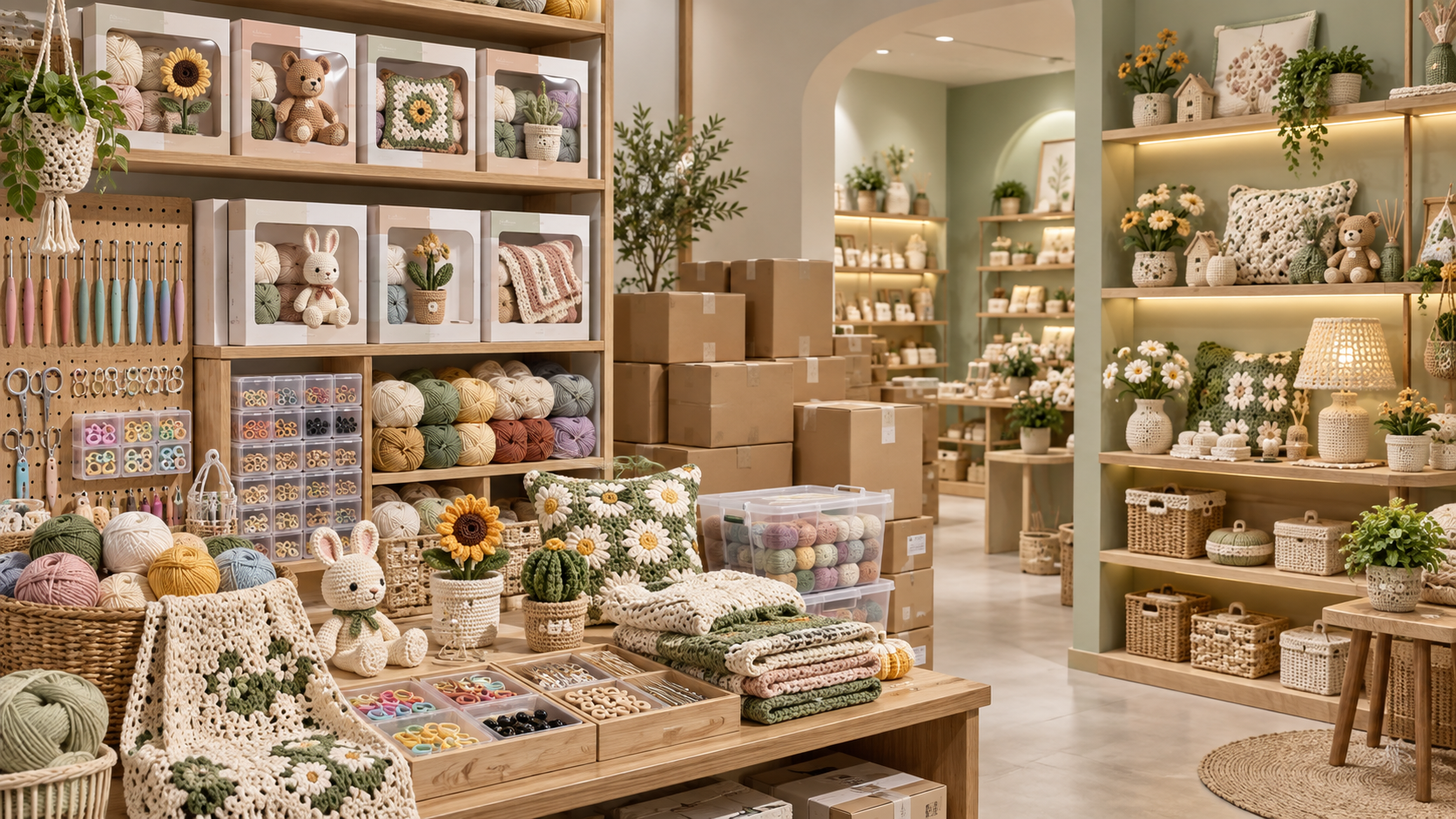
Buying from crochet kit wholesalers improves retail margins only when the wholesale model lowers the fully landed cost per saleable unit without creating excess inventory, quality claims, or markdown exposure. A lower factory or distributor price is not enough. Crochet kits carry several margin-sensitive variables at once: yarn consumption, hook and accessory completeness, pattern clarity, packaging presentation, seasonal relevance, and the amount of selling space required to convert a kit into a purchase.
The practical threshold is reached when a retailer can replenish a defined assortment at a predictable cost and sell-through rate, rather than treating bulk buying as a simple discount exercise. For a home décor or gift retailer, kits can be attractive because they combine a finished-project aspiration with a compact, giftable format. But they become margin dilutive when the range is too broad, the buyer overestimates demand for advanced projects, or the supplier’s low quoted price excludes the costs needed to make the product retail-ready.
Margin improvement begins with the right cost comparison
The relevant comparison is not wholesale purchase price versus an individual retail purchase price. It is the gross margin produced by a wholesale kit program versus the margin from the shelf space, cash investment, and replenishment effort allocated to alternative craft, gift, or seasonal décor products.
A useful internal calculation starts with:
Net retail sales less fully landed cost less expected inventory loss.
Fully landed cost should include unit price, freight allocation, import duties where applicable, local delivery, inspection or rework, labeling, and any packaging changes required for the intended market. Expected inventory loss includes damaged units, incomplete kits, returns, discounts, obsolete seasonal designs, and slow-moving stock that must be cleared.
For crochet kits, the apparent simplicity of the product can obscure these costs. A kit with yarn, stuffing, a hook, stitch markers, needles, instructions, and printed packaging has more points of failure than a single finished decorative item. If missing components are discovered at store level, the retailer may lose the sale, incur a replacement cost, and weaken confidence in the range. A wholesale saving that is smaller than the expected cost of these failures is not a genuine margin gain.
Margin improvement is therefore most credible when a buyer has enough volume to spread freight, quality-control, and design-approval costs across a stable order base. The exact volume differs by origin, shipping mode, packaging format, and delivery model. The operational signal is more important than a universal minimum order quantity: an order should be large enough that fixed sourcing costs do not materially distort the cost of each kit, but small enough that stock can turn before its merchandising relevance fades.
Where wholesale economics work best
Wholesale purchasing tends to be most effective for a narrow group of repeatable kit formats rather than an untested catalogue of designs. Beginner-friendly amigurumi, small home accents, seasonal ornaments, and compact gift kits are generally easier to merchandise than large, technically demanding projects because the finished outcome is easier to understand at a glance and the commitment of time and materials is more contained.
The strongest economics usually come from assortments with shared components. If several kits use compatible hook sizes, similar yarn weights, standard accessory packs, or a common box format, the supplier can often produce more efficiently and the retailer can simplify quality checks and replenishment. Shared architecture also makes it easier to substitute a discontinued colourway or refresh a design without rebuilding the entire range.
Exclusive colour combinations, private-label sleeves, or retailer-specific inserts can improve pricing power, but only after demand is established. Customization often adds artwork approval cycles, packaging minimums, and a greater risk that remaining inventory cannot be redirected to another channel. It should be treated as a margin-protection tool for proven lines, not as an automatic feature of the first wholesale order.
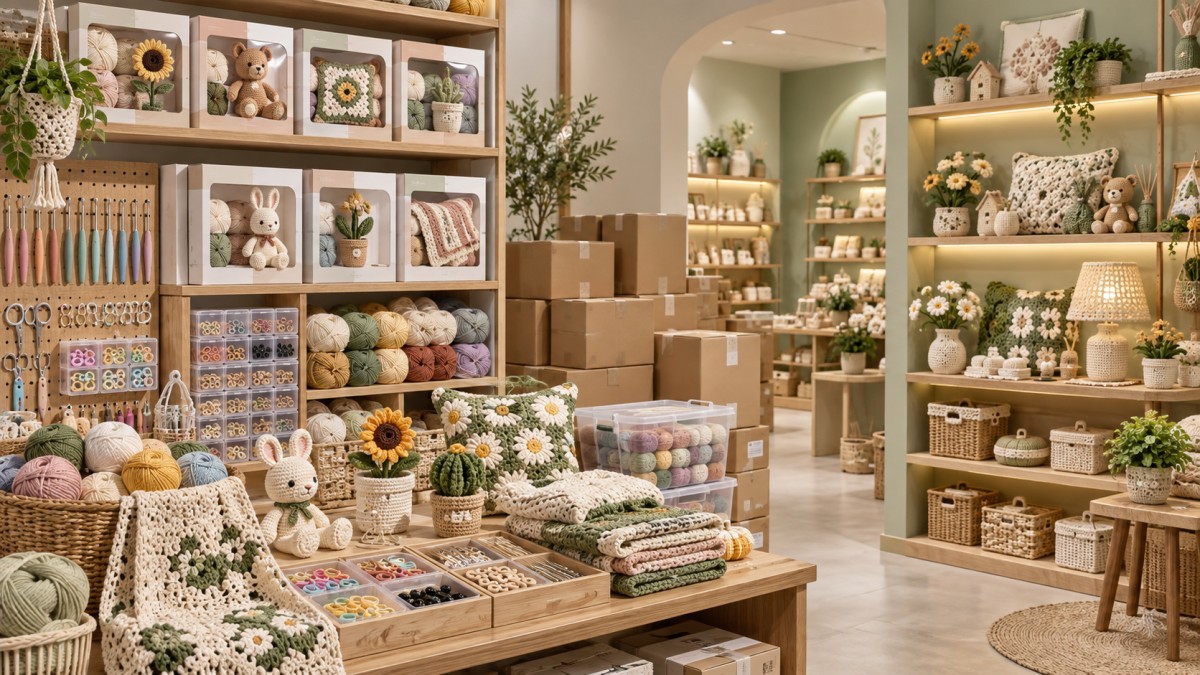
Seasonal buying requires a separate calculation. A spring craft assortment may sit beside low-commitment decorative products, such as Spring Window Clings Gel, Jelly Window Stickers for Glass Refrigerators Home, Welcome Spring Window Decorations - Flowers Butterflies Bird, Kids‘ Love. The two product types do not carry the same margin mechanics: reusable window clings are quick to understand and may have a short seasonal selling window, while crochet kits require more customer consideration but can support a higher ticket and a longer period of use. They should not be evaluated solely on percentage margin. The buyer needs to compare cash tied up, space used, expected sell-through before the seasonal reset, and the residual value of unsold stock.
Kit quality is a commercial variable, not only a compliance issue
When sourcing from crochet kit wholesalers, quality evaluation needs to focus on whether the customer can complete the advertised project. This is different from checking whether the outer carton looks acceptable.
Yarn quality affects more than appearance. Inconsistent thickness, weak joins, excessive shedding, unstable dye, or poorly matched colours can make a pattern difficult to follow. A beginner may interpret that difficulty as product failure. Similarly, an instruction sheet that assumes knowledge of abbreviations, does not identify stitch orientation clearly, or has inadequate diagrams can increase returns even when every physical component is present.
Samples should be reviewed as complete retail experiences. That means verifying the counted components against the packing list, reading the instructions in the language used at point of sale, assessing whether the finished item reasonably matches the package image, and checking whether the tools supplied are usable rather than merely included. For kits aimed at children, gifting, or casual hobby users, age grading, warning statements, small-part risks, and material safety requirements must be assessed for the destination market. The applicable obligations depend on where and how the product is sold; a supplier statement alone should not replace the importer’s or retailer’s compliance review.
Pre-shipment inspection is particularly valuable where kits contain many small parts. An acceptable quality limit for a carton of finished décor may be unsuitable for a mixed-component kit, because a single missing eye, needle, or instruction leaflet can render one retail unit unsaleable. The inspection plan should specify component count, yarn colour consistency, barcode readability, packaging integrity, and random verification against the approved sample.
Replenishment determines whether the initial saving survives
A wholesale order can look profitable at launch and still underperform if replenishment is unreliable. Retailers often make the error of negotiating heavily on the first container, pallet, or bulk order while accepting vague commitments on repeat availability. Crochet kits are vulnerable to this because yarn shades, pattern assets, accessory suppliers, and packaging materials may change between production runs.
Before allocating meaningful shelf space, establish whether the supplier can keep the core designs available, what lead time applies to repeat orders, whether minimums change after launch, and how discontinued components are handled. A supplier that can support staged deliveries or smaller repeat orders may produce a better annual margin than one offering the lowest first-order cost but requiring another large commitment each time stock runs low.
Reliability also affects markdown risk. When a bestseller cannot be replenished, the retailer may be left with less attractive companion designs. When a product arrives late, it may miss a gift window or planned campaign. In either case, the original unit-cost advantage is diluted by lost full-price sales.
Assortment breadth can quietly destroy the wholesale advantage
Bulk buying encourages variety because a supplier’s catalogue can make each additional design appear inexpensive. Yet every extra SKU creates a separate demand forecast, replenishment decision, visual merchandising requirement, and potential clearance problem. Crochet has distinct customer skill levels and aesthetic preferences; a wide selection does not automatically produce a balanced range.
A more defensible approach is to build around a limited core: one or two accessible entry kits, several designs aligned with the retailer’s décor or gifting identity, and a controlled seasonal layer. Track sales by design, price point, difficulty level, and time on shelf. A higher-priced kit may be more profitable in absolute currency even with a lower percentage margin if it sells steadily and requires no discounting. Conversely, a low-cost kit can be expensive inventory if it remains on display for months.
Pack configuration deserves the same scrutiny. Inner packs that force stores to receive too many units of a slow design can create local overstock even when total chain demand is sound. Mixed cartons may help test a range, while single-SKU cartons may be more efficient once a proven design requires frequent replenishment. The preferable option depends on store count, replenishment capability, and how quickly sales data become available.
When buying wholesale is the wrong decision
Wholesale purchasing is unlikely to improve margins when demand is unproven and the supplier requires deep SKU-level minimums; when product differentiation is weak and comparable kits are routinely discounted; when the intended price point cannot absorb freight and retail packaging costs; or when the organization lacks a practical process for receiving, checking, and replenishing multi-component products.
It is also a poor fit when the retailer’s main advantage is fast trend response. Long lead times and custom packaging commitments can turn a potentially attractive design into aged inventory before it reaches the shelf. In those circumstances, a smaller domestic distributor order, a test buy, or a simpler craft format may carry a higher unit cost but lower total risk.
The best outcome from crochet kit wholesalers is not the largest discount. It is a repeatable supply arrangement in which the product arrives complete, meets the required retail and safety expectations, turns at a pace consistent with the buying commitment, and can be replenished without forcing the business into excess stock. Once those conditions are in place, the lower unit cost becomes meaningful because it is supported by sell-through rather than offset by operational friction.
Leave A Message
If you are interested in our products and want to know more details, please leave a message here, we will reply you as soon as we can.

We specialize in supplying home decor, handicrafts, and daily necessities.


