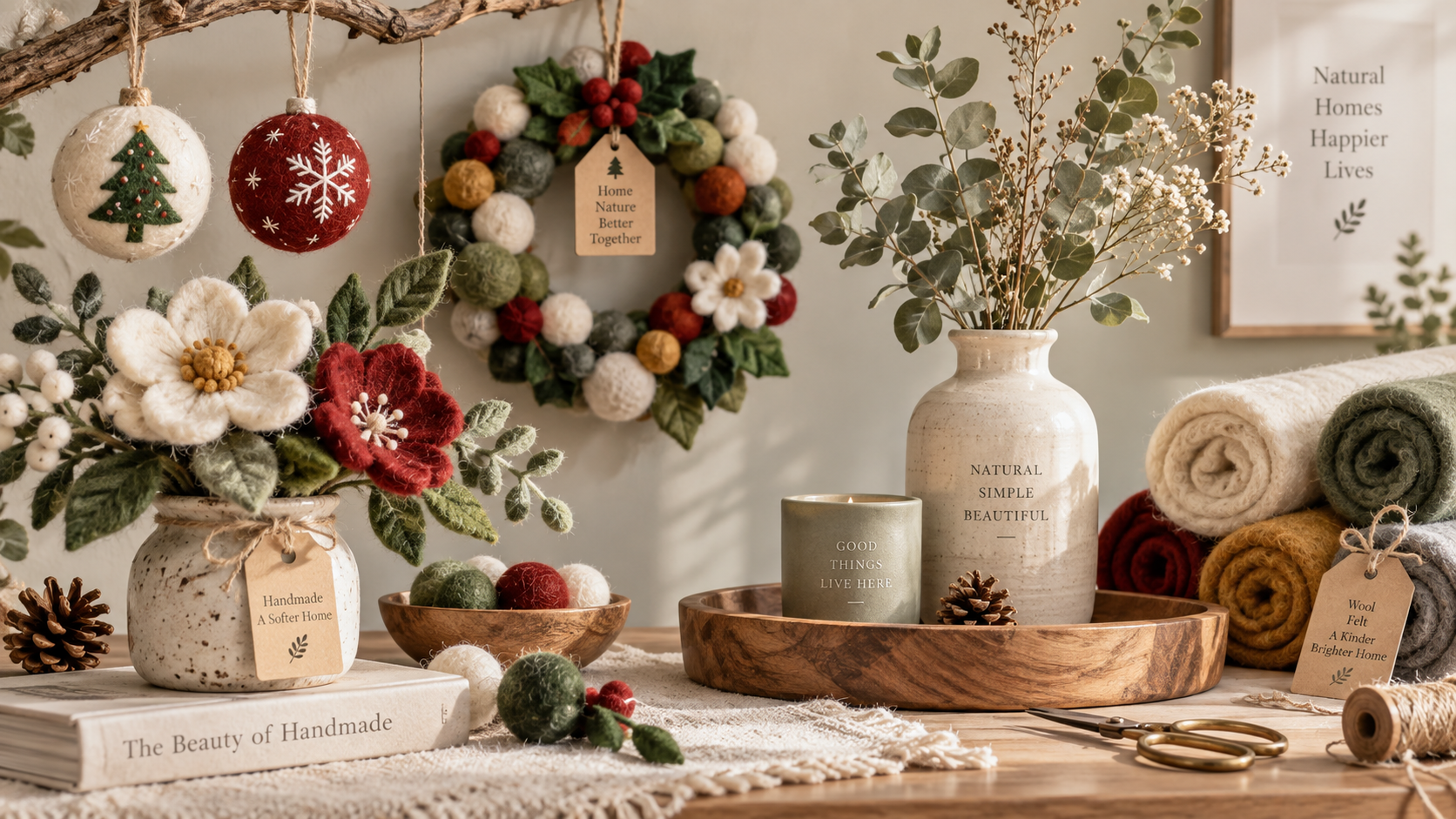
Bulk wool felt craft supplies are the better choice when felt is expected to carry the visual and tactile value of a home décor item, rather than simply act as a low-cost backing, filler, or classroom craft material. For buyers developing premium ornaments, handmade seasonal collections, nursery décor, tabletop accents, or giftable textile pieces, wool felt can make the finished product look more considered before a customer even examines the construction.
Synthetic craft felt still has a legitimate role. It is widely available, easy to color-match, and practical for designs where cost, bright printing, or disposable seasonal use matter more than fiber character. The mistake is treating the two materials as interchangeable because both arrive as felt sheets, rolls, or cut shapes. Their surfaces, behavior in production, and contribution to perceived product value are meaningfully different.
Choose wool felt when the material will remain visible
Wool felt earns its place when it is a front-facing design element. Its surface tends to have a softer, less plastic-like appearance than common synthetic felt, with subtle fiber variation that suits warm, handmade, rustic, and natural home décor directions. This matters for items such as tree ornaments, felt garlands, flower stems, appliquéd cushions, storage accents, coasters, and decorative figures.
In these applications, the buyer is not only purchasing fabric weight or color. They are buying a finish that supports a higher-value product story. A carefully stitched felt ornament can still look inexpensive if the base material has a shiny, stiff, or overly uniform surface. Wool gives makers more room to use simple shapes and restrained details because the material itself provides visual depth.
That does not mean every wool felt item should be positioned as luxury. It means the material is a stronger fit when the collection depends on texture, craft cues, and a more natural hand-feel to justify its retail presentation.
Where synthetic felt is usually the more sensible option
Synthetic felt is often preferable for large-volume promotional pieces, children’s activity kits, bright novelty décor, temporary party decorations, or products with many small hidden components. It can also be appropriate where the felt will be laminated, fully printed, heavily embellished, or used only as an internal layer. In those cases, the customer may not see or feel enough of the material for wool’s qualities to influence the purchase decision.
It is also useful when a design requires a very specific saturated shade across multiple production runs. Wool can have natural tonal variation, which is often attractive in a handcrafted range but may be less suitable for a tightly controlled graphic palette. A buyer should decide whether absolute color uniformity or material character has greater value for the collection.
Assess the finished object, not just the felt sample
A small swatch can be misleading. The relevant question is how the felt performs after cutting, sewing, stuffing, gluing, hanging, folding, and repeated handling. Procurement teams should request samples in the intended construction whenever possible. A material that looks appealing flat may prove too soft for a structured wall decoration, while a firmer option can distort when tightly turned through a sewn seam.
For bulk wool felt craft supplies, test the areas that create customer complaints: cut edges, stitch holes, corners, adhesion points, and parts that will be frequently touched. If the design includes layered appliqué, assess whether the layers lie cleanly or create unwanted bulk. If the item is a hanging ornament, check whether the felt holds its silhouette once a loop, bead, or wooden element is attached.
Also consider the care message before committing. Felt décor is generally better suited to spot cleaning and dry indoor display than frequent laundering. A wool-based product may be an excellent choice for a mantel garland or a decorative basket accent, but it is less appropriate for a kitchen accessory expected to endure repeated heavy washing.
Wool is especially useful in mixed-material collections
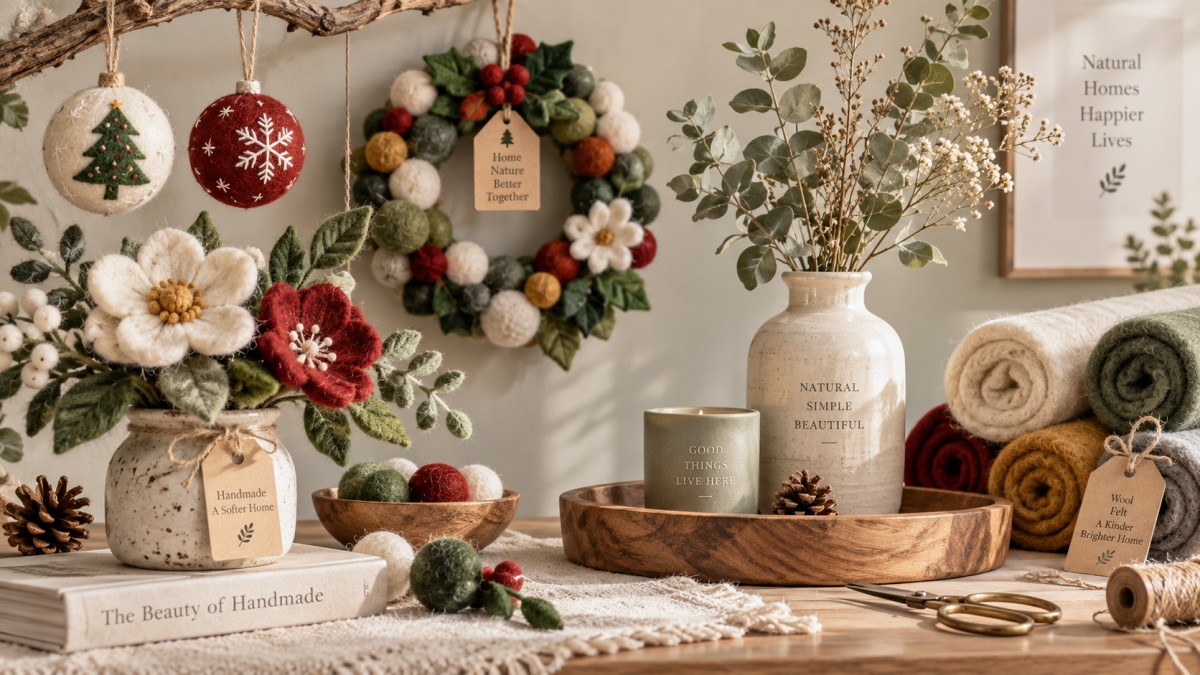
Home décor collections rarely rely on one material alone. Wool felt can work particularly well beside wood, ceramic, woven fiber, and fabric because it softens harder surfaces and introduces contrast without adding visual noise. A wooden sign, for example, may not need felt as its main construction material, yet a small felt leaf, flower, or seasonal hanging detail can make the presentation feel more dimensional.
For porch and entryway ranges, a piece such as the Wooden Large Vertical Love Grows Here Porch Decor, Garden Welcome Standding Sign Garden Decor Sign, Welcome Wall Sign for Yard Porch Farmhouse Door Decoration shows why materials should be assigned according to their job. Durable wood is the practical foundation for a double-sided hanging sign intended for a porch, wall, or garden setting. Felt would be better reserved for removable indoor seasonal accents or protected decorative additions, where its softness and texture can be appreciated without unnecessary exposure to weather.
This material-matching approach is often more effective than forcing wool felt into every part of a range. Buyers can maintain a coherent handmade look while choosing wood for structure, felt for warmth, and other materials for the functions they handle best.
Do not confuse “wool felt” with a complete specification
Wool content alone does not tell a factory how the material should perform. Before approving a bulk order, define the characteristics that matter for the actual product: thickness, density, firmness, color expectation, cut format, and whether the felt will be machine-cut, laser-cut, die-cut, stitched, or bonded. A soft felt suitable for pom-poms may be unsuitable for a freestanding decorative shape. A dense felt that gives crisp edges may be harder to manipulate in a small hand-sewn form.
Ask for the intended application to be reflected in the sample request. “Natural wool felt” is too broad for production. “Felt for layered ornament appliqué with visible blanket stitching” gives the supplier a usable brief and makes it easier to compare alternatives fairly.
A practical buying sequence
- Define whether felt is a visible value-bearing element or an unseen functional component.
- Identify the product’s use environment: protected indoor display, covered porch, high-touch decorative use, or short seasonal use.
- Review the construction method before choosing thickness or density.
- Compare finished samples under normal retail lighting, not only in a supplier’s material folder.
- Approve color and surface expectations with the understanding that natural fibers may not look as uniform as synthetic alternatives.
- Confirm that the supplier can maintain the agreed construction, color direction, and delivery requirements across the planned assortment.
For sourcing programs that combine fabric crafts with wood, ceramics, plastics, or handwoven elements, supply coordination can matter as much as the felt choice. A sourcing network that covers these categories can simplify the development of coordinated home décor collections, particularly when packaging, color direction, and seasonal delivery need to align across several material types.
The most reliable decision is not “wool is better than synthetic.” Wool is better when its texture will be seen, its softer character supports the design, and the finished item has enough perceived value to carry the material choice. When felt is hidden, heavily treated, exposed to demanding use, or governed mainly by low unit cost and strict color consistency, synthetic craft felt may serve the product more effectively.
Leave A Message
If you are interested in our products and want to know more details, please leave a message here, we will reply you as soon as we can.

We specialize in supplying home decor, handicrafts, and daily necessities.


