Start With the Product Decision, Not the Materials List
A custom pipe cleaner craft kit may look simple at first: chenille stems, pom-poms, eyes, glue dots, and an instruction sheet. In retail development, however, the product is not merely a collection of craft supplies. It is a guided activity, a safety-sensitive item, a packaging project, and often a seasonal or giftable SKU with a narrow selling window.
The strongest kits begin with a clear answer to one question: what should the customer be able to make, and how likely are they to complete it successfully? That decision influences every later choice, including stem thickness, number of colors, accessory size, instruction format, packaging dimensions, age grading, testing needs, and reorder feasibility.
For a home decor or gift-oriented assortment, the finished result often matters more than the making process alone. A kit that produces a small animal ornament, a flower arrangement, a holiday figure, or a tabletop decoration has a more obvious perceived value than a generic bag of mixed pipe cleaners. For an activity-focused assortment, repeatability and open-ended creativity may matter more. These are different product concepts and should not be developed under the same bill of materials.
Before asking a factory for samples, define the intended user experience in practical terms:
- Is the kit designed to make one finished item or several small projects?
- Is the result intended for display, gifting, play, party activity, or classroom use?
- Will the project be completed independently, with adult help, or in a group setting?
- Does the concept depend on holiday timing, a licensed character style, or a broad evergreen theme?
- What level of imperfection is acceptable in the finished result?
That final point is frequently underestimated. Pipe cleaner crafts are flexible and forgiving, but they are also prone to uneven shapes, exposed wire ends, loose accessories, and instructions that look easy to an experienced designer but are difficult for a first-time user. Product development should be based on real assembly trials rather than an idealized sample prepared by a skilled craft worker.
Choose a Project Architecture That Matches the Retail Position
A workable kit needs an internal structure. The usual components are the base material, shaping elements, decorative accessories, joining method, instructions, and packaging. Each category should have a defined purpose. Adding more items can make a kit appear generous, but excessive accessories increase packing complexity, create more small-part risk, and can leave customers uncertain about what to do next.
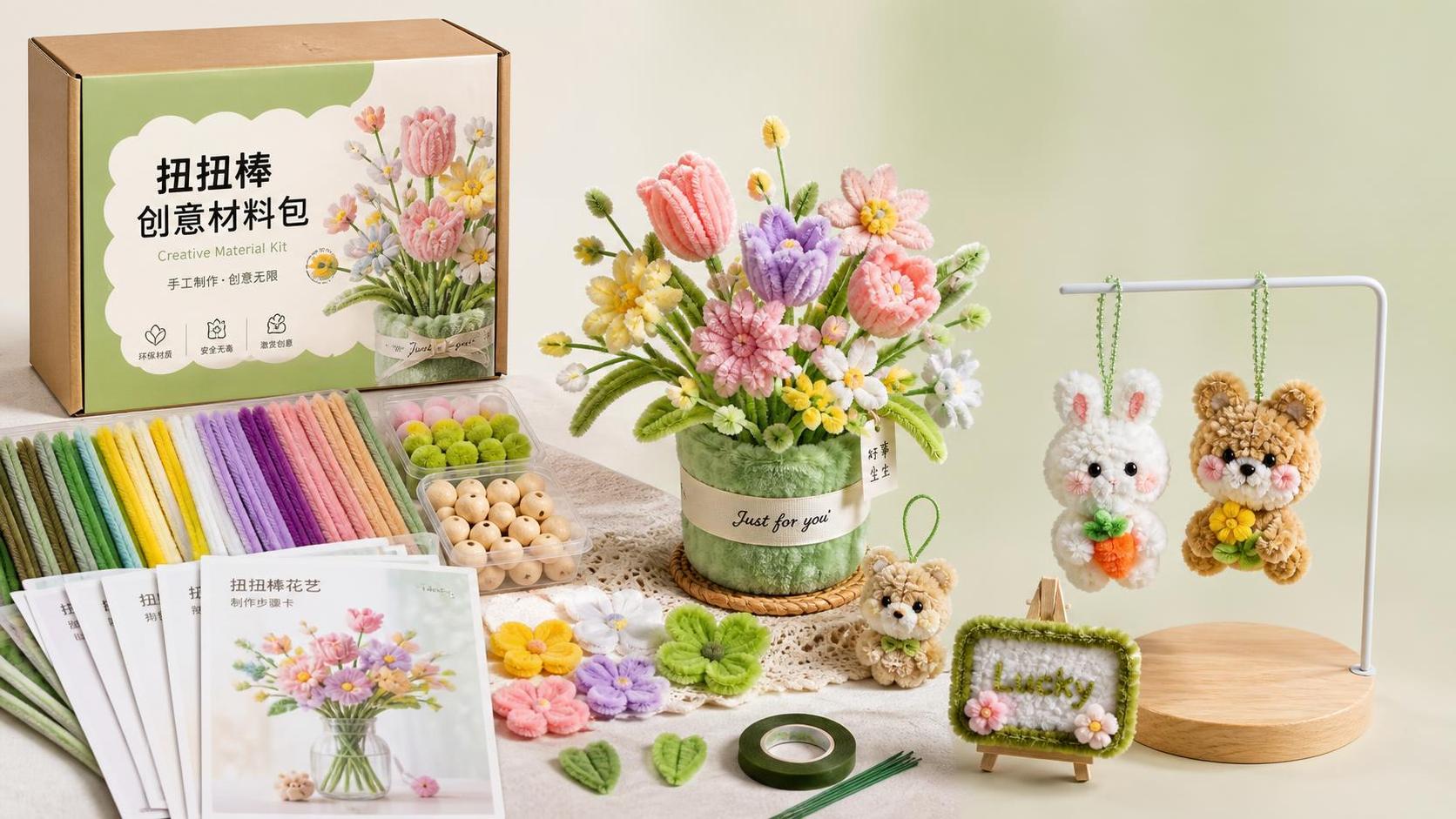
For example, an entry-level animal kit may use a limited palette of chenille stems, pre-sized pom-poms, paper templates, and a small number of decorative components. A more advanced decorative kit might include floral wire, wooden beads, felt shapes, ribbon, or mini display bases. The second concept can justify a higher price point, but it also needs clearer assembly control and more rigorous checks for component consistency.
There are three common product architectures:
Single-result kits are built around one recognizable finished piece, such as a reindeer, bouquet, photo holder, or table ornament. They work well for gift retail and seasonal programs because the customer immediately understands the outcome. Their weakness is that an overly difficult project can lead to disappointment and returns.
Multi-project kits provide materials and guides for several small designs. They fit party favors, travel activities, family crafting, and value-oriented retail. The main challenge is inventory balance: if one project needs a particular color or accessory in a tight quantity, packing errors become more likely.
Open-creation kits offer a broad assortment plus inspiration cards rather than a fixed outcome. This format has longevity and encourages repeat use, but it requires careful marketing language. If the packaging promises “endless creativity” while the material count supports only a few meaningful projects, customer expectations will not be met.
For home decor assortments, a hybrid approach often performs well: provide enough direction for one display-worthy project, while including a few spare stems or decorative elements for personal variation. The customer receives a dependable result without feeling restricted to a rigid craft exercise.
Pipe Cleaner Specifications Affect Both Quality and Safety
“Pipe cleaner” is a retail term rather than a complete technical specification. Developers should define the stem construction in the purchase specification: overall length, diameter, wire gauge or stiffness requirement, fiber density, fiber shedding tolerance, color consistency, and end treatment. A low-cost stem may look acceptable in a bulk bundle yet bend poorly, unravel after repeated twisting, or expose a sharp wire end during use.
The core wire is particularly important. Softer wire can be easier for younger users to bend, but may not hold a three-dimensional shape. A stronger core provides better structural support for animals, flowers, and standing ornaments, but it can be harder to manipulate and may create a more significant hazard if the end becomes exposed. The target age and project complexity need to guide this balance.
Chenille coverage should be assessed beyond color appearance. Sparse fibers can reveal the metal core, especially at bends. Uneven winding can create a rough surface or loose sections that snag. For premium decorative kits, color matching across production lots also matters. Green, red, gold, and neutral tones are often used in seasonal themes, and visible variation between stems can weaken the finished presentation.
Accessories should be selected with the same discipline. Googly eyes, plastic beads, sequins, pom-poms, adhesive dots, felt pieces, and wooden components each add a different risk profile. Small accessories may be unsuitable for younger children. Adhesive products need clear use directions and packaging that prevents drying or leakage. Glitter, if included at all, should be considered carefully because loose particulate materials create mess, quality complaints, and increasing scrutiny in sustainability-minded retail programs.
Age Grading Must Be Built Into the Concept
Age grading is not a label added at the end of development. It is a design decision that affects component selection, assembly steps, warnings, imagery, and the applicable compliance route. A kit marketed for children can be treated as a toy or creative activity product depending on its presentation and intended use; classification should be evaluated for each destination market rather than assumed from the product name.
In the United States, children’s products may be subject to requirements under the Consumer Product Safety Improvement Act, while toy products are commonly evaluated against applicable provisions of ASTM F963. In the European Union, products marketed as toys must meet the relevant requirements of the Toy Safety Directive, with EN 71 standards commonly used in conformity assessment. In the United Kingdom, equivalent toy safety obligations and marking requirements may apply. Requirements can vary with product design, target age, materials, and sales claims.
The practical lesson is straightforward: do not market a kit to a very young age group while relying on tiny loose decorations, thin exposed wire, or tool-like components. “Adult supervision required” is not a substitute for sound design. If the craft genuinely requires a sharp tool, such as a needle, that changes the product’s intended user, warning strategy, and retail channel suitability.
It is also important to distinguish between a decorative craft product and a children’s activity kit. A seasonal ornament kit aimed at adults and older hobby users may follow a different design logic from a children’s craft set. The packaging, photography, instruction language, and online listing should all support the same intended-use position. Mixed messages are a common source of compliance and customer-service risk.
Instructions Are Part of the Product, Not an Insert
A craft kit fails when its instructions fail. Many factories can pack components accurately; fewer can help convert a designer’s intuitive process into steps that a first-time user can follow without assistance. This is where development teams should spend more time than they usually do.
Effective instructions show the shape being formed at each stage, not merely the finished design. They identify where to twist, fold, overlap, or attach. They also indicate orientation, because a pipe cleaner figure can look entirely different when viewed from the front and side. If an accessory must be attached before a loop is closed, the sequence needs to be explicit.
For export retail, visual instructions reduce translation pressure, but they do not eliminate the need for clear text. Safety statements, age information, disposal guidance, and any adhesive instructions should be translated and reviewed for the markets where the product will be sold. Avoid relying on machine-generated translations for warnings or mandatory product information.
Assembly testing should involve people who did not design the kit. Observe where they pause, which materials they confuse, whether they run out of a component, and whether they can achieve a recognizable result within the stated time. If a project is described as beginner-friendly but requires repeated wire manipulation to make it stable, the product claim needs revision or the design needs simplification.
A useful benchmark is not whether every tester makes an identical result. Craft projects should retain room for personality. The test is whether users can make something they recognize as the promised design without needing extra tools, replacement materials, or outside tutorials.
Seasonal Themes Need Broader Commercial Logic
Seasonal craft kits can generate strong sell-through, especially when they combine an activity with a finished decoration or gift. Christmas animals, miniature trees, floral motifs, and personalized ornaments are familiar formats because they work before, during, and after holiday gatherings. Yet seasonal demand also brings forecast risk. A narrowly themed kit that arrives late can lose most of its commercial value within weeks.
When developing holiday lines, consider whether design elements can be adapted across occasions. A dog figure in a Christmas tree costume may be highly specific, but its underlying materials—gray fiber, green decorative elements, red accents, stars, and pom-poms—can potentially be used in adjacent pet-themed or winter craft concepts. Component sharing across SKUs can reduce purchasing complexity, provided that quality and color consistency are maintained.
Cross-category inspiration can be useful as well. Needle felting and pipe cleaner crafts are different techniques, but they share several commercial strengths: tactile making, a visible transformation, gift appeal, and the possibility of a display-worthy finished object. A product such as the Christmas Tree Poodle Dog Needle Felting Kit, DIY Wool Felt Craft Set with Tools, Foam Mat & Instructions, Beginner Friendly Animal Doll Kit, Handmade Holiday Decor or Gift for Dog Lovers, Christmas Crafts illustrates how a defined theme, complete component set, and clear beginner positioning can make a craft concept easier for customers to understand. For a pipe cleaner kit, the equivalent is not copying the technique, but applying the same discipline to project clarity and completion value.
Packaging Must Protect, Explain, and Control Cost
Packaging development for craft kits involves competing priorities. The pack must keep individual components organized, protect delicate accessories, display the project attractively, and remain efficient for shipping and retail replenishment. A large rigid box may improve shelf presence but can create unnecessary freight cost. A compact pouch may reduce volume but make the kit feel less giftable and provide less protection for formed components.
Retail-ready packaging should be tested through actual handling conditions. Loose stems can shift during transport, crushing printed inserts or causing the pack to look incomplete. Small bags of accessories can split if the seal strength is weak. Clear windows may help the consumer assess color variety, but they can also expose components to fading or make a premium kit look like a basic bulk assortment.
Packaging claims deserve the same review as product claims. “Everything included” should mean that no essential tool is missing. If scissors, glue, or a ruler are required, say so clearly. If the finished item is not intended as a toy, that distinction should not be obscured by child-focused imagery. If recycled-content or sustainability claims are used, they need to be supported by the actual packaging material and supply documentation.
Build Quality Control Around Failure Points
For a custom craft kit, quality control is not limited to counting pieces. The most useful inspection plan focuses on the points most likely to create a poor customer experience: incorrect colors, short counts, exposed wire, loose chenille fibers, damaged accessory bags, missing instructions, unreadable printing, and mismatch between the included materials and the illustrated project.
At the sample stage, confirm the finished design using production-intent materials rather than hand-selected development components. At pre-production, approve a sealed reference sample that includes the final pack configuration, printed instruction version, labeling, and barcode placement. During production, use packing records that make it possible to trace component lots, particularly where accessories are sourced from different suppliers.
Supplier capability also matters more than a single attractive quotation. A manufacturer with experience in handicrafts may manage hand-assembled packs well, while a partner specializing in wooden, fabric, ceramic, plastic, or handwoven items can support mixed-media concepts. The advantage of a diversified supply network is not simply access to more materials; it is the ability to coordinate compatible components, stable lead times, and consistent quality expectations across a broader product range.
The best custom pipe cleaner craft kits are developed as complete retail products. Their materials bend well, their instructions anticipate beginner mistakes, their components fit the stated age and market position, and their packaging protects both the contents and the commercial promise. Colorful stems may attract attention, but disciplined product development is what turns them into a kit customers can complete, enjoy, and recommend.
Leave A Message
If you are interested in our products and want to know more details, please leave a message here, we will reply you as soon as we can.

We specialize in supplying home decor, handicrafts, and daily necessities.


