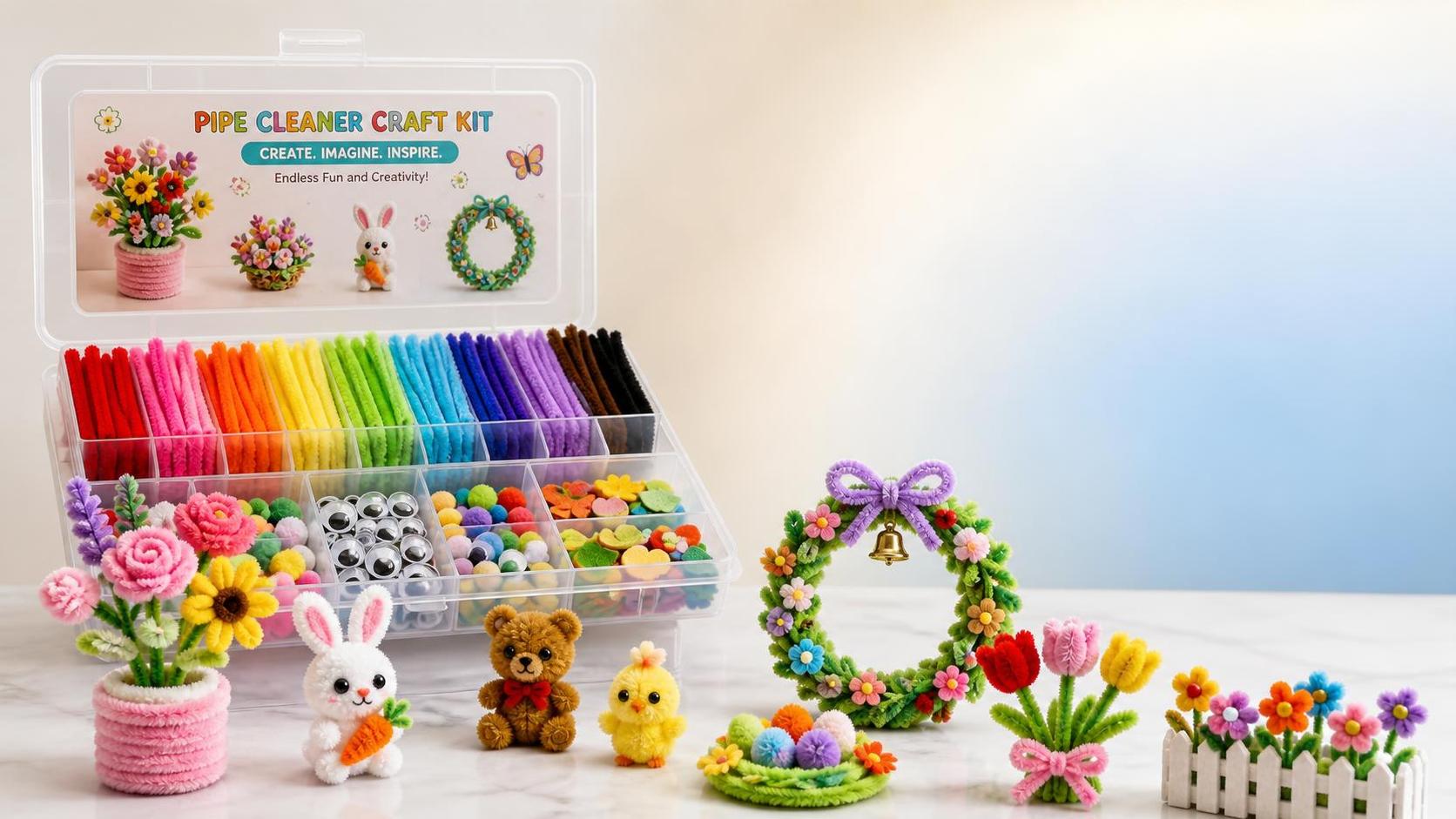
Reliable pipe cleaner craft kits depend on small details that are easy to overlook: wire flexibility, fiber coverage, color consistency, pack organization, and the way individual components arrive after transit. In classroom art projects, seasonal home decorations, model making, and hands-on learning activities, a kit must be easy to open, sort, shape, and store. A mixed assortment that looks appealing in a product image can become frustrating when stems shed fibers, colors transfer, or the wire is difficult to bend into simple forms.
A well-developed Pipe Cleaner Craft Kit Supplier works from the intended activity backward. A basic animal project, a miniature flower arrangement, a hanging ornament, or a decorative wreath may use the same material category, yet each requires a different balance of stem length, wire gauge, plush density, accessory selection, and packaging format. The product specification should describe these working characteristics clearly instead of relying only on a general color photograph or a broad label such as “craft chenille stems.”
Material Construction Shapes the Craft Experience
Most pipe cleaners combine a central metal wire with textile fibers twisted around it. The wire needs enough flexibility for repeated hand shaping, while retaining sufficient memory to hold a loop, spiral, petal, or character form. If the wire is too soft, completed decorations may collapse. If it is too rigid, twisting together several stems can be difficult, especially when projects call for small details such as antennae, legs, bows, or letters.
Fiber coverage matters just as much. Dense, evenly distributed fibers create a soft appearance and reduce the visibility of the metal core. Sparse fibers can expose sharp wire ends after cutting or bending. Uneven trimming may also make colors appear inconsistent, even when the fiber dye itself is stable. For craft kits intended to support decorative projects, a fuller pile generally gives pom-poms, flowers, animals, and garlands a more finished surface.
Common specifications include stem length, diameter, wire thickness, fiber composition, color range, and count per pack. These should be recorded with practical tolerance language where appropriate. Exact dimensions can vary slightly during twisting and trimming, but the kit should remain visually uniform when several stems are placed side by side. A mixed kit may contain standard straight stems alongside metallic, striped, glitter, or neon options; however, these finishes should be separated in the product description because their handling and shedding behavior can differ.
Color Planning Is a Functional Requirement
Color assortment is often treated as a styling decision, but it influences how readily a project can be completed. A pack with many near-identical shades may look rich in a display image while offering limited contrast for shapes, patterns, and labels. Balanced assortments usually include clear primary tones, secondary shades, neutrals, green for leaves and stems, and enough white, black, or brown for facial features and outlines. Seasonal palettes can then be added in dedicated portions rather than replacing the basic colors entirely.
For example, autumn projects may need orange, black, purple, green, and red in visible quantities, while winter ornament activities often depend on white, silver, blue, red, and deep green. When kits include too few of the colors needed for a shared theme, work stops midway through the activity even though plenty of total stems remain. The bill of materials should therefore list each color count rather than stating only an overall quantity.
Color transfer should be considered where stems will be handled alongside paper, fabric, unfinished wood, or light-colored surfaces. Dry rubbing tests and ordinary handling observations can reveal whether loose surface fiber or excess dye is likely to create avoidable mess. Storage conditions also matter. Excess heat, moisture, or prolonged pressure can affect pile direction, deform packed stems, or compromise some decorative coatings.
Kit Design Should Follow the Actual Project Flow
A practical craft kit does not need to include every possible accessory. It needs components that work together without creating confusion. Pipe cleaners are often paired with pom-poms, wiggle eyes, felt pieces, wooden shapes, paper cutouts, foam elements, ribbon, string, clips, or simple adhesive materials. Each additional item changes assembly time, packing complexity, and the risk of missing pieces.
Projects involving wire twisting should allow enough stem length for overlaps. A decorative flower may appear to require one stem for the bloom, but a secure structure can require separate stems for petals, a center, leaves, and a wrapped support. Cutting instructions should leave a margin for joining. Designs that use every millimeter of material may be difficult to reproduce consistently when the actual stem length varies slightly between batches.
- A single-project kit can use pre-counted components, reducing sorting time and making the finished result easier to standardize.
- Open-ended assortments work better when color groups are visibly separated and the package can be resealed after use.
- Multi-activity packs need a clear division between shared materials and project-specific pieces, otherwise early activities may consume materials reserved for later ones.
- Decorative add-ons should have a defined purpose. An accessory that does not attach securely or does not suit the project scale creates unnecessary waste.
Packaging can support this workflow. Inner bags, divided trays, paper bands, or labeled compartments can prevent fibers and loose accessories from mixing during transport. A package that is tightly compressed may save volume, but it can leave stems bent into permanent-looking curves. Straightening is usually possible, yet a heavily compressed kit may not look orderly when opened for the first time.
Safety Requires Attention Beyond a General Label
Pipe cleaner craft materials are frequently handled directly, so the surface finish and wire ends deserve close inspection. The cut end of a stem should be covered adequately by the twisted fiber. When stems are cut into short segments, the newly exposed wire can be more noticeable; activity instructions should account for this by directing cut ends inward where possible or by using soft decorative elements to cover joints.
Claims about non-toxicity, age suitability, or material compliance should only be made when supported by relevant product documentation and testing records for the specific item. The same caution applies to glitter, coatings, pigments, adhesives, and plastic accessories. A kit assembled from several components should be assessed as the packaged combination, since a suitable pipe cleaner alone does not establish the status of every included item.
Small parts deserve separate handling in both package design and activity planning. Pom-poms, beads, eyes, clips, and miniature ornaments may be visually useful, but they introduce different supervision and labeling considerations. Strong visual appeal should not obscure the need for a realistic review of component size, attachment method, and intended activity conditions.
Seasonal Crafts Need Compatible Surface Decorations
Pipe cleaners are frequently used to build freestanding or hanging shapes for seasonal displays. Their wire core makes them useful for outlining pumpkins, bats, ghosts, stars, wreaths, and lightweight character forms. When a project includes window or wall decoration, the attachment material should be chosen separately from the pipe cleaner structure. A fuzzy stem is effective as a frame or hanging element, but it does not adhere reliably to glass by itself.
For a Halloween display activity, reusable soft TPR gel decorations may complement handmade pipe cleaner figures when applied to clean, smooth windows or other compatible surfaces. The colorful motifs in Halloween Window Gel Clings Ghost Pumpkin Bat Witch Cat Boo Blood Decal Stickers for Halloween Home Party Window Decorations can be placed as a separate background element while pipe cleaner shapes add dimensional detail around the display. Surface compatibility, removal instructions, and storage conditions should be considered before combining materials. Gel clings may be reusable when kept clean and stored properly, but dusty surfaces or textured finishes can reduce their adhesion.
This type of mixed-media project illustrates why kits benefit from a defined creative boundary. If the goal is a tabletop craft, hanging elements and reusable window decals may need separate packaging. If the goal is a display set, the contents should identify which pieces are structural, which are decorative, and which should remain removable. That distinction prevents a temporary gel decoration from being used as a load-bearing attachment point.
Sampling Should Recreate Real Handling Conditions
A pre-production sample can confirm appearance, but a useful review also examines practical use. Bend several stems into tight circles and repeated twists. Cut a few pieces to observe the exposed ends. Compare colors under ordinary indoor lighting. Remove stems from the pack to see whether fibers pull free or whether the bundle has been overly compressed. If accessories are included, assemble the intended project rather than judging the pieces individually.
It is also sensible to open more than one inner pack where a kit uses mixed colors or multiple components. A single sample may not reveal an inconsistent count, a color allocation error, or a packaging configuration that makes a shared activity difficult. Carton packing should protect the kit from crushing while avoiding empty space that allows items to shift excessively. Moisture protection may be appropriate when paper instructions, fabric elements, or wooden components are included.
Artwork, instruction sheets, barcode placement, warning text, and carton marks should be finalized before mass packing begins. Late revisions can create mixed packaging versions within one shipment. Clear file control is particularly important when the outer package shows a specific color selection or a sample project that depends on exact included components.
Common Specification Gaps
One frequent mistake is specifying only the total number of stems. A kit described as containing many pieces may still lack enough of a particular color to complete its featured activity. Another is approving a sample based on softness alone, without testing whether the wire retains a shape after several bends. Glitter finishes can also appear attractive in a flat image but may create loose particles or uneven coverage during handling.
Instructions can introduce their own problems. Steps that assume glue, scissors, rulers, or hanging hardware are available should state those requirements clearly if they are not included. A pictured craft should not imply that an accessory is supplied when it is only shown as a styling prop. For home decor crafts, this distinction matters because display quality often depends on small extras such as string, adhesive dots, backing cards, or supports.
Another avoidable issue is treating storage as an afterthought. Pipe cleaners retain shape well, which is useful once a craft is assembled, but packed stems can also keep unwanted bends. Resealable packaging, a rigid insert, or a reusable box can make remaining materials more manageable between activities. Finished crafts should be kept dry and away from crushing pressure, especially when combined with paper, fabric, or lightweight wood elements.
From Specification to Repeatable Supply
Consistent craft kits begin with a controlled reference sample and a concise specification that links every visible feature to a measurable or inspectable requirement. The document can identify the stem dimensions, color allocation, finish type, accessory count, packing method, artwork version, and carton configuration. It should also state which details may vary naturally, such as minor fiber direction, and which are not acceptable, such as exposed wire, incomplete packs, major color mismatch, or broken accessories.
During assembly, component counting and color sorting should occur before the final seal. Final inspection is more useful when it includes both packed-kit checks and individual-material checks. Carton review then confirms that the finished kits are protected for handling and transport. This sequence keeps material quality, project usability, and presentation connected instead of treating them as unrelated tasks.
Pipe cleaner craft kits succeed when the materials support the intended decoration without forcing workarounds. A balanced color mix, dependable fiber coverage, workable wire, sensible accessory choices, and packaging that preserves order create a kit that remains practical from opening through assembly and storage.
Leave A Message
If you are interested in our products and want to know more details, please leave a message here, we will reply you as soon as we can.

We specialize in supplying home decor, handicrafts, and daily necessities.


