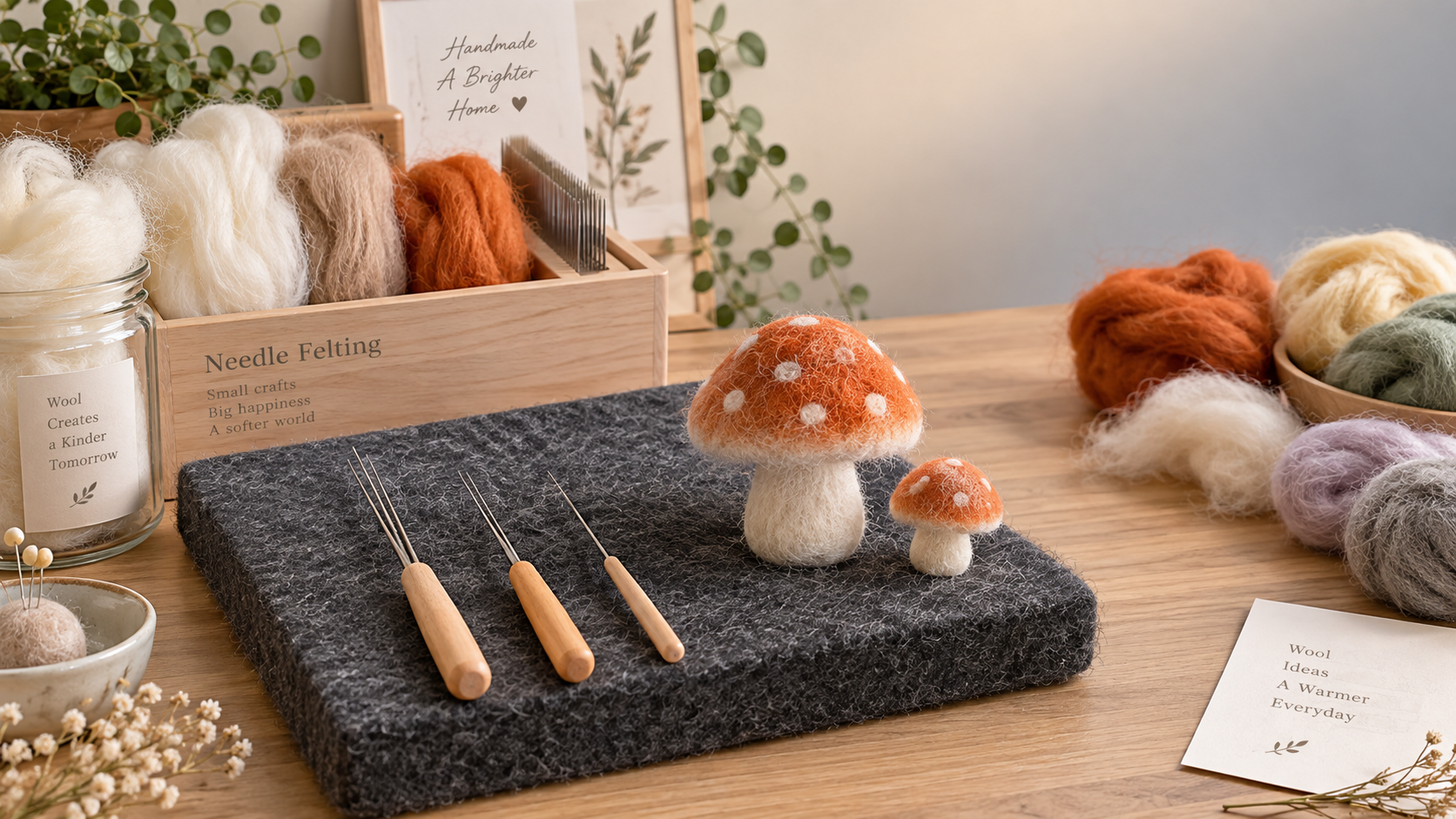
A needle felting kit works when its parts are matched to the density, scale, and surface quality of the intended piece. Loose wool becomes firm because a barbed needle repeatedly carries fibers inward, where they tangle and lock together. That simple action produces very different results when the needle gauge, fiber preparation, working mat, and shaping sequence change. A coarse needle can build a compact base quickly, while the same needle can leave visible punctures on a small ornament. Fine detail wool may create a clean surface, yet it becomes slow and frustrating if it is expected to form the structural core.
Needle Selection Controls Speed and Surface Quality
Felting needles are commonly identified by gauge and by the arrangement of their barbs. As gauge increases, the needle becomes finer. Lower-gauge needles have a wider shaft and larger barbs, moving more fiber with each insertion. They are useful during early shaping, especially for rounded forms, dense pads, and larger decorative objects. Their tradeoff is a more pronounced needle mark and a higher chance of disturbing a refined outer layer.
Fine needles are suited to closing the surface, attaching thin color layers, and defining features such as leaf veins, small petals, eyes, or lettering. They compact less wool per stab, so using one from the beginning extends the work without improving the internal structure. A reliable sequence starts with a coarse or medium needle for bulk, moves to a medium needle once the outline holds its form, and reserves a fine needle for final smoothing.
Needles break most often because the shaft enters at an angle and is pulled sideways while still embedded. The correction is mechanical: insert and withdraw on the same line, then reposition before the next stroke. This matters near armatures, seam joins, and firm spots where resistance changes suddenly. A needle that feels stuck should be withdrawn carefully rather than twisted. Replace a needle when it bends, rusts, loses barbs, or requires noticeably more force than a comparable new needle.
Choose Wool by Its Job, Not by Color Alone
Wool differs in staple length, crimp, preparation, and fiber thickness. These characteristics affect both the rate of felting and the finish. Carded wool has fibers arranged in mixed directions. It is airy, easy to pull apart, and effective for building volume. Its irregular orientation gives the needle many crossing fibers to catch, making it a practical core wool for ornaments, figurines, and dimensional home accents.
Combed top has long fibers aligned in one direction. It is useful for clean bands of color, hair-like details, and controlled surface layering. Before attaching it, pull off a small amount and loosen it slightly; placing an intact dense strip onto a form often creates a ridge with poorly anchored edges. Fine merino creates a soft, refined appearance, but its short, delicate fibers can be less forgiving when substantial bulk is required. Coarser wool often forms a stable base more quickly and can be covered later with a finer decorative layer.
- Use inexpensive carded wool inside pieces that need volume, such as balls, fruit shapes, small houses, or padded hanging ornaments.
- Select a wool color close to the final surface when the finished layer will be thin; a dark core can show through pale fibers after repeated needling.
- Reserve bright, clean combed wool for visible motifs, where color edges and direction matter more than rapid compression.
- Keep fibers dry and free from oil, adhesive residue, or embedded plant matter. Contamination interrupts felting and can leave a permanent dark speck on light-colored work.
Fiber quantity is often misjudged at the start. A loose bundle loses considerable volume as air is removed and fibers interlock. Rather than estimating from the desired finished size alone, form a deliberately oversized, loose core and reduce it in stages. Stop compacting when the piece holds its intended outline and resists gentle squeezing without becoming stone-hard. Over-felting makes it difficult to insert later details, reshape a curve, or create a soft decorative feel.
The Mat Must Protect Both the Needle and the Form
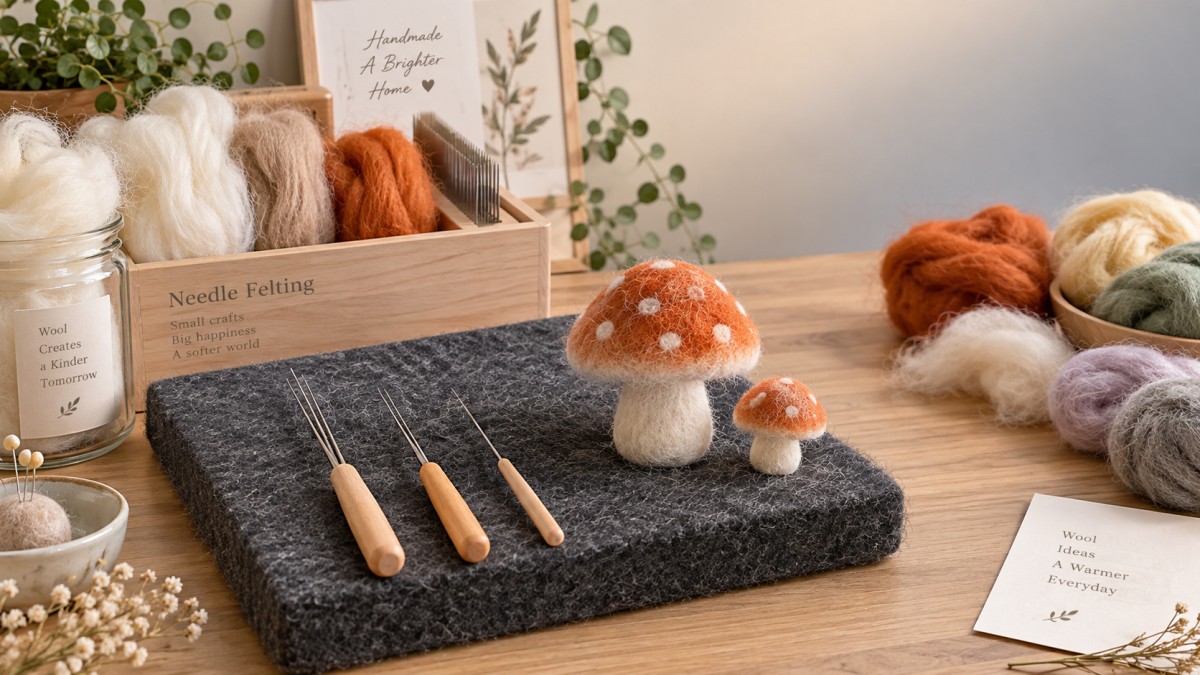
A felting mat provides resistance beneath the wool while leaving enough space for the needle point to pass through. Dense foam mats are widely used for general shaping because they are stable and inexpensive, but repeated work creates grooves. When the working area becomes deeply pitted, wool can catch in the damaged surface and pull apart during lifting. Rotate the mat regularly and replace it when the surface no longer releases fibers cleanly.
Brush-style mats reduce snagging because the needle travels between bristles rather than into a solid foam base. They are useful for flat appliques, thin sheets, and pieces that need a clean underside. The softer support also reduces accidental flattening. However, a brush mat is less stable for forceful sculpting of a dense ball or a narrow upright form. For those operations, a firm foam block or a shaped felting pad gives better control.
Mat size should reflect the project rather than the size of the kit box. A small pad is adequate for brooch-sized motifs, but a wall hanging, garland component, or wide flat panel needs a surface that supports the entire work area. Hanging unsupported wool over the edge encourages uneven compression. Keep the mat on a flat table, not on a lap or cushion, and ensure fingers remain outside the needle path. Finger guards reduce puncture risk during close detail work, though their bulk can make tiny placements less precise.
Build Dimensional Projects From the Inside Out
For a compact home decor object, begin with the hidden form. Roll carded wool into a loose ball, cylinder, or teardrop, then felt the outer surface lightly while turning the form after every group of strokes. Rotation prevents a flat side from developing unnoticed. Once the outline becomes stable, inspect it from several angles under consistent light. A form that looks symmetrical from above may still lean or bulge when displayed on a shelf.
Separate pieces should be attached before the final surface is fully hardened. Place a small amount of loose fiber across the joint, felt into the main body, then felt into the added component. The bridging fiber creates a mechanical connection. Pressing a finished limb or petal against an already dense surface without bridge fibers creates a weak join that can detach during handling.
Surface Layers and Detail Placement
Apply decorative wool in thin, overlapping wisps. Start at one edge and tack the fibers down with shallow strokes, then work inward. Deep stabbing at this stage drives the color into the core, dulling the outline and leaving the surface uneven. When adding circles, stripes, or floral details, lightly mark their position with arranged fibers before compacting. Correcting a misplaced dark feature after it has been driven into pale wool often requires removing surrounding fibers and rebuilding the area.
For flat decorations, felt the reverse side briefly after the front has begun to hold together. This locks fibers through the thickness and reduces curling. If an applique will be sewn onto fabric, leave the back slightly softer so the needle can pass through without cracking a dense edge. If it will be glued onto wood, clean and dry the receiving surface first, then use an adhesive appropriate for textile-to-wood bonding after the felting is complete.
Project Guides Should Specify the Finish Condition
A useful project guide defines more than a shape and color palette. It should identify whether the final object is intended to be soft, firm, freestanding, flat, or mounted. A soft felted garland ball can tolerate a slightly irregular core; a freestanding mushroom or house ornament needs a denser base and a stable contact point. A guide for a seasonal window display may combine felted ornaments with removable visual elements. For example, Wholesale OEM ODM Custom Four Seasons Holiday Gel Window Stickers, Personalized Pattern Size Gel Clings for Spring Easter Valentine’s Day St Patrick’s Day Halloween Thanksgiving Fall Christmas Party Home Decor can be paired with felted hanging pieces when temporary, washable TPR window decoration is desired alongside tactile wool accents.
Before repeating a design, record the wool preparation, needle sequence, approximate finished density, and attachment method. A photograph alone does not reveal whether a shape was built over a core, compressed from carded wool, or reinforced with a hidden armature. These production details determine whether a later piece matches the original in stiffness, proportion, and surface finish.
Store needles in a closed holder, keep wool separated by color and fiber type, and remove loose wool from the mat after each session. A clean kit preserves the most important working feedback: the feel of the needle entering the fiber, the resistance of the form, and the moment when a surface has become finished rather than merely compacted.
Leave A Message
If you are interested in our products and want to know more details, please leave a message here, we will reply you as soon as we can.

We specialize in supplying home decor, handicrafts, and daily necessities.


