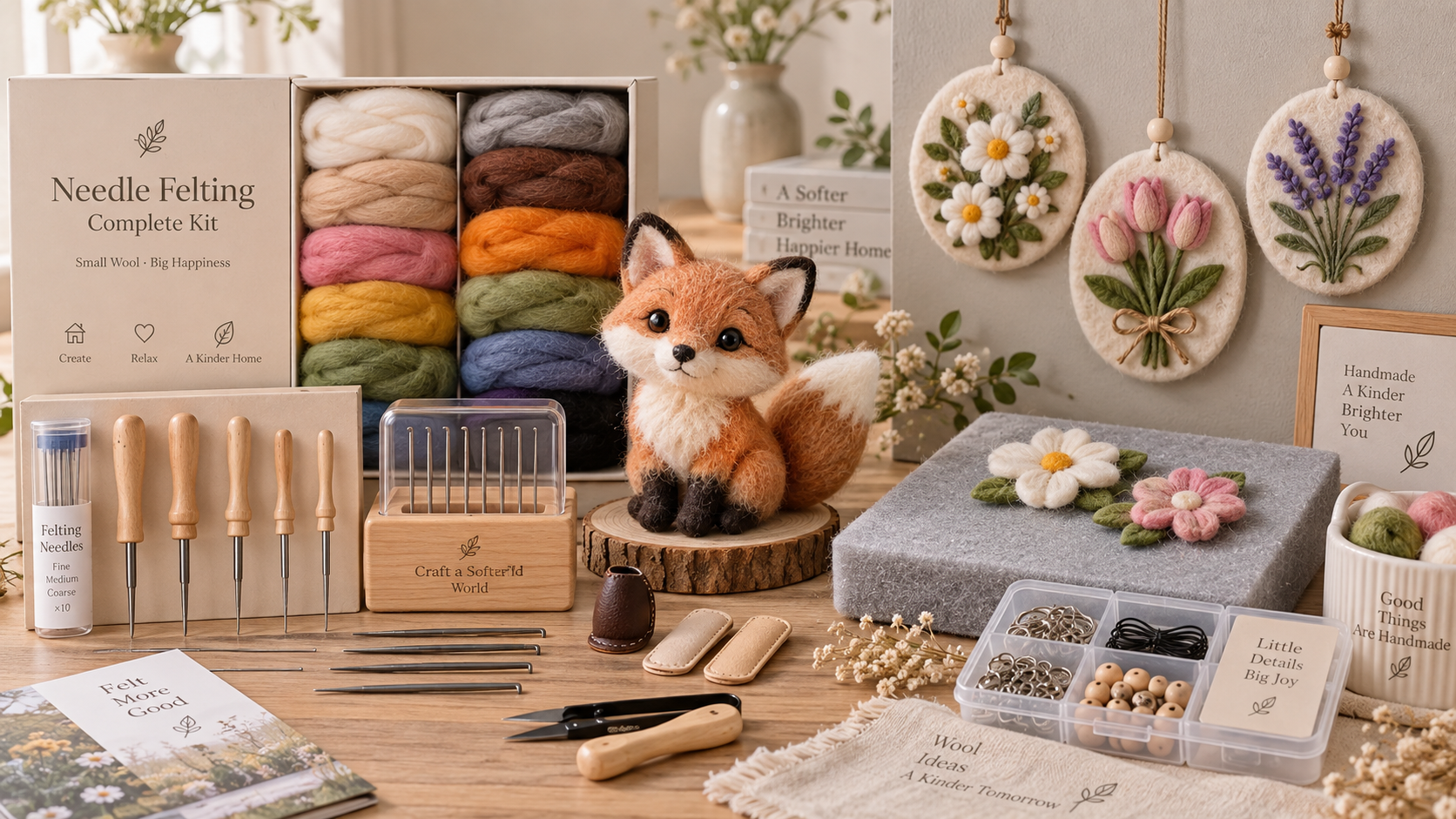
Selecting a Needle Felting Kit for Detailed Animal Figures or Flat Decorations
Choosing the right needle felting kit makes refined animal figures and flat decorations easier to create, with cleaner details, stronger shapes, and more consistent results.
For users and operators, the best choice depends less on packaging and more on project complexity, wool quality, needle selection, working surface, and safety features.
A suitable kit should support the way you work, whether you are shaping a small fox ornament, making a flat floral plaque, or producing seasonal decor.
Start With the Type of Decoration You Want to Make
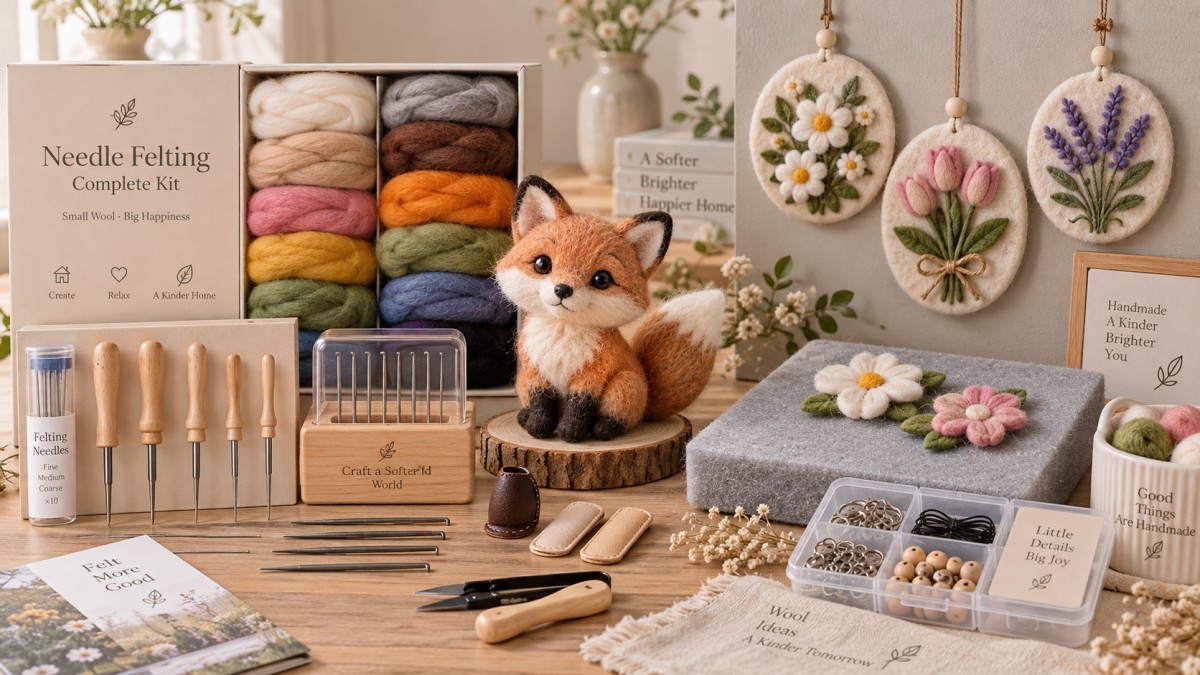
Before buying a needle felting kit, decide whether your main projects will be three-dimensional animal figures, flat appliques, ornaments, or mixed-media home decorations.
Detailed animal figures require more shaping control because operators build volume, define body parts, blend colors, and refine small areas around faces, paws, ears, and tails.
Flat decorations are usually easier for beginners because wool is felted directly into a shallow shape, backing fabric, felt sheet, or pre-cut decorative base.
For flat work, prioritize enough wool colors, a stable foam pad, and needles that can cover broad areas without damaging delicate fibers.
For dimensional animals, choose a kit with several needle gauges, sufficient core wool, fine finishing wool, and tools for holding tiny components securely.
Operators making both styles should avoid overly basic kits containing one needle type and limited wool, since those sets quickly restrict creative control.
Choose Needles Based on Shaping, Detailing, and Speed
Felting needles are the most important working tools in any needle felting kit because their barbs interlock wool fibers and gradually create a firm structure.
Coarse needles work faster when building a core shape, compressing larger wool sections, or joining separate pieces such as heads, bodies, wings, and legs.
Fine needles are better for facial details, color blending, smoothing surfaces, and working around narrow areas where aggressive felting can leave visible holes.
A practical kit should include multiple replacement needles because needles can break when inserted at an angle, especially during detailed work on compact shapes.
Single-needle tools offer excellent control for small animal features, while multi-needle holders speed up flat decorations, backgrounds, and larger decorative panels.
Look for clearly labeled needle sizes or types, rather than anonymous tools, because operators need predictable performance when repeating designs or training new users.
Assess Wool Quality Before Considering the Number of Colors
A large color assortment may look attractive, but wool quality matters more than quantity when you need crisp forms, smooth surfaces, and stable finished decorations.
Carded wool, often called roving, is commonly used for needle felting because its loose fibers felt efficiently and can be shaped with gradual control.
Core wool is especially useful for animal figures because it creates volume economically before a thinner layer of colored wool is applied for the visible surface.
Fine decorative wool should have reasonably consistent fiber length and color, helping users create even coatings, controlled gradients, and recognizable animal markings.
Avoid wool that feels excessively oily, tangled, or unevenly processed, since it can slow felting, create lumpy surfaces, and make precise color placement difficult.
For repeat home decor projects, select kits with labeled colors or refill options, allowing operators to recreate popular ornaments without guessing at shades.
Make Sure the Working Surface Fits the Project Size
A firm but forgiving felting pad protects needles and supports even penetration, making it essential for both safe operation and clean-looking finished work.
Foam pads are common in starter kits, but they can compress over time and may shed small particles after extensive use.
Brush-style mats provide a useful alternative for delicate flat pieces because fibers are less likely to become deeply embedded during repeated needle punching.
For detailed animal figures, a medium-density foam block often provides better stability while you rotate the piece and shape curved surfaces from different angles.
Choose a pad larger than your expected design area, particularly for flat decorations, because working near an edge increases the chance of bent needles.
Keep the pad clean and replace it when it becomes deeply pitted, uneven, or contaminated with mixed fibers that could transfer unwanted colors.
Check for Safety Tools That Support Longer Craft Sessions
Needle felting requires repeated vertical motion with extremely sharp needles, so safety accessories are practical requirements rather than unnecessary extras for regular operators.
A needle holder with a protective grip improves comfort and reduces accidental slips, especially when working for extended periods on small detailed components.
Finger guards made from leather, rubber, or similar protective materials are valuable when holding tiny ears, noses, leaves, or ornament edges close to the needle.
Beginners should practice placing fingers behind the working area, maintaining vertical needle movement, and stopping before rotating a piece to avoid snapped needles.
For shared workspaces, classrooms, or home craft sessions, store needles in a closed case and keep replacement needles separated from loose wool materials.
A well-organized kit helps operators focus on shaping rather than searching for tools, reducing interruptions during color blending and delicate finishing work.
Look for Accessories That Add Real Decorative Value
Useful accessories should support the finished decoration rather than simply increase the apparent size of the kit with items that receive little practical use.
Animal figure projects benefit from glass eyes, small noses, wire, thread, and basic sculpting tools, provided these parts are appropriate for the intended display setting.
Flat home decor pieces may need felt backing, hanging cords, embroidery hoops, fabric bases, or small frames to transform wool artwork into usable decorations.
Seasonal displays often combine handmade textures with simple removable accents, such as Christmas Gel Window Clings - Xmas Santa Claus Snowman Snowflake Penguin Christmas Tree Gift Window Stickers for Kids for smooth glass surfaces.
These reusable soft TPR decorations can be removed and stored after celebrations, while needle-felted ornaments add a tactile handmade element to the same home, classroom, or party display.
When selecting accessories, consider whether the completed item will be hung, displayed on a shelf, attached to a wreath, or handled by children.
Match the Kit to Your Skill Level and Production Needs
Beginners generally need a focused needle felting kit with clear essentials, since too many unfamiliar tools can make the first projects feel unnecessarily complicated.
A beginner-friendly set should provide enough wool for practice, several needles, a pad, simple instructions, and at least one achievable decorative project.
Intermediate users should choose greater flexibility, including extra wool colors, replacement needles, shaping aids, and materials suitable for creating original animal designs.
Operators producing decorations for small events, retail displays, or repeated seasonal projects need refillable materials and tools that perform consistently across batches.
In these situations, standardizing wool colors, needle types, and pad sizes makes training easier and helps maintain a more uniform appearance across completed pieces.
Do not rely solely on project photos when evaluating a kit, because attractive images do not confirm needle durability, wool weight, or accessory usefulness.
Use a Simple Checklist Before Buying
Choose a kit only after confirming that its contents match your preferred project type, expected skill level, working frequency, and desired finishing quality.
For detailed animals, check for core wool, fine needles, replacement needles, sufficient color variation, eye accessories, and a stable pad for three-dimensional shaping.
For flat decorations, prioritize broad felting coverage, durable backing options, usable color combinations, and a surface large enough for the intended design.
Also check material safety when projects may be used around children, displayed in shared spaces, or incorporated into household decorative arrangements.
Conclusion
The best needle felting kit is not necessarily the largest set; it is the one that gives you reliable wool, suitable needles, safe handling, and useful accessories.
Choose tools according to whether you create sculpted animal figures or flat decorative designs, then invest in quality materials that make each finished piece cleaner and longer-lasting.
Leave A Message
If you are interested in our products and want to know more details, please leave a message here, we will reply you as soon as we can.

We specialize in supplying home decor, handicrafts, and daily necessities.


