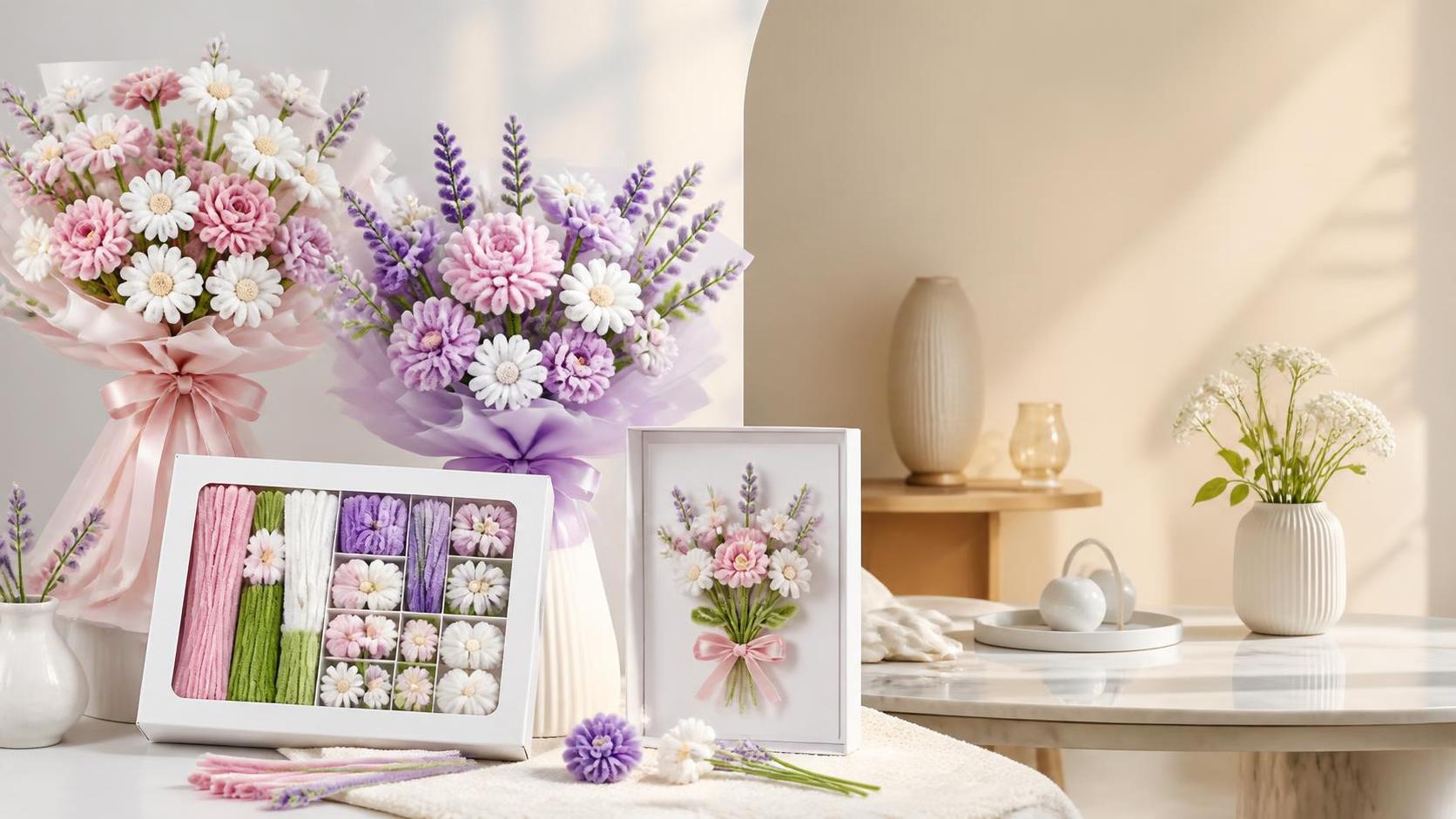
Pipe Cleaner Craft - Flower Bouquet Kits
Pipe cleaner flower bouquet kits sit in an interesting place within home decor. They are not expensive, not complicated, and not purely seasonal, yet they solve a real retail problem: how to offer a decorative craft item that feels giftable, display-friendly, and easy for end users to understand at a glance.
That matters more than it may seem. In craft and home decoration categories, products often fail not because the idea is weak, but because they are either too hard to assemble, too childish for adult buyers, or too decorative to justify repeat sell-through. A well-designed pipe cleaner bouquet kit avoids some of these traps. It combines the appeal of handmade flowers with a low learning threshold, compact packaging, and broad placement options across gift shops, variety retailers, hobby chains, and seasonal displays.
For buyers looking at this category seriously, the question is usually not whether pipe cleaner crafts are “cute.” The real question is whether the kit can move reliably in retail, whether quality stays consistent order after order, and whether the style fits actual home decor preferences rather than only children’s craft shelves.
Why bouquet kits travel well across retail formats
Flower bouquet kits have a built-in advantage: the finished result looks familiar and presentable. A customer does not need much explanation to understand what they are buying. Compared with abstract DIY sets, bouquets are visually direct. They can be marketed as room accents, handmade gifts, party favors, holiday fillers, or quiet weekend craft projects.
Pipe cleaners also make the product more accessible than many other craft materials. They are flexible, lightweight, and forgiving. If the intended market includes families, beginners, or casual hobby users, that ease of use matters. For retailers, ease of use often translates into fewer complaints about difficulty and fewer abandoned projects after purchase.
There is also a practical merchandising benefit. Bouquet kits can be styled in soft pastels for spring, brighter tones for children’s gifting, or more muted palettes for home decor channels. The same basic format can be adapted without changing the product logic entirely. That gives buyers room to test different visual directions while keeping sourcing relatively manageable.
What buyers should check before choosing a supplier
The first thing to look at is not just appearance, but kit completeness. In this category, missing or confusing components quickly damage the user experience. A bouquet kit should make clear what is included, how many stems or decorative parts can be made, and whether wrapping, ribbon, or display accessories are part of the set or only shown for presentation.
Material consistency is the next issue. Pipe cleaners vary more than many buyers expect. Thickness, wire flexibility, fiber density, and color uniformity all affect the final look. If the wire is too stiff, shaping becomes frustrating. If it is too soft, flowers lose form during handling or transport. For a home decor product, that difference shows up immediately on shelf.
Packaging deserves equal attention. Retailers often want a kit that is easy to display, but compact enough for efficient shipping. A bulky window box may look attractive, yet it can increase freight cost and complicate carton planning. In many projects, the right balance is a pack that protects shape, explains the craft clearly, and still supports stable outer carton loading. This usually needs to be judged case by case.
Supply chain matters more than trendiness
Craft products are often treated as trend-driven items, but stable execution is what keeps them commercially useful. A supplier with only one narrow production line may struggle when a bouquet kit requires mixed materials, gift packaging, or coordinated decorative accessories.
This is where a broader manufacturing base becomes practical rather than cosmetic. Located in Ningbo, a city long associated with foreign trade, our company operates two certified factories: one focused on handicrafts and another on wooden and fabric crafts. We also work closely with certified partner manufacturers in ceramics, plastics, and handwoven products, many of them approved by major European and American retail chains. For buyers, that kind of network can reduce friction when a project grows beyond a single simple item and becomes part of a wider home decor collection.
A bouquet kit may begin as a standalone SKU, but retailers often want matching seasonal accents, tabletop pieces, soft craft accessories, or giftable DIY sets that share a visual language. A stable multi-category supply chain makes those transitions much easier.
Where pipe cleaner bouquets fit in a broader craft assortment
One mistake buyers sometimes make is evaluating these kits in isolation. They are usually stronger when positioned as part of a layered craft offering. A retailer that already sells felt craft sets, wool kits, seasonal ornaments, or beginner DIY gifts can use bouquet kits as a lower-barrier entry point.
That cross-category logic is visible in adjacent products too. For example, beginner-friendly decorative craft sets such as Christmas Tree Poodle Dog Needle Felting Kit, DIY Wool Felt Craft Set with Tools, Foam Mat & Instructions, Beginner Friendly Animal Doll Kit, Handmade Holiday Decor or Gift for Dog Lovers, Christmas Crafts show how end users respond to complete, approachable kits that produce a display-worthy result. Although needle felting and pipe cleaner bouquet making are different crafts, the same buying logic applies: people want a project that feels achievable, attractive, and giftable without requiring advanced skills or a long tool list.
That is why the most successful bouquet kits are rarely the most complicated ones. They are usually the ones with a clean concept, coordinated colors, and instructions that do not intimidate the user.
Common risks that are easy to overlook
There are a few practical risks worth checking early.
One is age positioning. Pipe cleaner kits can look child-oriented even when the intended market is broader. Color selection, bouquet styling, and packaging language all influence whether the product reads as kids’ craft, teen hobby, or tasteful home decor DIY. If that positioning is unclear, the item may land awkwardly between departments.
Another is instruction design. In low-complexity kits, buyers sometimes underestimate how much clear guidance matters. A simple kit with poor instructions can perform worse than a slightly more advanced kit that is well organized. This becomes especially important for export projects, where local language adaptation, symbols, and warning text may need to be confirmed against the destination market’s requirements.
The last risk is visual mismatch between sample and mass production. Handcrafted-looking products live or die by finishing details. If petal shapes, stem lengths, or accessory colors vary too much, the bouquet may lose the polished look that made the sample appealing in the first place.
A realistic way to evaluate the category
Pipe Cleaner Craft - Flower Bouquet Kits are not a miracle product, and they do not need to be. Their strength is simpler than that. They offer an accessible craft experience, a finished piece that works in home decor and gifting, and enough design flexibility to support different retail moods through the year.
For buyers, the better approach is to assess them as a commercial craft format: material feel, assembly clarity, packaging efficiency, style alignment, and supply reliability. If those elements are handled well, bouquet kits can be a dependable part of a home decor assortment rather than just a short-lived novelty.
And if the project is meant to sit alongside other handmade decor lines, it is worth confirming early how far the supplier can support adjacent categories, seasonal extensions, and mixed-material development. That is often where a good-looking item turns into a workable long-term program.
Leave A Message
If you are interested in our products and want to know more details, please leave a message here, we will reply you as soon as we can.

We specialize in supplying home decor, handicrafts, and daily necessities.


