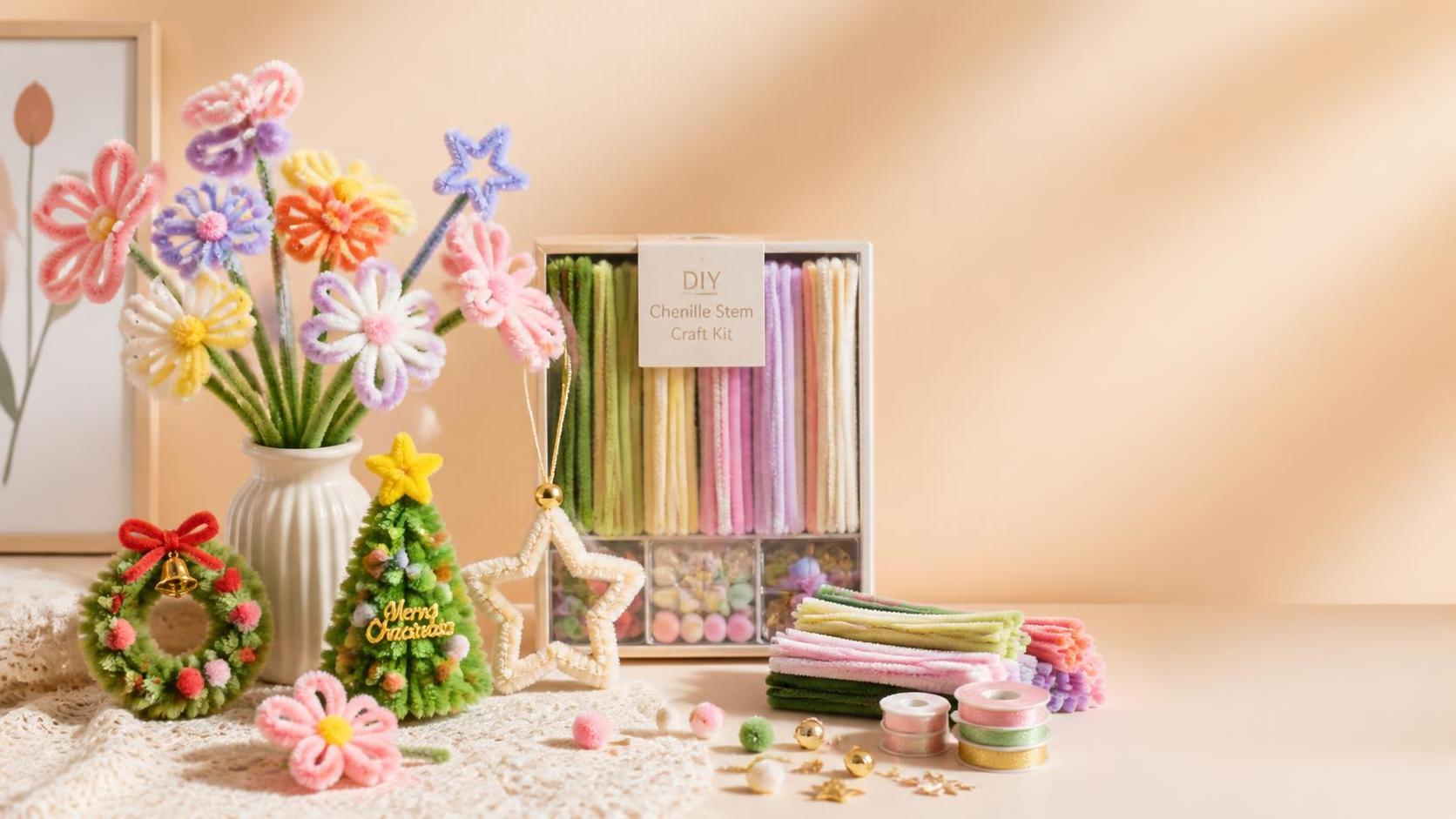
If you’ve ever wondered, “What is another name for a pipe cleaner craft?”, you’re not alone. In home decor and DIY circles, pipe cleaners are also widely known as chenille stems, valued for their flexibility, bright colors, and creative potential. From seasonal ornaments to handmade decorative accents, these simple craft materials inspire endless ideas for stylish, affordable, and charming home decoration projects.
That simple vocabulary difference matters more than it seems. In consumer retail, education, hobby crafting, and home decoration supply chains, the term “pipe cleaner” is common in everyday language, while “chenille stem” is often the preferred commercial or catalog term. For importers, sourcing teams, and product developers, understanding that these names usually refer to the same material helps avoid confusion in supplier communication, product searches, and assortment planning.
Pipe cleaner craft and chenille stem craft usually mean the same thing
In most craft-related contexts, a pipe cleaner craft is another way of saying a chenille stem craft. The material is typically made from wire wrapped with soft fibers, creating a fuzzy, bendable stick that can be twisted, looped, or shaped by hand.
The older term “pipe cleaner” came from the material’s original practical use, but in today’s decorative market, it is primarily a craft supply. That is why wholesalers, retailers, and professional sourcing catalogs often use “chenille stems” instead. The latter sounds more product-neutral and better reflects its role in arts, gifts, and seasonal decor rather than smoking accessories.
For buyers working across regions, both names are still active in the market. North American retail listings frequently use “pipe cleaners” because that is the phrase consumers type into search bars. Trade suppliers and factory-side documentation may lean toward “chenille stems.” In practical terms, the naming difference is not about product function; it is about channel language.
Why the naming matters in home decor and seasonal craft business
For home decor businesses, the question is not just linguistic. It affects sourcing efficiency, merchandising, and even product positioning.
A business developing DIY kits, children’s craft lines, party decorations, or seasonal ornament packs needs to know how the end market searches for materials. A consumer may want “Halloween pipe cleaner spiders,” while a supplier database may classify the same raw material under “chenille stems.” If teams do not recognize the overlap, they may miss vendors, duplicate sourcing work, or misunderstand product specifications.
This is especially relevant in cross-border trade. Manufacturers in China and other export centers often produce for multiple retail systems at once. One buyer may request “metallic chenille stems,” another may ask for “glitter pipe cleaners,” and a third may describe only dimensions and colors. The successful supplier is the one who translates naming differences into clear production requirements: wire gauge, stem length, fiber density, colorfastness, packaging format, and compliance needs.
Where chenille stem crafts fit in the current decor market
Chenille stems remain a low-cost, high-flexibility material, which gives them surprising resilience in the home decor and hobby market. They are widely used in:
- seasonal ornaments and wreath embellishments
- children’s room decorative projects
- DIY party accessories
- floral and miniature craft details
- school and family activity kits
- holiday figurines and handmade gift toppers
What keeps the category relevant is not material sophistication, but ease of use. Consumers do not need tools, technical skill, or large budgets. For retailers, that supports impulse purchases and repeat seasonal demand.
In the home decoration sector, chenille stem crafts are rarely sold as premium standalone decor. Their value is stronger in interactive decoration: craft kits, family activities, classroom projects, party preparation, and temporary seasonal styling. That distinction matters for assortment planning. Businesses expecting high-ticket decorative value may be disappointed; businesses targeting creativity, participation, and seasonal turnover are more likely to see stable demand.
Common misunderstandings buyers should avoid
One common mistake is assuming all chenille stems are interchangeable. They are not. Material quality varies widely, especially in imported bulk supply. Differences can appear in wire strength, fluff density, shedding, color consistency, and bend retention. For decorative applications, these details affect whether the final item looks clean and durable or cheap and misshapen.
Another mistake is treating the category as relevant only to children’s crafts. In reality, chenille stems are often integrated into broader seasonal decoration programs, including wreath accents, tabletop DIY kits, gift-wrap accessories, and retail craft bundles. Their role may be secondary, but it is commercially useful.
A third misunderstanding is overlooking compliance and safety expectations. If a product is intended for children, decoration kits, or mass retail channels in Europe or the United States, the compliance requirements may go beyond the basic raw material description. Exact requirements depend on the product form, age grading, and market destination, so buyers should confirm applicable testing and labeling obligations with suppliers and compliance teams rather than assuming a generic craft item is automatically acceptable.
What procurement teams should check before placing orders
When sourcing chenille stem craft materials or finished DIY craft sets, procurement teams should focus less on name and more on execution details. Useful checkpoints include:
- length and diameter tolerance
- wire flexibility and break resistance
- fiber coverage and shedding level
- color assortment consistency across batches
- packaging suitability for retail or kit assembly
- applicable testing, especially for children-oriented items
- factory capability for seasonal volume peaks
Seasonality is particularly important. Chenille stems are often tied to Halloween, Christmas, Easter, and back-to-school promotions. Lead time pressure can rise quickly when buyers combine low unit value with high packaging complexity. The raw material itself is simple, but the final commercial product often depends on color sorting, multipack assembly, barcode compliance, and retailer-specific packing rules.
That is why many importers prefer suppliers with broader handicraft coordination ability rather than a single narrow production line. In seasonal programs, mixed-material execution matters. A Halloween assortment, for example, may combine paper, felt, wooden pieces, chenille stems, gel window decorations, and printed packaging in one retail concept.
Products outside the chenille stem category can also complement the same merchandising logic. For example, reusable seasonal decorations such as Halloween Window Gel Clings Ghost Pumpkin Bat Witch Cat Boo Blood Decal Stickers for Halloween Home Party Window Decorations serve a different function, but they appeal to the same customer need: low-cost, easy-to-use, family-friendly seasonal styling. For buyers building a coordinated holiday assortment, understanding these adjacent categories can improve cross-selling and shelf planning.
How naming influences SEO, cataloging, and retail discoverability
For online sellers and content teams, “pipe cleaner craft” and “chenille stem craft” should not be treated as competing ideas. They reflect different search behaviors.
“Pipe cleaner craft” is often stronger for consumer-facing content because it matches everyday language. “Chenille stems” may perform better in professional catalogs, B2B product descriptions, and specification sheets. Businesses that ignore one of the terms may reduce discoverability either upstream in sourcing or downstream in retail search.
The practical solution is simple: use both terms naturally where relevant. Consumer education pages, product descriptions, and sourcing documents should clarify early that chenille stems are also called pipe cleaners. This reduces confusion and improves communication across design, procurement, and sales teams.
Is the category still worth attention?
Yes, but with realistic expectations. Chenille stem crafts are not a breakthrough material category, and they are unlikely to drive premium decor growth on their own. Their commercial strength lies elsewhere: affordability, versatility, strong seasonal fit, and compatibility with craft-based engagement.
For importers and wholesalers in home decor, this makes them useful in three situations. One is when developing entry-level seasonal DIY lines. Another is when assembling mixed-material craft kits for retail programs. The third is when supporting decorative categories that benefit from simple, tactile, family-oriented participation.
So, what is another name for a pipe cleaner craft? In most cases, it is a chenille stem craft. But for business users, the better question is not just what to call it. It is how to classify it, source it correctly, and position it within a decor program that consumers will actually buy. That is where naming stops being a language detail and becomes part of better commercial decision-making.
Leave A Message
If you are interested in our products and want to know more details, please leave a message here, we will reply you as soon as we can.

We specialize in supplying home decor, handicrafts, and daily necessities.


