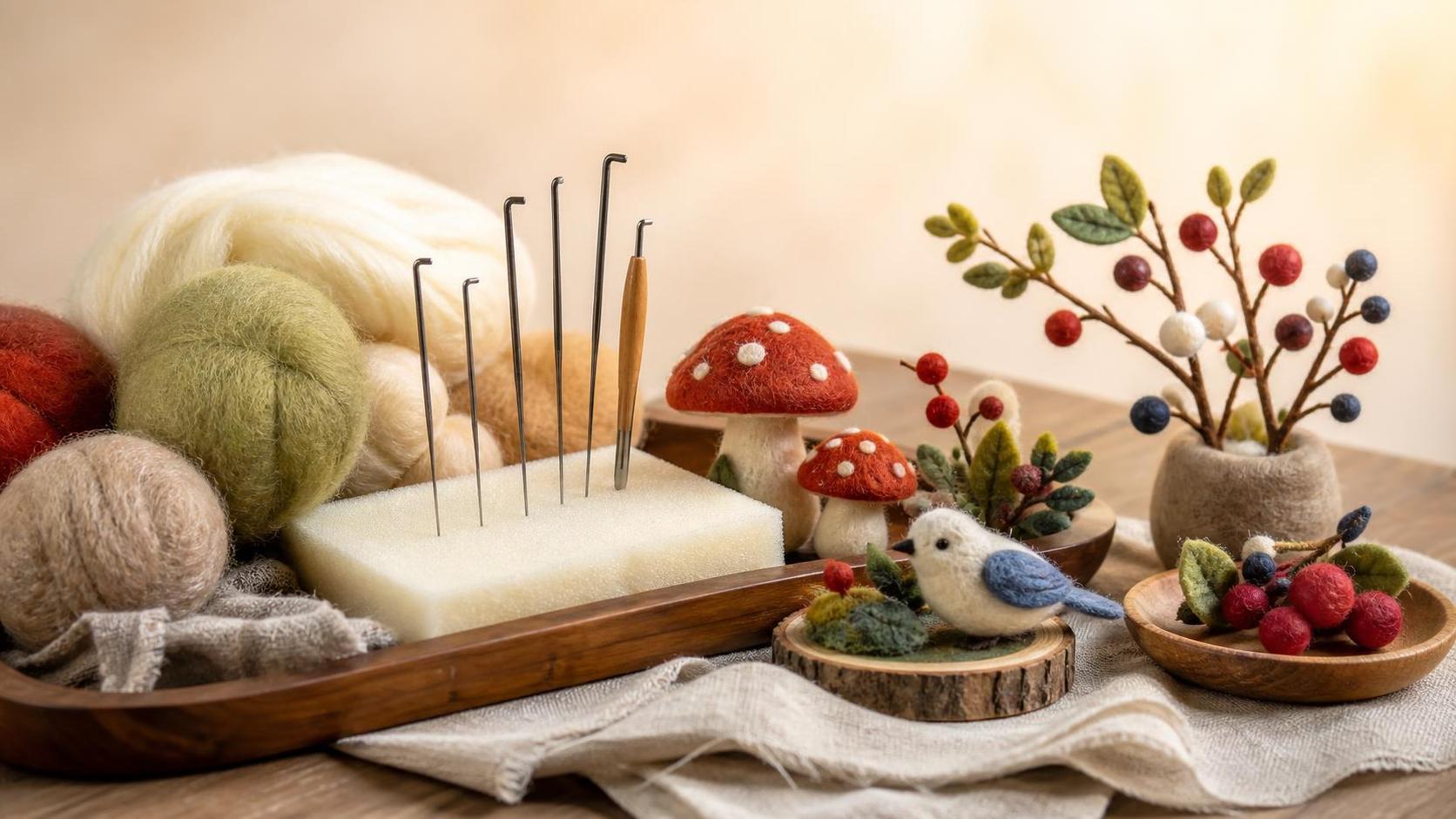
Sculptural needle felting kits are a practical starting point when the goal is to make small decorative objects with shape, surface detail, and enough firmness to display on a shelf, tray, or seasonal table setting. The difference between a flat felted embellishment and a sculptural piece usually comes down to fiber choice, needle selection, and how steadily the core is built. A kit that looks attractive on the outside can still be frustrating if the wool is too short, the needles are poorly matched to the project size, or the colors are bundled without a useful range of values.
Wool is the material that decides most of the working experience. For sculptural work, carded wool is often easier to control than very smooth combed top because it tangles quickly and compresses into shape with less slipping. Coarse wool can be useful for the inside of larger forms, especially if the piece needs volume without using the best finish fiber all the way through. Finer wool gives a cleaner surface, but it may take longer to firm up if the shape is large. Many kits work best when they include a clear division between core wool and outer color wool. Without that separation, beginners often overuse decorative shades in the interior, then run short when it is time to finish visible areas such as petals, ears, fruit, mushrooms, birds, or miniature house accents.
The feel of the fiber matters as much as the color. Wool that is too dry or overly compacted in packaging can be hard to tease apart, and dense clumps tend to leave uneven lumps inside the sculpture. If the wool has been packed tightly for transport, pulling it open gently by hand before felting can restore loft and make layering easier. Clean, evenly dyed fiber is also helpful when the project is meant to sit in a home setting near ceramic vases, wood trays, linen runners, or other tactile decor items where surface quality is easy to notice.
Needles and the shape they produce
Felting needles look simple, yet their gauge and barb arrangement change the pace and finish of the work. A medium needle, often in the 36 or 38 range, is commonly used to build the initial form. It moves fiber inward efficiently and helps establish density. A finer needle, such as 40 or 42, is better for smoothing the outer layer, attaching small details, and reducing visible puncture marks. Star needles and twisted needles can speed up shaping because they catch more fiber, but they may leave a rougher surface if used too aggressively on the outermost layer.
Needles are brittle. That is normal, not necessarily a quality defect. They snap most often when pushed sideways, forced through a form that is already too dense, or used at an angle while the piece is being rotated quickly in the hand. A stable foam pad or brush mat reduces breakage because it supports the needle path. For compact 3D projects, multi-needle handles can save time during the early stage, but they are less precise once the sculpture starts to develop curves and smaller transitions.
Tool sets sometimes include finger cots, awls, scissors, and wire. These extras are useful only when they match the project. Wire armatures can help tall stems, long animal legs, or upright decorative shapes hold position, but they should be fully wrapped and cushioned so the wool does not wear thin around sharp bends. Small embroidery scissors are useful for trimming stray fibers after finishing, although heavy trimming should not replace proper felting because cut ends can create a fuzzy, blunt-looking surface.
Density is where many projects go wrong
A sculptural piece should not feel rock hard immediately. Early layers need enough compression to hold shape, but if the center becomes too dense too soon, later detailing becomes difficult. Needles will resist entering the form, added fibers may sit on the surface instead of bonding, and the finished object can show abrupt seams. Working in thin layers avoids that problem. Build a loose core, compact it gradually, then add color in controlled wraps rather than trying to stab a large tuft into place at once.
Common misjudgment appears in round forms. Crafters often keep turning the piece and felting only the most visible side, which creates an oval even when a sphere was intended. Measuring by touch helps: roll the form between the fingers, identify flat spots, and add a small amount of fiber only where the shape needs correction. This is especially important for decorative fruit, pumpkins, berries, and animal heads used in home decor arrangements.
Color needs value, not just variety
A kit with many bright shades may still be limited if all the colors sit at the same value. Sculptural needle felting relies on light, mid, and dark tones to create volume. A mushroom cap, for example, looks flatter when made from one red. It gains depth when a slightly darker red is tucked into the underside and a muted highlight is added to the top curve. The same applies to leaves, flower petals, miniature birds, and seasonal ornaments.
Natural home decor palettes often work better when they are softened a little. Instead of choosing only saturated primary colors, combine muted greens, warm creams, heathered browns, dusty rose, oat, moss, charcoal, and off-white. These shades sit comfortably beside wood, fabric, ceramic, and handwoven accessories. Small accent colors still matter, but they usually read better when anchored by neutral wool underneath.
- A warm white is more forgiving than a stark optical white, which can make handmade texture look harsh under indoor lighting.
- Green benefits from variation. A leaf made with one flat green may look cut out, while olive, sage, and a touch of yellow-green create a more natural surface.
- Black is useful in very small amounts for eyes, line accents, or shadow, but using too much can make a tiny sculpture appear visually heavy.
Color planning also affects seasonal decor. Spring and garden themes often combine soft green, cream, muted floral tones, and weathered wood finishes. That is one reason sculptural felt projects are frequently displayed near rustic signs or porch accents. A piece such as Wooden Large Vertical Love Grows Here Porch Decor, Garden Welcome Standding Sign Garden Decor Sign, Welcome Wall Sign for Yard Porch Farmhouse Door Decoration pairs naturally with felted flowers, bees, carrots, seedling motifs, or miniature nest forms because the soft green background and farmhouse styling leave room for tactile handmade elements without visual conflict.
Surface finishing changes the final impression
After the main shape is complete, refinement is usually slower than construction. Loose fibers can be laid in the direction of fur, petal growth, or grain-like surface movement, then felted with a fine needle. This is where a sculpture stops looking like a bundle of wool and starts looking intentional. Repeated shallow needling on the outer layer smooths the finish, but overworking one spot may cause dark fibers from the core to migrate outward or create a pitted surface.
If the piece is decorative rather than toy-like, attachments should be tested by gentle pulling. Ears, leaves, stems, wings, and hanging loops need a broad join area. Many failures happen because details are attached only at the visible edge. Wrapping a small draft of matching fiber around the base of the detail and felting that transition into the body gives the join more strength and a cleaner look.
Some sculptural projects are meant to hang on hooks, knobs, wreaths, or wall pegs. In that case, weight distribution matters. A very soft top section can stretch over time if a cord is inserted without internal support. For static shelf decor, this is less of a concern, but for hanging ornaments or mixed-media arrangements, a hidden loop or internal anchor should be secured before the outer finish is completed.
Storage, transport, and display conditions
Needle felted decor is lightweight, but it is not immune to pressure. During storage or shipping, tightly packed pieces can flatten, especially if they include thin petals, pointed ears, or raised surface details. Boxes should allow a little breathing room, and tissue or soft fill is preferable to hard compression. Moisture is another consideration. Wool itself can tolerate some ambient humidity, but prolonged damp conditions may affect shape, surface cleanliness, or any glue used in mixed-material assemblies.
Placement indoors is usually straightforward: shelves, mantels, tiered trays, entry consoles, and decorative bowls all work if the piece is kept away from repeated friction. Outdoor use is more limited. Under a covered porch, sculptural felt can be used briefly for seasonal styling, but direct rain, strong wind, and prolonged sun exposure may shorten its life noticeably. When the surrounding decor includes wood signs with a pre-attached rope for easy hanging and a double-sided message for entryways or garden-facing walls, felted accessories tend to perform best as removable companions rather than permanent outdoor fixtures.
Good kits make the first few projects easier because they reduce avoidable material problems. Good technique matters more over time: choose wool with enough loft to bond well, use the needle size that matches the stage of the work, and build color through layers instead of relying on one flat shade. That approach produces small sculptural pieces with the kind of texture and warmth that fit naturally into home decor.
Leave A Message
If you are interested in our products and want to know more details, please leave a message here, we will reply you as soon as we can.

We specialize in supplying home decor, handicrafts, and daily necessities.


