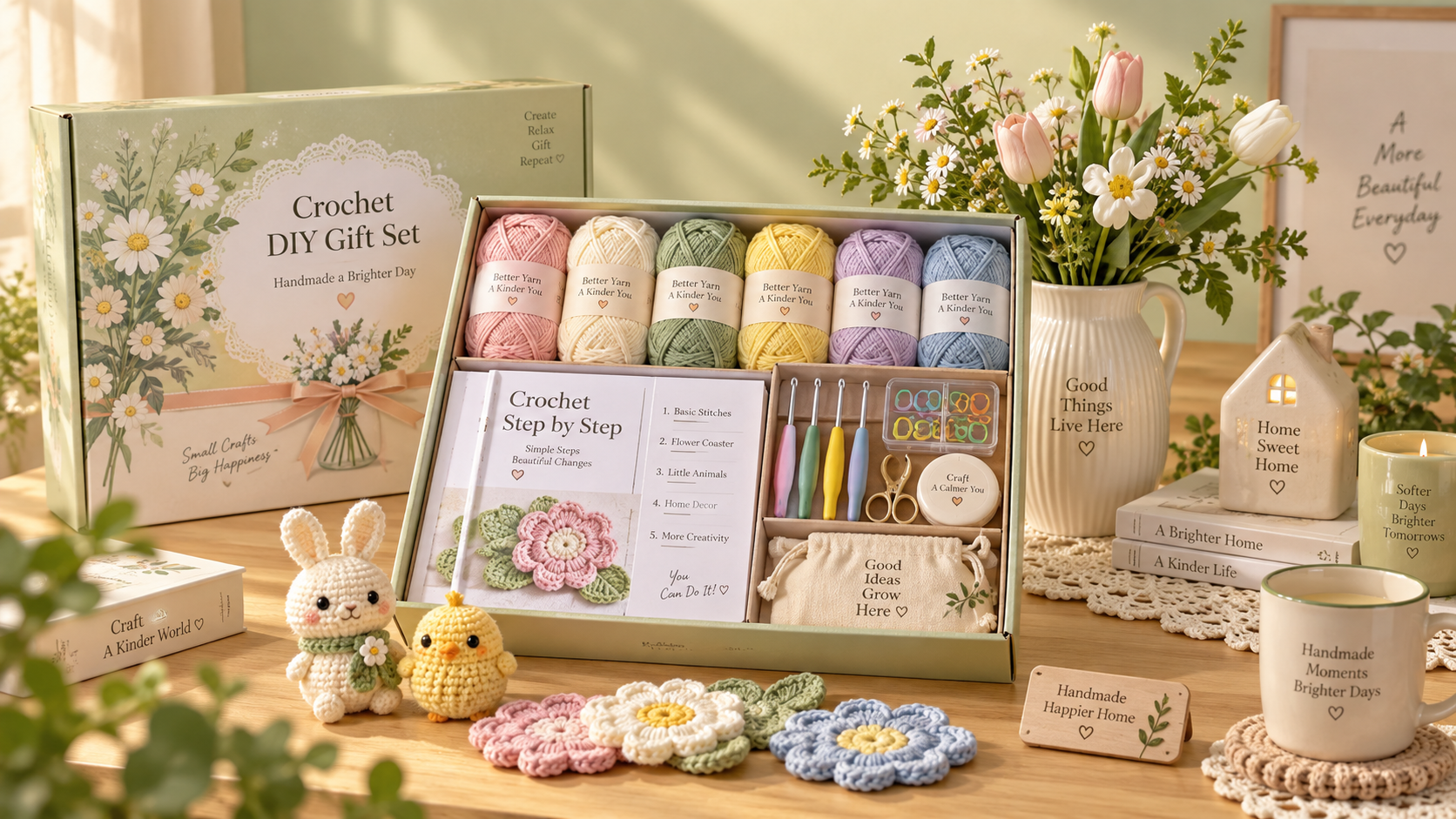
A DIY crochet kit becomes a strong gift-retail candidate when it removes the hesitation that often stops a casual shopper from buying a craft project: “Will the recipient know how to use this?” For a buyer reviewing a seasonal craft assortment, the central decision is not whether crochet is popular in general. It is whether the kit feels giftable at first glance, works for an inexperienced maker, and can be replenished without quality drifting between orders.
The most suitable kits combine a clear project outcome, pleasant materials, understandable guidance, and packaging that can stand on a shelf or be placed directly into a gift basket. When those elements are aligned, a diy crochet kit can serve several retail occasions at once: birthdays, holiday gifting, rainy-day activities, beginner hobby purchases, and small add-on gifts for home décor shoppers.
Gift suitability starts with a visible, achievable result
Gift buyers rarely have time to study yarn weight, stitch terminology, or pattern complexity. They usually make a decision within seconds based on the finished sample, the package message, and whether the project looks manageable. A kit should therefore show what the customer will make rather than merely listing components.
Projects with a compact, recognizable outcome are generally easier to position than large open-ended projects. Small decorative figures, simple floral pieces, coasters, ornaments, or beginner accessories give the recipient a defined goal. The finished item should feel useful, displayable, or charming enough that the giver can imagine the recipient enjoying both the making process and the result.
Retail evaluators should examine whether the package answers several practical questions without requiring a staff explanation:
- What does the finished item look like?
- Is this intended for a first-time crocheter or a more experienced maker?
- What materials and tools are included?
- How much commitment does the project appear to require?
- Can it be given as a complete present without additional shopping?
A kit can contain good materials and still underperform as a gift if its presentation makes the project look confusing, incomplete, or overly technical. Clear visual communication matters because the purchaser may not be the person who will crochet.
Beginner usability protects the gift experience
A common retail problem appears after a visually appealing craft kit is purchased by someone who assumes it is suitable for anyone. The recipient opens the box, encounters unfamiliar abbreviations or missing tools, and sets it aside. That experience reduces the chance of another purchase from the same range, even when the original product looked attractive on the shelf.
For repeat sales, beginner-friendly design is not a minor feature. It is the foundation of customer confidence. Instructions should use readable formatting, step-by-step sequencing, and visual support where helpful. A pattern may still introduce basic stitches, but it should not depend on knowledge the package does not clearly state.
Before adding a crochet range, assess the instruction system rather than judging only the finished sample. Look for logical progress from the starting loop through assembly and finishing. Check whether yarn colors are identified consistently, whether stitch counts are easy to follow, and whether the pattern explains key transitions. If a project uses more advanced techniques, the package should identify that clearly instead of presenting it as a beginner kit.
Tool completeness also affects perceived value. The recipient should not discover that an essential hook, stuffing material, needle, marker, or fastening component is absent unless the packaging plainly states otherwise. A retail-ready kit does not have to include every possible accessory, but it should avoid creating an unexpected barrier between opening the gift and beginning the project.
Material quality must be felt, not only claimed
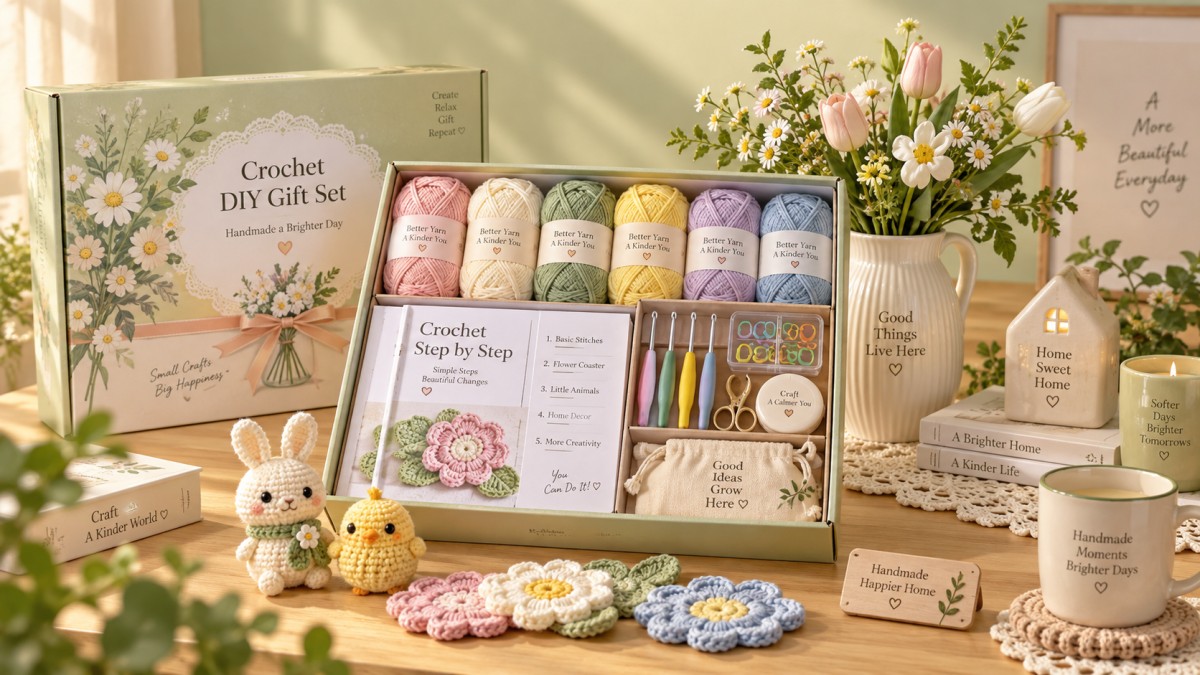
Craft shoppers often judge quality through touch. Yarn that splits easily, varies noticeably in thickness, sheds excessively, or tangles during use can make even a simple project frustrating. For gift retail, the yarn should be appropriate for the stated pattern, reasonably consistent in color, and comfortable to handle. The hook and accessory components should likewise feel functional rather than disposable.
During product evaluation, request samples that allow the team to inspect more than the outer box. Open the kit and compare the material list with the actual contents. Confirm that the yarn quantity appears sufficient for the stated design, including finishing and assembly. Review whether small parts are individually organized and whether the components can withstand normal shelf handling without becoming disordered.
Packaging should support both gifting and store operations
A successful craft kit package has two jobs. It must appeal to the shopper, and it must work for the retailer’s receiving, shelving, and replenishment process. Overly decorative packaging can be impractical if it crushes easily, cannot stack, or conceals the project image. Conversely, a plain pouch may protect components but fail to communicate gift value.
The strongest options balance protection with display. Consider whether the package can hang, stand, or sit neatly in a gift section; whether the product name and skill level remain visible when stocked closely together; and whether seasonal themes can be recognized from a distance. A cohesive range with consistent box dimensions or label placement can also simplify planogram execution.
Cross-merchandising is useful when it supports a real shopper mission. A spring crochet project, for example, can sit near small home accents, gardening-themed gifts, or entryway décor. A display built around a cheerful seasonal atmosphere may include a complementary item such as the Wooden Large Vertical Love Grows Here Porch Decor, Garden Welcome Standding Sign Garden Decor Sign, Welcome Wall Sign for Yard Porch Farmhouse Door Decoration. Its soft green background, rustic lettering, garden imagery, and double-sided wooden design can help create a porch-and-garden theme, while the crochet kit remains the hands-on gift within that presentation. The products should be treated as coordinated merchandising elements, not as substitutes.
Repeat sales depend on range planning, not only one attractive design
A single novelty kit may generate initial interest, but repeat purchasing is more likely when the customer sees a reason to return. This can come from collectable characters, seasonal variations, progressive skill levels, or coordinated color stories. The range does not need to be large at launch. It does need enough distinction that a shopper who enjoyed one project can identify an appropriate next project.
There is a practical boundary here: too many similar designs can make selection harder and increase slow-moving stock. A better approach is to compare designs by role. One may be an easy entry-level gift, another a seasonal display item, and another a slightly more detailed project for customers who have completed the first. Each should have a clear place in the assortment.
Buyers should also ask whether artwork, instructions, yarn shades, and accessory packs can remain consistent through replenishment. A product that changes visibly between batches can create customer-service issues, particularly when shoppers expect to collect related designs. Stable sourcing is therefore part of the product evaluation, even though it is not always visible from the retail package.
Questions to resolve before committing to a range
Before placing an order, request clear answers on the specific version being evaluated. Confirm the finished project size, included components, recommended skill level, package dimensions, packing method, and whether instructions match the language needs of the intended market. Review sample quality across more than one unit when possible, since a single well-packed sample may not reveal variation in yarn, accessories, or printing.
Also consider the likely return reason. In gift retail, returns often arise when the item appears different from its package, lacks a needed component, or proves far more difficult than expected. The best prevention is accurate presentation. A kit does not need to promise an effortless experience; it needs to describe the experience honestly and give the recipient a fair path to complete the project.
When a DIY crochet kit is visually gift-ready, complete enough to start immediately, realistic about skill level, and supported by dependable packaging and replenishment standards, it can earn space beyond the craft aisle. It becomes a flexible gift product with a stronger chance of generating both seasonal interest and the next purchase.
Leave A Message
If you are interested in our products and want to know more details, please leave a message here, we will reply you as soon as we can.

We specialize in supplying home decor, handicrafts, and daily necessities.


