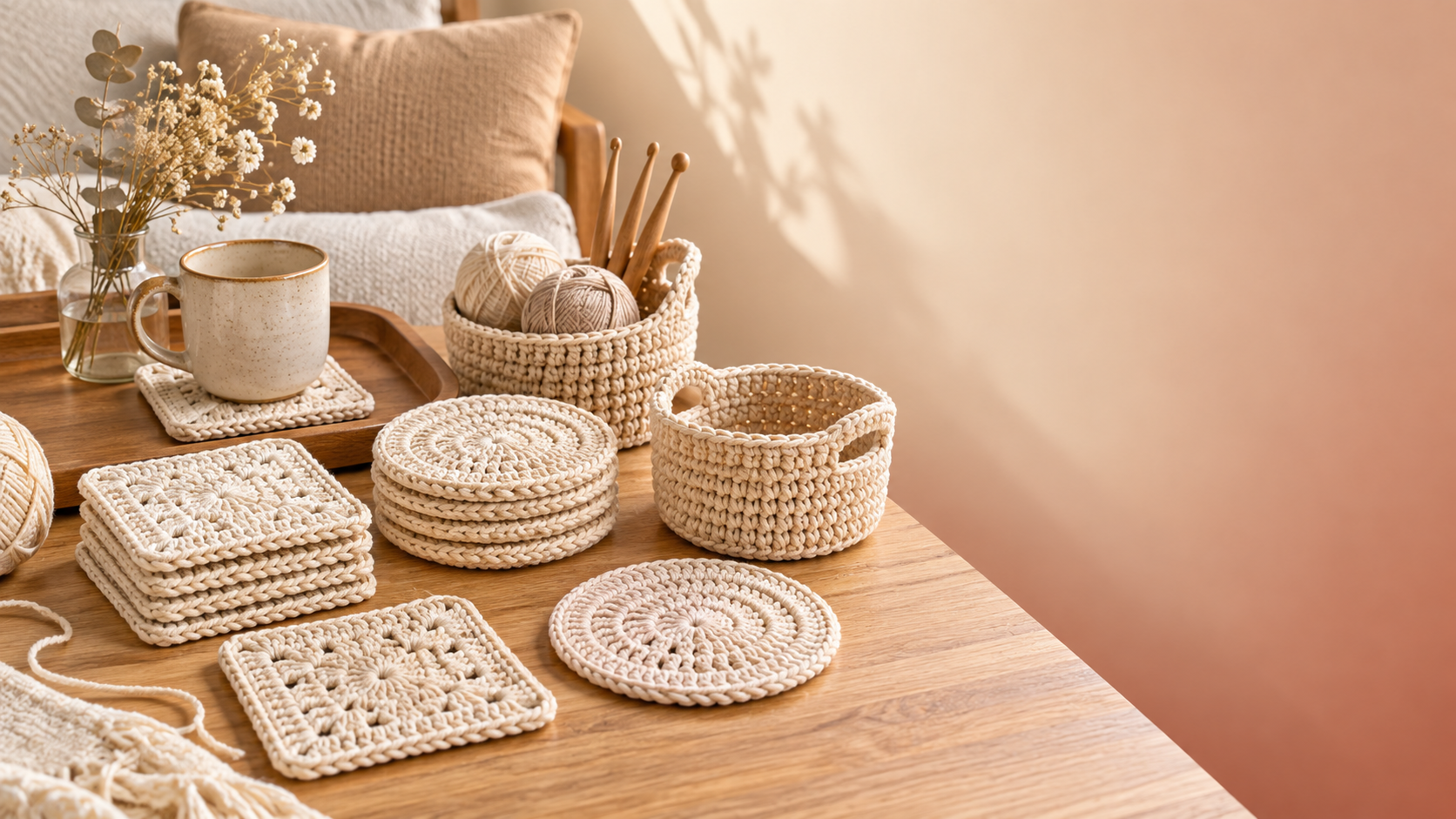
Beginner crochet project kits work best when the project teaches one new skill at a time. A coaster is not just a small finished item; it is practice in holding yarn, forming even stitches, counting accurately, and fastening off neatly. A basket adds shaping. A cushion cover introduces larger panels, joins, and color planning. Starting with a complicated amigurumi figure, fitted garment, or heavily textured wall hanging usually asks for too many decisions before the basic movements feel natural.
The most useful crochet project kits for beginners therefore follow a progression: flat work first, then simple three-dimensional forms, then projects that require repeated pieces or finishing. This approach produces usable home decor while giving each skill enough repetition to become reliable.
Start with flat projects that reveal stitch mistakes early
Coasters, mug rugs, placemats, and small dishcloth-style squares are the most practical first projects. They are short enough to finish without losing momentum, and their flat shape makes errors easy to see. If one edge begins to widen, the maker is probably adding stitches. If it pulls inward, stitches may be missing. Those problems are much harder to identify after several rounds of shaping.
Choose a kit with a light-colored, smooth yarn and a hook size that is comfortable to grip. Dark, fuzzy, split-prone, or novelty yarn can hide the individual loops a beginner needs to recognize. The goal of a first kit is not an intricate surface effect. It is learning how a chain, single crochet, and turning chain affect the fabric.
A simple square or rectangle is especially valuable because it teaches consistent turning. The first and last stitch of every row are the places where beginners most often lose count. A kit that includes clear row-by-row instructions, stitch abbreviations, and a finished-size reference makes it easier to catch the issue before the piece becomes noticeably uneven.
Move from coasters to round pieces before tackling shaped decor
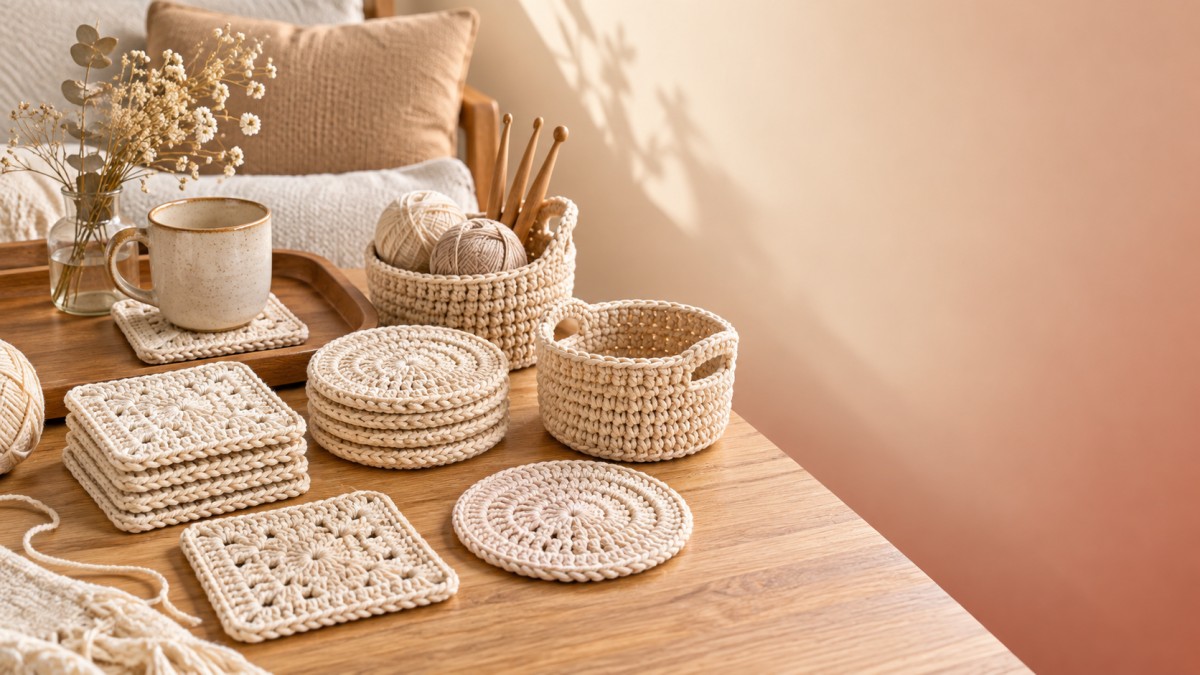
After flat rows feel manageable, round coasters and small trivets are a sensible next step. They introduce working into a ring, increasing stitches, and keeping track of rounds. These are core techniques for bowls, baskets, plant-pot covers, and many decorative motifs.
Round work is useful because it teaches a different kind of counting discipline. In rows, the maker counts across. In circles, they must also recognize where each round begins and ends. A stitch marker is essential here. Beginners sometimes try to identify the starting point by eye, then place an increase in the wrong location and end up with a wavy circle or a cup-shaped piece.
Look for project kits that specify whether the rounds are joined or worked continuously. Joined rounds create a visible seam but are easier to read. Continuous rounds give a cleaner spiral appearance, yet require more attention to the marker. Neither method is inherently better; the appropriate choice depends on whether the kit is teaching color changes and neat round transitions or simply introducing basic shaping.
Mini baskets teach useful structure without excessive complexity
A small crochet basket is often the best first three-dimensional home decor project. It begins as a flat circle or oval, then changes direction when the sides are worked upward. This teaches the relationship between stitch placement and shape without requiring the precise increases, decreases, and facial details found in stuffed figures.
For a first basket, select a compact design with one stitch type, a plain rim, and no lid. Stiff cotton yarn, cord-like yarn, or two strands held together can create a more stable result, but they also demand more hand pressure. Someone still struggling to insert the hook cleanly may be better served by ordinary cotton yarn and a shallow basket rather than a large, rigid storage bin.
This is also the point where tension becomes visible in a useful way. Tight stitches can make the basket firm but difficult to work; loose stitches can leave gaps and a floppy wall. The right result is usually even rather than extremely tight. A well-designed kit should show whether the intended basket is decorative, intended for lightweight items, or meant to hold its shape on a shelf. Crochet fabric alone is not automatically suitable for heavy storage.
Use cushion covers to build endurance and finishing skills
Once a beginner can maintain even tension over several sessions, cushion-cover kits provide a meaningful next challenge. They create a larger decorative object, but the construction can remain straightforward: two rectangles, a single panel folded and seamed, or a set of joined granny squares.
A plain panel teaches steady row counting over a longer distance. Granny squares teach work in the round, corner construction, and joining pieces together. Both are useful, but they solve different learning needs. Choose a plain-panel cushion if consistent stitch height and edge control need more practice. Choose a square-based cushion if the maker is comfortable with rounds and wants to learn joining and color placement.
Finishing is where a cushion project becomes more than repetitive stitching. Seams need to be aligned, yarn tails should be woven in securely, and an opening may need buttons, ties, or an envelope overlap. A beginner kit should state clearly whether it includes the insert, closure materials, and enough yarn for the stated size. It is frustrating to finish the crochet work only to discover that the cover cannot be assembled as shown.
Do not confuse a small project with an easy project
Some compact crochet project kits are poor starting points despite their size. A tiny flower keychain may require very small stitches, several color changes, and precise assembly. A miniature animal can involve invisible decreases, stuffing, safety components, and tight spiral rounds. A lace motif may demand careful stitch placement and repeated pattern reading. These projects can be rewarding later, but they do not offer the repetition that builds basic control.
Likewise, a large blanket is not necessarily difficult in stitch terms, but it can be a demanding first commitment. Repeating a simple stitch for many hours helps practice, yet a new maker may not know whether uneven edges are improving or compounding until much later. A smaller throw panel, table runner, or cushion front offers more manageable feedback.
What a beginner-friendly kit should include
The contents matter as much as the project choice. Yarn quantity should match the pattern, and the instructions should name the hook size rather than leaving the maker to guess. A kit is more usable when it provides a stitch guide, clear photographs or diagrams for construction changes, and a list of any extras needed for completion.
- Choose smooth yarn in a pale or mid-tone color so stitches remain visible.
- Prefer one main stitch plus one clearly explained new technique.
- Check that the finished item has a realistic purpose: coasters, a small tray basket, a plant-pot cover, or a cushion panel.
- Use a kit with a forgiving shape; rectangular panels and shallow baskets tolerate small tension changes better than fitted or sculpted objects.
- Keep the first color palette simple. Add color changes after the stitch rhythm is comfortable.
Home decor projects also give beginners a useful reason to finish well. A coaster can protect a side table; a basket can organize light accessories; a cushion cover can change the feel of a chair or bench. For an entryway or porch display, handmade textile accents can be balanced with a durable focal piece such as this Wooden Large Vertical Love Grows Here Porch Decor, Garden Welcome Standding Sign Garden Decor Sign, Welcome Wall Sign for Yard Porch Farmhouse Door Decoration. Its double-sided wooden design and hanging rope suit a seasonal display, while crochet pieces are better reserved for covered areas where yarn will stay cleaner and drier.
A practical sequence for building confidence
Complete two or three flat projects before moving on, rather than switching after a single coaster. Repetition matters because the first attempt often involves learning how to hold the yarn and hook; the second is where counting improves; the third is where tension begins to settle. Then make a round trivet or shallow basket, followed by a cushion cover or joined-square table runner.
When choosing the next kit, ask one question: “What specific technique will this project add to the skills I can already repeat?” If the answer is clear, the project is likely a good step forward. If the answer is “everything,” choose something simpler. Gradual progress produces better-looking decor, fewer abandoned projects, and a stronger foundation for more decorative crochet work later.
Leave A Message
If you are interested in our products and want to know more details, please leave a message here, we will reply you as soon as we can.

We specialize in supplying home decor, handicrafts, and daily necessities.


