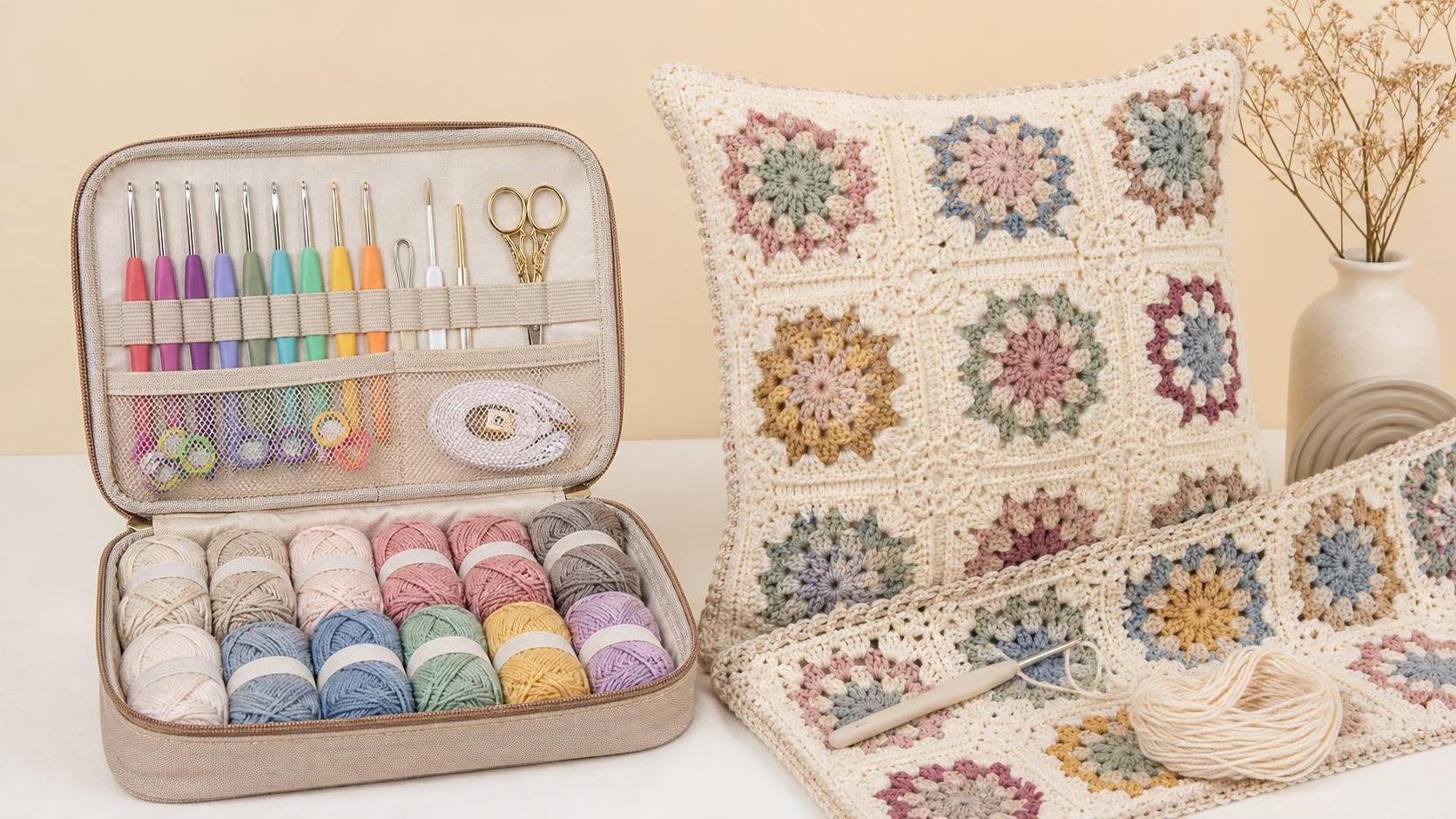
Choosing a good professional crochet kit starts with the working parts, not the gift-box look. A serious kit should let the maker maintain even tension, complete multiple types of stitches cleanly, and move from sample swatches to finished decor pieces without replacing half the contents. In home decor work, that matters because crochet is often used for cushion covers, table runners, baskets, wall hangings, plant-holder sleeves, seasonal ornaments, and mixed-material decorative accents. If the kit is weak at the tool level, the finished product usually shows it in loose edges, uneven rows, fuzzy surfaces, or handles and loops that distort after light use.
The crochet hooks deserve the closest inspection. A professional kit should include a practical size range rather than random duplication. Hooks commonly need to cover finer yarns for lace-like edging and thicker yarns for textured decor pieces. The hook shaft should be smooth, with a consistent diameter and no rough transition near the throat, because snagging in that area slows down stitch formation and can split yarn fibers. If the hook tip is too sharp, it may pierce strands instead of catching the full loop. If it is too blunt, tight stitches become difficult to enter, especially in cotton yarn used for placemats or storage accessories. Aluminum hooks are often preferred for glide and shape stability, while ergonomic handles may reduce hand fatigue during long production runs, though handle quality varies widely and some soft grips loosen over time.
Yarn quality is the next dividing line between a decorative sample kit and a professional one. A useful kit should include fiber that matches the intended result. Cotton yarn is often a strong choice for home decor because it gives stitch definition, absorbs dye well, and usually performs better than fuzzy acrylics when a clean pattern line is needed. It can also hold structure in coasters, trivets, small hanging pockets, and tabletop items. Acrylic may still be suitable for lightweight seasonal pieces where softness and color variety matter more than firmness. Blended yarns can be practical when a project needs both resilience and a softer hand feel. What matters is that the yarn weight is clearly matched to the included hook sizes and pattern guidance. A kit with attractive yarn colors but inconsistent thickness can produce irregular surfaces and inaccurate dimensions.
Amount matters as much as fiber type. Some kits include enough yarn for practice stitches but not for a full decorative piece. In a professional context, that creates problems immediately because the user cannot properly evaluate drape, edge control, repeat consistency, or finishing behavior. A good kit should contain enough material to complete at least one realistic project at its intended size, with a small margin for error. If tassels, fringe, pom-poms, or color-block sections are part of the design, the yarn allowance needs to reflect that. Running short near the end of a project often forces a dye-lot substitution, and even small color shifts may become obvious in neutral or solid-tone home decor.
Basic accessories should be selected for actual use, not simply to make the component count look generous. Stitch markers need to open and close reliably without snagging the yarn. Tapestry needles should have an eye large enough for the included yarn and a blunt enough tip for weaving ends through stitches rather than splitting them. Small scissors should cut cleanly across cotton and synthetic fibers instead of bending them first. A tape measure is useful only if its markings are legible and stable. Row counters, blocking pins, and a simple storage case can also be worthwhile, but low-quality extras do not improve a kit if they fail after a few uses.
Pattern guidance should match real project conditions
A professional crochet kit is judged partly by how well its instructions translate materials into finished objects. Good guidance should specify yarn weight, hook size, gauge expectations where relevant, stitch abbreviations, finished dimensions, and the degree of stretch to expect after handling. For home decor, dimensions are not a minor detail. A plant cover that stretches too much may sag; a cushion panel that finishes undersized may warp during seaming; a wall hanging with uneven tension may tilt after hanging. If the pattern avoids measurements or gives only vague suggestions, the kit may be attractive for casual gifting but weak for reliable making.
Charts and written instructions each have their place. Detailed written steps help with texture changes, edging, and assembly, while charts can make repeated motifs easier to follow. The best kits often use both, especially for geometric decor, floral appliques, and pieces that repeat across rows. Clear photos of intermediate stages can also prevent common mistakes such as working into the wrong loop, miscounting turning chains, or placing increases too close to the edge. Instructions should reflect the actual yarn and hook in the package. Generic patterns inserted into unrelated kits are a frequent source of frustration because tension, density, and finished scale can change significantly.
Another sign of quality is whether the kit accounts for finishing. Blocking, joining panels, attaching loops, shaping handles, hiding ends, and maintaining straight edges are all part of a professional result. A kit intended for decorative baskets or hanging organizers may also need guidance on reinforcement, lining, or combining crochet with wood, fabric, or hanging hardware. In home decor, mixed materials are common. A crocheted cover might be wrapped around a wood ring, attached to a fabric backing, or paired with a hanging sign, wreath base, or seasonal wall accent such as Halloween Sign Halloween Spooky Porch Sign Vertical Wooden Porch Sign for Door Decorations, Farmhouse Hanging Wall Sign for Home Outdoor Garden Decor. In those cases, stitch style alone is not enough; the project has to sit properly against another material and keep its shape when displayed.
Durability shows up in small manufacturing details
The difference between a hobby-level kit and a more professional one is often found in finishing quality. Hooks should have no burrs, discoloration, or bent heads. Yarn should be wound or packed in a way that reduces tangling and contamination. Printed instructions should remain readable during repeated handling, especially if the kit is used in workshop, sampling, or repeated test-making situations. If storage pouches are included, seams and closures should be checked because weak zipper tracks or poor stitching create avoidable losses in small tools.
Packing also affects yarn condition. Fibers compressed too tightly for long periods can flatten, and loosely packed novelty yarns can mat or snag before the project even begins. Moisture exposure during storage or transport may create odor, staining, or texture changes, particularly in natural fibers. For that reason, a good kit should arrive with components separated enough to prevent abrasion between metal tools and yarn, and protected enough that labels, dye references, or instructions do not smear or detach.
Color consistency is another practical issue. In decorative crochet, slight differences may be acceptable in highly variegated yarn, but they are much more visible in minimalist interiors where whites, natural cotton shades, olive greens, charcoal, or muted seasonal palettes are expected to look clean and intentional. If a kit includes multiple skeins of the same color, they should appear visually consistent under ordinary indoor lighting. Strong mismatch between skeins can ruin striped runners, symmetrical covers, and paired items such as matching baskets.
Common misunderstandings when judging crochet kits
One frequent mistake is assuming that more pieces mean better quality. A kit can include many hooks, novelty accessories, and decorative packaging while still failing at the basics. Ten poor hooks are less useful than four well-made ones in the right sizes. Another misunderstanding is treating softness as a universal sign of better yarn. For garments, softness may be the priority. For home decor, excessive softness can make shapes collapse, reduce stitch definition, and attract pilling in areas that are touched often.
There is also a tendency to overlook gauge because crochet feels flexible. In reality, gauge controls not only size but also surface density and stability. A loose gauge may work well for airy lace curtains or open decorative panels, but it can look sloppy in holders, sleeves, and forms meant to sit upright. A good professional crochet kit should not force the user to guess which level of density suits the intended object.
Another weak point is seasonal styling without year-round usability. Some kits are visually tied to one short period and become hard to adapt after that season. A stronger approach is to include projects or colorways that can work as part of a broader decor rotation. Seasonal accents still have value, of course, especially where display pieces are changed regularly. A double-sided decorative item, for example, can extend use through more than one occasion, much like a rustic hanging sign that shows a Halloween-facing message on one side and a standard welcome design on the reverse. That kind of flexibility often matters in decor planning because storage space, display turnover, and visual continuity all affect whether an item remains practical.
Materials should suit the intended display environment
Crochet used indoors on shelves, tables, sofas, or walls does not face the same stress as decor near entryways, covered porches, or garden-adjacent spaces. A professional kit should reflect that. Cotton and cotton blends may perform well indoors but can absorb moisture if used in damp areas. Acrylic may resist some moisture better, though appearance and hand feel differ. If a project includes hanging loops, ring attachments, or structural cords, those components should be strong enough for the expected weight and placement. Decorative wall pieces can tolerate softer construction than hanging storage pockets or bottle holders.
Texture also interacts with maintenance. Openwork patterns collect less lint than dense plush textures, but they may snag more easily. Light-colored yarn shows dust and handling marks more quickly. Deep, saturated shades can look rich, yet they may require attention to colorfastness if paired with pale fabric or wood surfaces. A good kit does not need to solve every environment, but it should make sensible material choices for the kind of item it asks the user to make.
In more polished kits, the components feel coordinated. The yarn weight suits the hook, the hook suits the pattern, the pattern suits the intended decor use, and the finishing tools support a clean result. That coordination is more important than whether the kit looks premium at first glance. When the components are mismatched, the user spends time compensating for the kit instead of evaluating the craft itself.
A good professional crochet kit, then, is one that works reliably from the first chain to the final finishing step. It should provide stable hooks, usable yarn in sufficient quantity, instructions tied to real dimensions, and accessories that support repeated handling. In home decor, that standard becomes even more visible because finished pieces are displayed in open view, often against wood, fabric, ceramics, or seasonal accents where every irregular edge and weak seam is easy to notice.
Related Posts
Online Message
Leave A Message
If you are interested in our products and want to know more details, please leave a message here, we will reply you as soon as we can.

We specialize in supplying home decor, handicrafts, and daily necessities.


