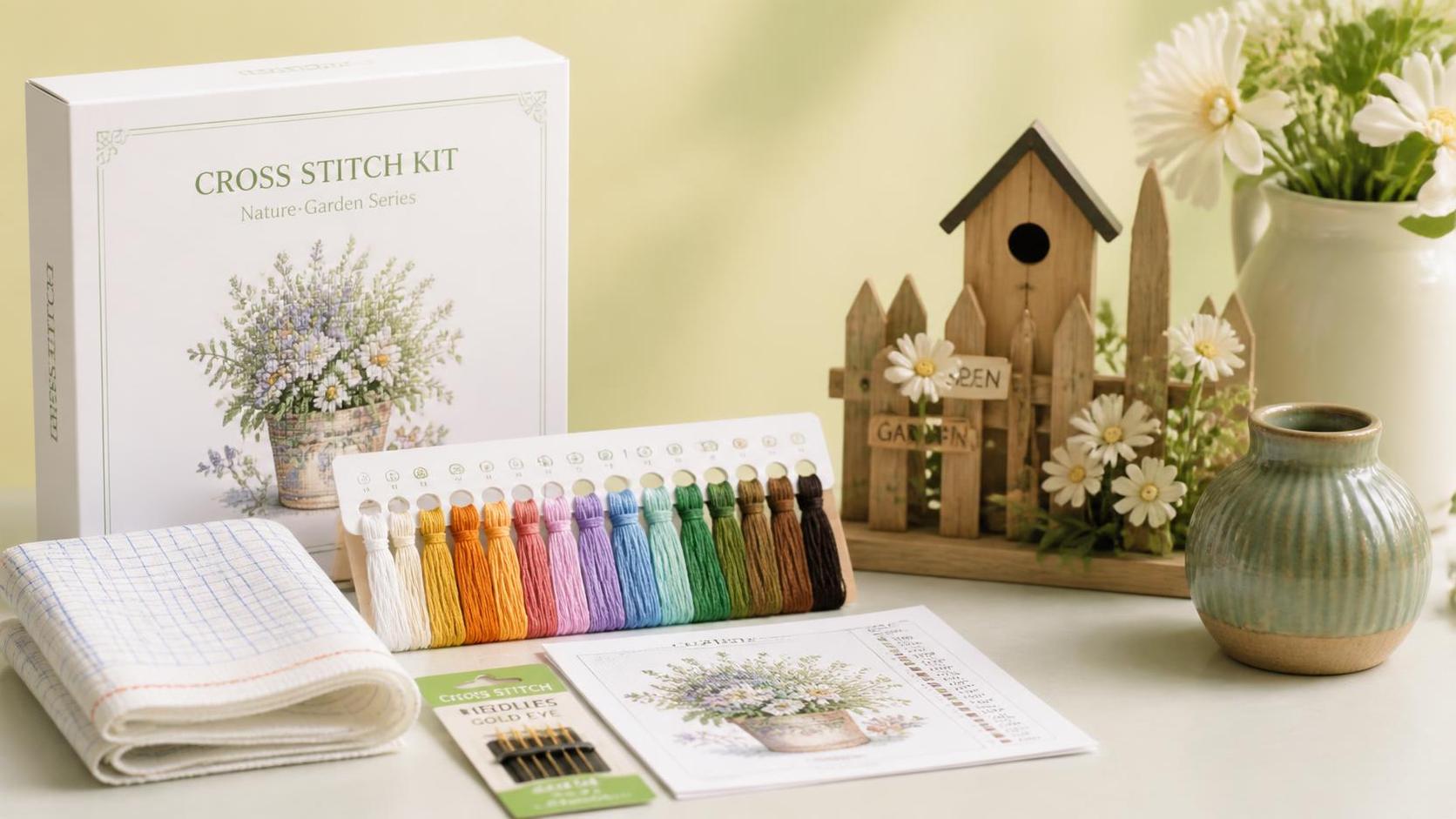
Cross stitch kits sit at an interesting intersection of hobby retail, home décor, gifting, and seasonal merchandising. For wholesalers and importers, the category may appear straightforward: fabric, thread, needles, a chart, and packaging. In practice, its commercial performance depends on far more than the design itself. The supplier’s ability to standardize materials, control component accuracy, manage intellectual-property risk, and support changing retail formats often determines whether a program generates repeat orders or becomes a source of returns and markdowns.
The demand base for cross stitch remains resilient because it serves several consumer needs at once. It is an accessible creative activity, a screen-free leisure product, and a way to produce personalized decorative items. Yet the market is no longer driven only by traditional floral samplers or heritage-style patterns. Beginner kits, small-format projects, modern typography, pet themes, seasonal motifs, and giftable craft sets have expanded the category’s reach. A capable cross stitch kit manufacturer and wholesale supplier needs to understand this shift not merely as a design trend, but as a change in product architecture, packaging, and inventory planning.
Why sourcing cross stitch kits is more complex than it looks
A finished kit is judged by the consumer as a single experience. If one component is missing, mislabeled, difficult to use, or visually inconsistent with the package image, the perceived value of the complete product falls sharply. This makes component management central to manufacturing quality.
Fabric is a common source of variation. Aida cloth remains widely used because its open grid helps beginners count stitches, but the actual usability depends on weave consistency, stiffness, edge treatment, colorfastness, and cutting accuracy. Even a minor inconsistency in the grid can create frustration when a pattern requires precise alignment. For printed-fabric kits, the clarity and durability of the printed guide matter as much as the fabric itself. Ink bleeding, weak contrast, or a guide that remains visible after washing can lead to complaints.
Thread selection also affects both cost and consumer perception. Buyers should ask whether thread is cotton, polyester, or a blended material; whether shades are controlled by a recognized internal color standard; how thread lengths are prepared; and whether the color card corresponds exactly to the chart. Loose bundles with insufficient labeling may reduce packing cost, but they increase the risk of consumer error and customer-service claims. Pre-sorted thread cards can improve usability, particularly in starter and intermediate kits, although they add assembly time and require stronger quality control.
The chart itself should be treated as a technical document rather than a decorative insert. Symbol distinction, contrast, multilingual instructions, finished-size information, stitch count, and legend accuracy must all be reviewed during pre-production sampling. A chart that is legible on a monitor may not be legible after printing at a small format. This is especially important for kits sold through mass retail, where customers are less likely to tolerate unclear instructions than experienced craft enthusiasts.
Assortment planning should begin with the retail use case
Wholesale buyers often make the mistake of selecting designs based only on visual appeal. Better assortment decisions begin with where and how the product will be sold. A specialty craft store can carry more technical patterns, larger projects, and premium material stories. A gift retailer generally needs projects that are easy to understand, compact, attractively packaged, and suitable for a defined occasion. Online marketplaces may reward distinctive imagery and clear skill-level segmentation, but they also expose suppliers to high review sensitivity when contents differ from expectations.
Project duration is one of the most commercially useful but underused product attributes. A small motif that can be completed over a weekend addresses a different consumer need from a large framed landscape requiring many hours of work. These should not be mixed indiscriminately under one entry-level range. Clear differentiation by difficulty, estimated completion time, fabric count, and included finishing materials helps retailers reduce purchase uncertainty.
Seasonality needs similar discipline. Christmas, Easter, Halloween, spring gardening, and harvest themes can create strong short-term demand, but late delivery can eliminate much of their value. The real sourcing question is not whether a seasonal motif is attractive; it is whether artwork approval, sample confirmation, production, freight, and store allocation can be completed before the relevant buying window. For seasonal craft kits, dependable calendar management matters more than a small unit-price advantage.
Cross stitch also works best when considered within a broader home décor craft assortment. Retailers increasingly build coordinated displays around a season or decorating mood rather than a single hobby category. A farmhouse or garden-themed cross stitch range, for example, can sit alongside signs, wooden ornaments, ceramics, and textile accents. Products such as this Wooden Large Vertical Love Grows Here Porch Decor, Garden Welcome Standding Sign Garden Decor Sign, Welcome Wall Sign for Yard Porch Farmhouse Door Decoration illustrate the type of complementary décor item that can support a spring or garden display. The relevance is not that every craft supplier should add large décor products, but that coordinated themes can improve cross-category merchandising when production capabilities and quality controls are aligned.
Supplier capability is measured in process control, not catalog size
Many suppliers can show hundreds of patterns. Fewer can demonstrate a stable process from artwork development to final packing. For importers, the core assessment should focus on the points where errors become expensive to correct.
Artwork ownership is one such point. Cross stitch designs can be created internally, licensed, commissioned, supplied by the buyer, or derived from public-domain material. These routes are not equivalent. A supplier should be able to state clearly who owns the artwork, what use rights apply in each sales territory, and whether exclusive designs can be offered. Unclear rights can result in marketplace takedowns, retailer disputes, or forced product withdrawals. A visually successful item is not commercially safe if its design provenance is uncertain.
Another key point is the sample-to-bulk transition. The approved sample should define more than the final appearance. It should record fabric specification, thread shades, needle type, insert paper quality, packaging materials, barcode position, carton configuration, and permitted tolerances. Without this reference, a bulk order can drift in details that appear minor at the factory but matter in retail presentation.
Inspection should include a practical assembly check rather than relying only on visual carton inspection. Factories should verify kit completeness through defined sampling procedures, compare thread codes against the chart, inspect printed instructions, and check packaging seal integrity. For higher-value kits, it is sensible to open samples from different production periods rather than only from the final packed batch. This helps detect whether component substitution or packing errors occurred during production.
Compliance considerations extend beyond the craft materials
Compliance obligations vary by destination market and product positioning. When a cross stitch kit is intended for children, the applicable toy-safety framework and labeling requirements may be substantially different from those for an adult hobby product. A kit should not be casually marketed toward children simply because its design is simple or colorful. Age grading, small components such as needles, packaging claims, and testing obligations all need to be considered before sales copy or artwork is finalized.
For adult craft kits, buyers should still review chemical compliance requirements relevant to the destination market, particularly for dyes, printed fabrics, coatings, adhesives, and plastic accessories. Packaging obligations may also apply under local waste, recycling, and labeling rules. Requirements change by country and retailer, so the correct approach is to establish a market-specific compliance checklist before order placement rather than assume that a general factory certificate covers every item.
Wooden or fabric-based companion décor requires its own review. Moisture content, paint adhesion, hanging hardware, sharp edges, and outdoor-use claims can all affect product suitability. A porch sign promoted for outdoor display, for example, should be evaluated according to the likely exposure conditions; “outdoor” should not be used as a broad claim if the finish is suitable only for sheltered spaces.
MOQ, packaging, and replenishment determine the real wholesale risk
Unit cost is visible, but inventory exposure is often the more important number. A design-heavy cross stitch program can create substantial SKU complexity: different patterns, fabric counts, colorways, languages, and package formats may each require separate minimum quantities. Buyers should distinguish between a supplier’s stated MOQ and the practical MOQ created by custom printing, special components, or exclusive artwork.
Packaging deserves early discussion because it influences freight efficiency, damage rates, shelf impact, and e-commerce performance. Flat packs reduce volume but may crease charts or fabric. Rigid boxes offer a more premium presentation but increase material use and shipping cost. For online channels, the package must withstand parcel handling while still communicating contents clearly. If the finished project shown on the cover is substantially larger or more detailed than a buyer expects, returns can increase even when the kit is technically accurate.
Replenishment is another differentiator. Core designs with stable appeal should be supported by repeatable material sourcing and retained production records. Trend-led designs may justify shorter runs, but buyers should avoid treating every item as seasonal novelty. A balanced range typically includes dependable evergreen subjects, selective seasonal programs, and a smaller portion of test-oriented designs. This structure reduces the risk of tying up capital in patterns that lose relevance before a second order is possible.
What a sound buying decision looks like
The strongest cross stitch kit sourcing programs are built around consumer usability and operational reliability at the same time. Before selecting a supplier, buyers should be able to answer practical questions: Is the design legally usable in the intended market? Can the kit be completed with the tools and instructions provided? Are fabric, thread, and printed materials controlled consistently? Does the packaging match the retail channel? Can the supplier maintain quality when an initial order becomes a repeat program?
Ningbo’s established export ecosystem can be advantageous for buyers looking to combine handicrafts, wooden décor, fabric items, ceramics, plastics, and handwoven products within a coordinated home décor sourcing strategy. However, geographic concentration alone is not a quality guarantee. The deciding factor remains whether individual factories and partner facilities operate with documented specifications, traceable approvals, appropriate audits where required, and realistic production planning.
In a category built around patience and precision, the supply chain must reflect the same qualities. The most competitive wholesale offer is rarely the one with the largest pattern library or the lowest quoted price. It is the one that turns a creative concept into a complete, compliant, correctly packed, and repeatable retail product with the fewest avoidable surprises.
Leave A Message
If you are interested in our products and want to know more details, please leave a message here, we will reply you as soon as we can.

We specialize in supplying home decor, handicrafts, and daily necessities.


