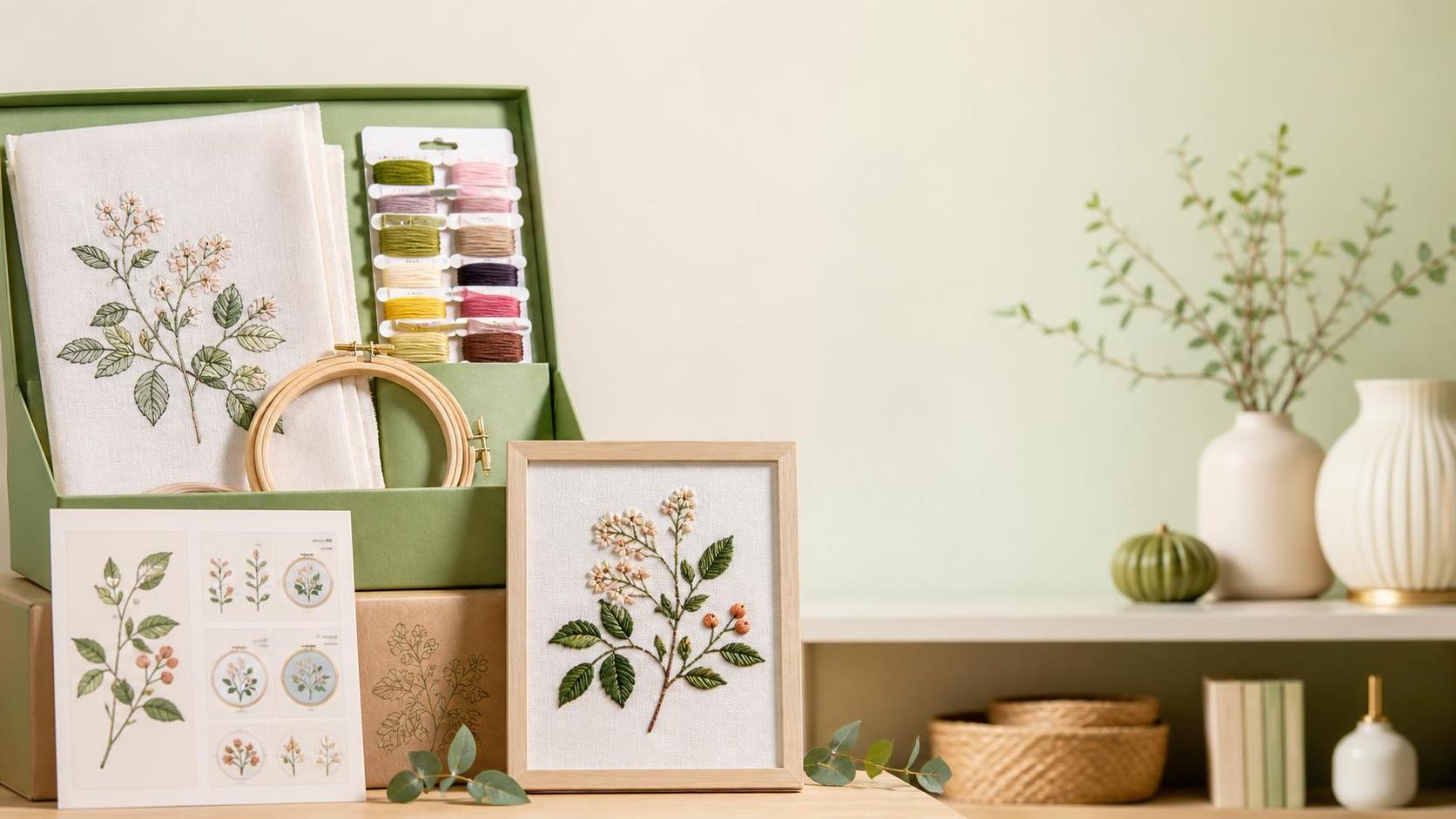
What Buyers Are Really Looking for in an Embroidery Kit Supplier
An embroidery kit is easy to underestimate. To a consumer, it may look like a simple combination of fabric, thread, needles, instructions, and packaging. To a retailer, home décor brand, or craft distributor, it is a product category where small sourcing failures quickly become visible: missing components, unclear instructions, inconsistent thread colors, damaged hoops, poor packaging, or delivery dates that miss a seasonal launch window.
This is why the search for an embroidery kit manufacturer and wholesale supplier is rarely about finding the lowest unit price. Buyers are normally trying to determine whether a supplier can turn a creative idea into a repeatable retail product, while controlling the practical risks that sit behind a seemingly handmade item.
For home décor businesses, embroidery kits also sit at an interesting intersection. They can be sold as leisure products, but their finished output often becomes wall art, shelf decoration, personalized gifts, seasonal ornaments, or soft furnishings. That dual role means the product must work both as a craft experience and as a decorative result.
Embroidery Kits Are a Product System, Not Just a Bill of Materials
A commercially viable kit needs more than attractive artwork. The design must be achievable for the intended skill level, the contents need to be complete and easy to identify, and the finished piece has to match the visual expectation created by the package. A pattern that appears elegant on a mood board can become a difficult retail item if the stitch sequence is unclear, the color chart is hard to read, or the fabric is not stable enough for beginners.
For wholesale buyers, the first useful question is not “What designs do you have?” It is “What part of the kit can be standardized, and what part can be customized?” Standardizing needles, thread cards, hoops, backing boards, and carton formats can reduce purchasing complexity. Meanwhile, design themes, printed fabric, instruction language, labels, and packaging graphics can be adapted for a specific market or private-label collection.
That distinction matters because customization has different consequences depending on the component. Changing a printed motif may be straightforward. Changing the thread palette, packaging structure, warning labels, or wooden display component can affect lead time, cost, testing needs, and minimum order quantities.
The retail experience begins before the first stitch
Consumers often decide whether a kit feels premium or frustrating within the first few minutes of opening it. Components should be separated or clearly labeled. Thread quantities must correspond to the pattern’s actual coverage requirements, not merely an estimated stitch count. Instructions should show the essential techniques and explain where to start. For beginner-oriented kits, the level of visual guidance is often more important than the complexity of the finished artwork.
Brands that treat instruction design as an afterthought usually create avoidable return risk. This is particularly relevant when a product is sold across countries, where language, measurement conventions, and safety communication need to be reviewed for the destination market.
Match the Kit to Its Commercial Setting
The best embroidery kit for an independent gift shop is not necessarily right for a mass retailer, online marketplace, museum store, or home décor chain. The product must fit the channel’s price architecture, shelf space, customer profile, replenishment model, and seasonal calendar.
Home décor-oriented embroidery kits tend to perform better when the finished result has a defined place in the home. A framed botanical sampler, a small embroidered hanging decoration, or a project designed for a cushion cover provides a clearer purchase rationale than an abstract craft exercise. However, suppliers and buyers should be cautious about adding too many decorative components merely to increase perceived value. Extra wood pieces, frames, ribbons, beads, or hanging hardware can improve presentation, but every added component introduces another quality and assembly checkpoint.
Why Supply-Chain Structure Matters More Than a Catalogue
A broad product catalogue is useful, but it does not by itself prove supply reliability. Buyers should understand whether their supplier manufactures core items directly, sources them through qualified partners, or combines both approaches. In the home décor craft sector, this mixed model is common and can be commercially practical. One factory may focus on textile handicrafts, while a partner handles wooden accessories, ceramic details, plastic tools, or woven packaging elements.
The real issue is control. Can the supplier maintain approved specifications across different material categories? Is there a process for confirming that wood finish, fabric print, thread color, and packaging artwork remain consistent? Does the supplier know which changes require a new pre-production sample?
For companies sourcing from Ningbo and surrounding manufacturing networks, the advantage is often access to a mature export ecosystem. A supplier with dedicated handicraft and wood-and-fabric production capabilities, alongside established relationships in ceramics, plastics, and handwoven goods, may be able to support coordinated home décor ranges rather than isolated SKUs. That can be valuable for buyers building collections with shared color stories or seasonal themes. Still, buyers should verify which factory owns each production step and how final quality responsibility is assigned.
Do not confuse certifications with product approval
Factory certifications and retail-chain audit experience can be meaningful indicators of operating discipline, but they are not a substitute for product-specific due diligence. A certified facility can still produce a kit with incorrect contents, insufficient warnings, unsuitable packaging, or color variation. Conversely, a well-designed product still needs its production process checked before volume orders are released.
For an embroidery kit, the practical control points commonly include:
- Fabric weight, weave consistency, print alignment, and edge treatment.
- Thread composition, color matching, winding method, and sufficient quantity per shade.
- Needle type, point protection, and safe placement inside the packaging.
- Wooden hoops, frames, tags, or display elements for sanding, coating, dimensions, and splinter risk.
- Instruction accuracy, language review, age grading, warnings, and artwork version control.
- Outer packaging strength, component retention, barcode placement, and carton packing details.
Requirements can vary by market and sales channel. Claims related to safety, material composition, sustainability, or age suitability should be supported by relevant documentation and testing where applicable. Specific legal obligations should be confirmed for the destination market rather than assumed from a supplier’s previous export history.
Sampling Should Test the Whole Customer Journey
Many buyers approve samples based mainly on appearance. That is necessary, but incomplete. A proper sample review should include an actual assembly and stitching trial. Someone who did not design the kit should open it, follow the instructions, complete key areas of the pattern, and inspect the finished item. This quickly reveals whether the thread labels match the chart, whether the fabric distorts, whether the needle is appropriate, and whether the instructions assume knowledge that the target customer may not have.
This type of review is especially important for kits positioned as home décor gifts. The customer is not only buying materials; they are buying the confidence that the finished piece will look good enough to display or give away. A kit that technically contains all required parts can still disappoint if the final embroidery lacks shape, the fabric cannot be mounted neatly, or the included finishing method feels improvised.
The same principle applies to mixed-material décor programs. Consider a porch or entryway assortment where craft-oriented products sit next to finished decorative signs. A supplier’s ability to coordinate fabric crafts with wooden pieces can help keep the collection coherent. For example, a double-sided wooden welcome sign with a soft green background, white wood-grain finish, rustic lettering, and pre-attached hanging rope may be evaluated not only as a standalone item, but as a reference for the farmhouse visual language of nearby textile kits. A product such as Wooden Large Vertical Love Grows Here Porch Decor, Garden Welcome Standding Sign Garden Decor Sign, Welcome Wall Sign for Yard Porch Farmhouse Door Decoration illustrates how material finish, seasonal messaging, and display use can influence the broader assortment story.
Lead Time Is Often Decided Before Production Starts
In this category, missed delivery dates are frequently caused by decisions made too late during development: artwork remains unapproved, packaging files are incomplete, thread colors are still being revised, or a buyer has not finalized compliance wording. Production capacity matters, but the pre-production timeline is often the more fragile part of the schedule.
Buyers should ask for a milestone-based plan covering design confirmation, sample submission, approval deadlines, material procurement, pre-production sample sign-off, bulk production, inspection, and shipment booking. The aim is not to demand unrealistic certainty. It is to identify where an adjustment will affect the launch date.
Seasonal home décor is particularly exposed. A spring-themed kit or farmhouse porch collection may have a short selling window. When that window is missed, lower freight cost or a small unit-price saving rarely compensates for the lost retail opportunity.
A Better Supplier Conversation Starts with Specific Questions
Before comparing quotations, buyers benefit from supplying a concise but complete brief: target customer, intended retail channel, expected price position, finished size, skill level, packaging expectations, destination markets, estimated order volume, and desired delivery window. This enables a manufacturer to identify practical limits early rather than quoting an attractive number against an incomplete specification.
The most useful supplier discussions also move beyond “Can you make this?” Ask how the supplier would control component shortages, what variations are likely between sample and bulk production, which materials are sourced externally, and what happens when a substituted item is proposed. A dependable wholesale relationship is not defined by the absence of changes. It is defined by whether changes are visible, documented, and approved before they reach the customer.
For buyers building a long-term embroidery kit range, the strongest choice is usually the supplier that can balance creative flexibility with disciplined execution. The collection needs fresh designs, but it also needs stable materials, readable instructions, consistent packing, and realistic delivery management. In a market where consumers judge both the making experience and the finished décor result, those operational details are part of the product itself.
Leave A Message
If you are interested in our products and want to know more details, please leave a message here, we will reply you as soon as we can.

We specialize in supplying home decor, handicrafts, and daily necessities.


