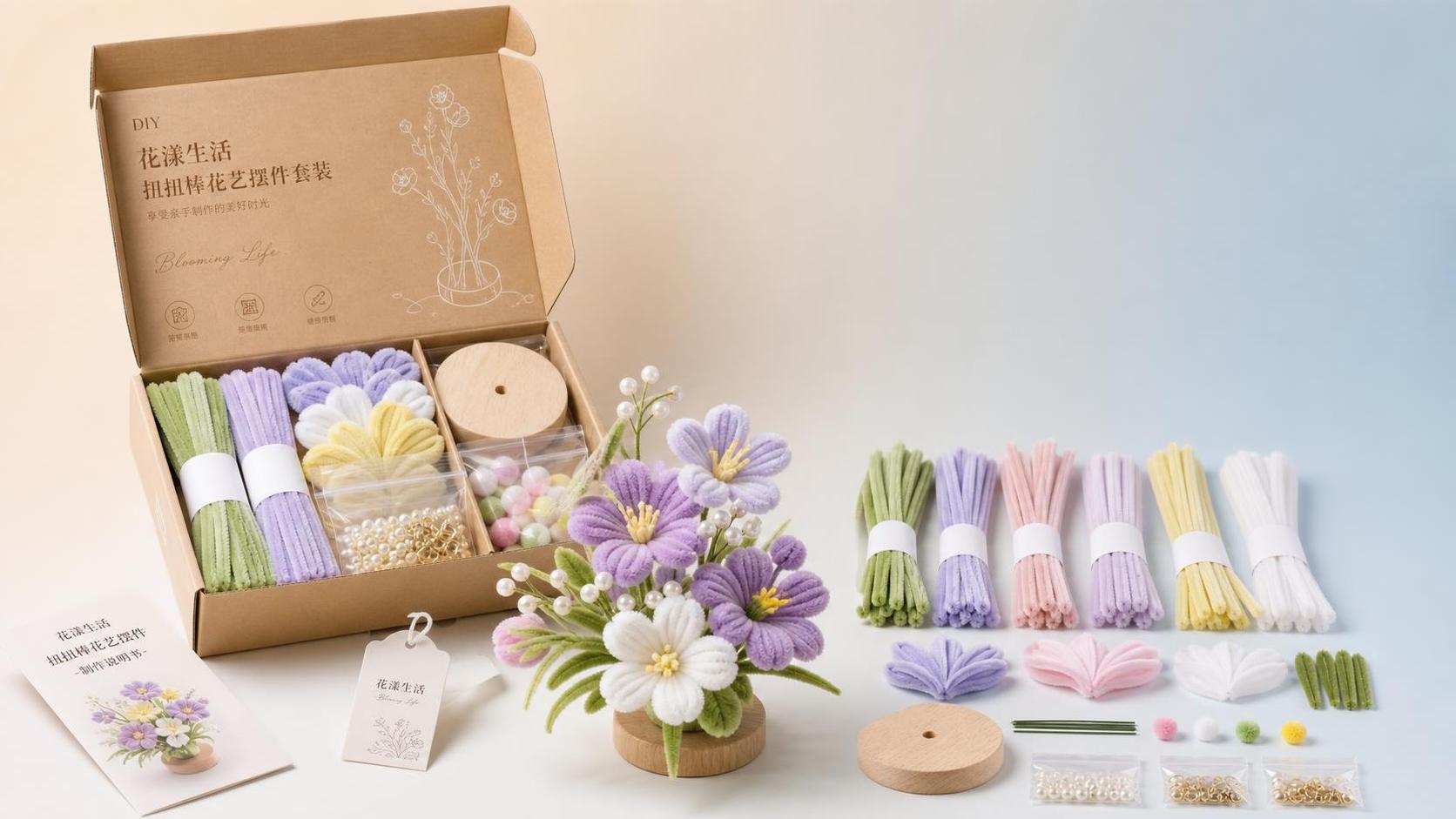
A pipe cleaner craft kit succeeds or fails long before the finished animal, flower, ornament, or room decoration is assembled. The wire must bend repeatedly without snapping, the plush fiber must remain secure, the colors must be consistent, and every small component must arrive in the intended quantity. Selecting a pipe cleaner craft kit manufacturer therefore requires a close look at materials, production controls, packaging discipline, and the practical realities of supplying home decor and handicraft ranges.
A catalog image is only a starting point. It may show attractive color combinations and imaginative project ideas, but it cannot reveal whether the stems shed fibers, whether wire ends are adequately covered, or whether a packed kit remains complete after transport. A reliable selection process turns the product concept into a clear specification, then tests whether a production source can repeat that specification across future orders.
Define the Craft Kit Before Reviewing Production Capability
Pipe cleaner kits vary widely in complexity. A simple seasonal activity may contain colored chenille stems and an instruction sheet. A more developed home decor kit can include wooden bases, felt shapes, pom-poms, adhesive elements, ribbon, beads, pre-cut paper, and display packaging. Each additional component introduces another material source, counting step, and potential point of variation.
Write the product brief around the actual making experience. State the finished item, recommended age range where relevant, required component count, color palette, finished dimensions, assembly sequence, pack format, and any intended display use. If a project forms a standing ornament, clarify whether the included stems must support their own weight or wrap around a supplied base. If it is intended for a wall hanging, determine whether a hanging loop, adhesive pad, or other fixing element is included.
The brief should distinguish between visual requirements and functional requirements. “Pastel colors” is a visual direction; it needs approved swatches or reference samples before production. “Easy to twist by hand” is functional; it needs a sample review using the intended number of bends and the same stem diameter proposed for bulk production. General descriptions leave too much room for mismatched expectations.
Inspect the Pipe Cleaner Construction
The basic pipe cleaner consists of a central wire with fibers twisted around it. Small changes in this construction affect handling, appearance, and safety. Stem length, wire gauge, wire temper, fiber density, fiber type, twist tightness, and cut-end treatment all deserve attention.
A stem that feels overly rigid can make simple shapes difficult to form, especially where the project depends on tight coils or small loops. One that is too soft may sag when used for legs, petals, antennae, or free-standing decorative structures. The proper balance depends on the project rather than a universal preference. Request samples in the intended colors and lengths, because dense dark fibers, metallic fibers, and lighter pastel fibers may not behave identically.
Fiber coverage deserves close inspection under ordinary indoor light and after handling. Sparse coverage can expose the wire through the pile, while loose fibers can transfer to clothing, packaging, or nearby craft materials. Run a finger along the stem, twist it several times, and inspect the surface again. Pay particular attention to both ends. A cleanly trimmed stem may still have a sharp or insufficiently covered wire point beneath the fiber.
For multicolor assortments, confirm whether colors are identified by a physical sample, a color code, or a printed reference. Screen display colors are not dependable production standards. A kit containing a themed palette can look disjointed when reds, greens, neutrals, or metallic tones shift between batches.
Look Beyond the Main Stem Material
Many craft kits are mixed-media products. The pipe cleaners may be the main assembly material, yet the perceived quality often depends on the supplementary pieces. Wooden shapes require smooth edges and consistent drilling if holes are used. Felt pieces need clean cutting with minimal fraying. Pom-poms need stable size and color. Adhesive components must retain their backing and avoid sticking to the instruction sheet or inner bag during warm transit conditions.
Ask for a component list that separates purchased parts from parts made in-house or assembled locally. This does not require disclosure of confidential sourcing relationships; it establishes which elements are subject to separate lead times and which quality controls are applied before kitting. Where ceramics, plastic ornaments, fabric pieces, or handwoven details are included, confirm how fragile parts are protected inside the retail pack.
Seasonal craft ranges often combine different decoration formats. For example, a Halloween assortment could pair a hands-on pipe cleaner activity with reusable window accents such as Halloween Window Gel Clings Ghost Pumpkin Bat Witch Cat Boo Blood Decal Stickers for Halloween Home Party Window Decorations. In that situation, the specification should keep the materials and packaging requirements separate. Soft TPR window clings need protection from dust and distortion, while pipe cleaner components need controlled counting and secure inner containment. Combining products under one theme does not make their production risks identical.
Evaluate Sample Quality as a Process, Not a Single Approval
An initial sample can show whether the concept is feasible, but it may not represent routine production. A stronger approach uses more than one review stage. The first sample confirms proportions, construction, and materials. A revised sample resolves visible changes. A pre-production sample, made with the intended materials, print files, packing method, and assembly instructions, becomes the reference for bulk goods.
Keep the approved reference organized by component. A finished assembled project alone may hide substitutions inside the box. Retain photographs of the open kit, individual bags, printed inserts, close views of stems, and the completed item. Record details that are otherwise easy to forget, such as whether the silver wire is fully concealed, which side of a felt cutout faces forward, or how many stems appear in each color group.
Assembly trials expose problems that visual review misses. Follow the actual instructions from an unopened sample kit. Count every piece before starting. Note whether the sequence is intuitive, whether a required bend can be made without tools, and whether the final item resembles the printed image. A kit can contain all listed parts and still create frustration when a crucial step assumes a skill level not reflected in the design.
Production Controls That Matter in Kitting
Pipe cleaner craft kits are vulnerable to counting errors. A missing stem or one absent decorative eye can make the project impossible to complete, even when every other part is acceptable. Clarify how components are counted: by weight, automated counter, manual sorting, or a combination of methods. Weight-based counting can be efficient for uniform stems, but it needs regular verification because fiber density and moisture can affect total weight.
Inner packaging design supports quality control. Small loose items may need sealed bags, while long stems may be bundled by color or protected with a paper wrap to prevent tangling. Separate compartments are useful when adhesive pieces, glitter items, or fragile embellishments could contaminate other components. The outer carton should prevent the retail package from being crushed or bowed, particularly if the kit includes a display window.
Ask how the production source handles line clearance between different projects. Leftover parts from a previous design can create a subtle but damaging error in a mixed craft assortment. Color-coded work orders, physical separation of components, and final pack verification are practical signs of controlled kitting. The exact method may vary, but there should be a traceable way to identify the approved bill of materials and the version of the instruction sheet used for each run.
Confirm Documentation and Material Claims
Safety and compliance requirements depend on the destination market, intended age group, materials, packaging claims, and product classification. Avoid treating generic statements such as “safe” or “non-toxic” as a substitute for relevant documentation. The applicable requirements should be identified before final material selection, especially when a kit includes small loose components, paints, adhesives, plastic pieces, or products associated with children’s activities.
Request documentation that is relevant to the specific materials and destination requirements, and verify that descriptions on packaging do not exceed what the available support can substantiate. If the product is presented as reusable, washable, recyclable, or suitable for a specific age range, those claims need consistent supporting information and practical product behavior. A reusable decorative component, for example, also needs packaging or storage guidance that prevents it from becoming misshapen or contaminated after first use.
Printed instructions require similar care. Warnings, component descriptions, language versions, disposal information, and assembly diagrams should be reviewed as production files rather than treated as late-stage artwork. A small change to a component can invalidate an illustration or create confusion in the written steps.
Assess Communication Through Specific Production Questions
General assurances reveal little about how a project will be managed. More useful questions relate to an actual kit: Can the source produce a custom stem length? Is there a minimum run for a particular fiber color? Which items affect the longest lead time? How are color changes approved? Can an inner bag be revised without changing the outer pack? What happens when a component fails incoming inspection?
Clear responses should distinguish confirmed capability from items that require testing or outside sourcing. Conditional answers are normal in product development, particularly when a design combines wood, fabric, plastic, and handmade details. The concern is not uncertainty itself; it is uncertainty being hidden until production is underway.
Communication quality also appears in revision control. Each update to artwork, instructions, colors, or component quantity needs a dated version. Without this discipline, a final sample may contain one revision while the packaging file or purchase order reflects another. Small ambiguities become costly once multiple components are being packed together.
Plan for Shipping Conditions and Seasonal Timing
Craft kits often ship well when designed with transit in mind, but bulky or delicate elements can create avoidable damage. Long stems may bend permanently if the pack is too narrow. Clear windows can scratch. Printed boards can curl in humid conditions. Adhesive-backed items can shift when exposed to heat. Ask for packed-carton dimensions, carton construction, and a sample of the final retail pack before approving shipment arrangements.
Seasonal home decor products require additional schedule discipline because a delayed arrival can miss the selling period entirely. Work backward from the desired in-market date, allowing time for sample approval, artwork confirmation, material preparation, bulk assembly, inspection, freight movement, and receipt handling. Do not assume that a previously produced kit can be repeated on the same timeline if it uses new colors, new packaging, or mixed-material accessories.
Maintain a concise issue record during development. It should identify the issue, affected component, agreed correction, approved reference, and date. This record is useful when repeating the kit in a later season or adapting it into a new theme. It also keeps minor details, such as a changed stem count or revised glue-dot placement, from disappearing between sample approval and final packing.
A dependable pipe cleaner craft kit manufacturer is identified through evidence: samples that withstand real assembly, materials that match the written specification, controlled component counting, accurate production files, and packaging suited to the route the goods will travel. Those details create a craft kit that remains enjoyable to assemble and presentable as part of a home decor assortment.
Leave A Message
If you are interested in our products and want to know more details, please leave a message here, we will reply you as soon as we can.

We specialize in supplying home decor, handicrafts, and daily necessities.


