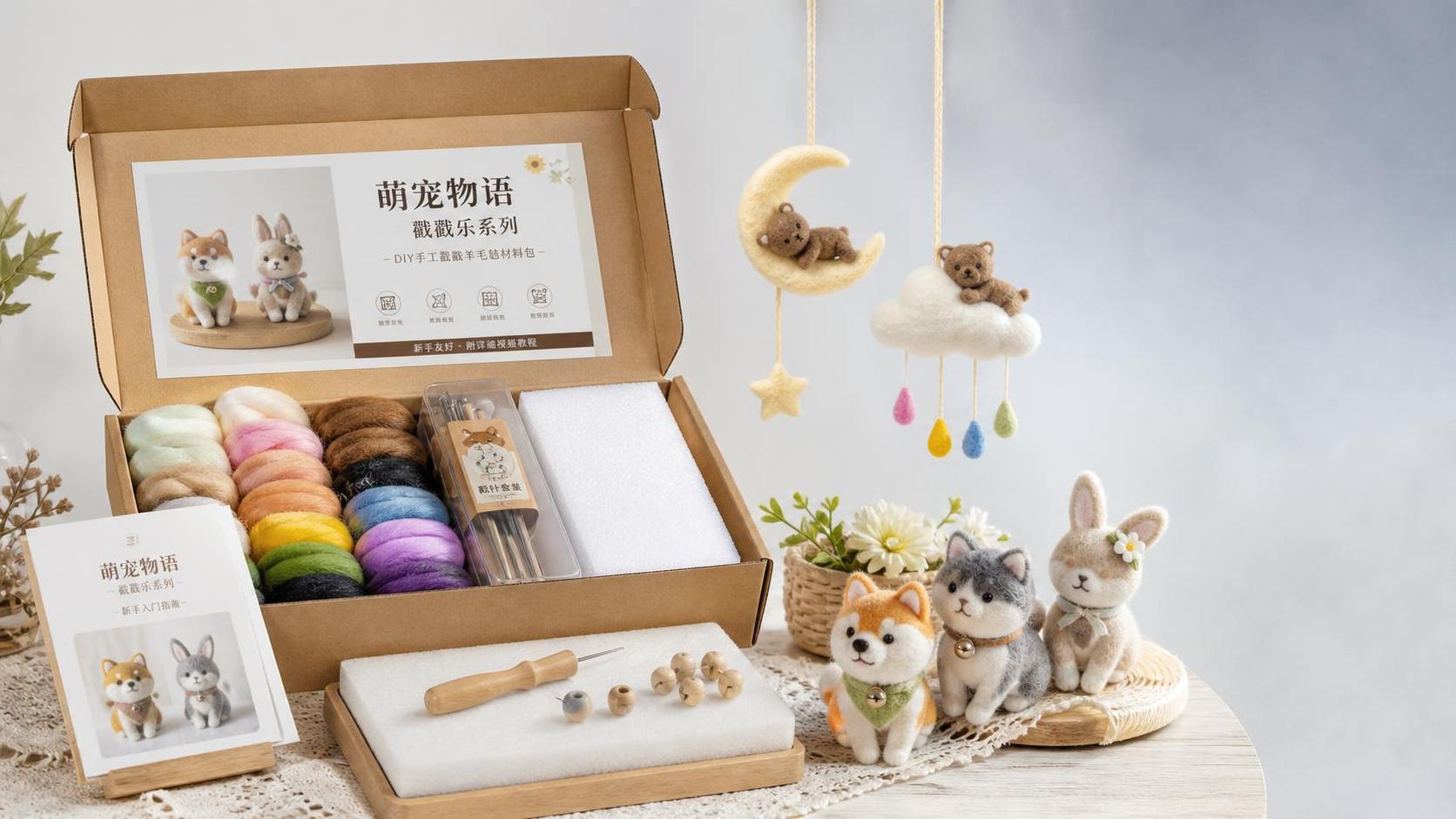
What Buyers Actually Need From a Needle Felting Kit Supplier
Needle felting kits sit at an interesting intersection of craft, gifting, seasonal retail, and home decor. A finished felt ornament, miniature animal, garland, or tabletop accent may look simple, but the kit behind it has to work for a first-time maker. That makes sourcing more demanding than selecting loose wool or choosing a decorative finished item.
For retailers, private-label brands, subscription-box operators, and creative businesses, the central question is rarely whether needle felting is popular in the abstract. The practical question is whether a particular kit can be sold, shipped, displayed, and used with a predictable customer experience. A kit that photographs well but frustrates beginners can create returns and weak reviews. A kit with appealing contents but inconsistent packaging or unclear safety information can become difficult to scale across markets.
That is why evaluating a needle felting kit manufacturer should begin with the complete product system: project design, wool preparation, needles, accessory quality, instructions, packaging, compliance documentation, and delivery reliability.
A Kit Is a Guided Experience, Not Just a Bill of Materials
Many wholesale inquiries begin with a component list: wool colors, felting needles, foam pad, eyes, thread, key rings, or wooden details. Those components matter, but they do not independently determine whether the kit is commercially viable.
The buyer should first define the intended user. A beginner-oriented kit needs enough wool allowance for mistakes, a stable working surface, straightforward shaping steps, and instructions that do not assume existing craft vocabulary. An intermediate kit can offer more complex forms and fewer safeguards, but it needs to make that choice clear on-pack and online. Trying to serve every skill level in one SKU often leads to an unfocused product that satisfies neither group.
Project completion time is also a commercial variable. Small decorative projects that can be completed in one sitting are often easier to position as gifts, weekend activities, or seasonal impulse purchases. More involved designs may command a higher perceived value, but they require better instructions and more realistic customer expectations. A supplier should be able to discuss the intended project duration, difficulty level, finished dimensions, and the amount of material allocated to each step.
For home decor buyers, the final object deserves as much attention as the making process. The finished piece should be suitable for the use case claimed on packaging: hanging ornaments need secure loops, tabletop pieces need a stable base, and keychain designs need attachment points that will not pull loose under ordinary handling. If the product is meant to be displayed in a nursery, living room, or seasonal setting, color fastness, loose-part risk, and dust-prone surface treatment should be considered before artwork is approved.
Where Quality Problems Usually Start
In needle felting, the most visible defect may appear at the end of the project, but the cause is often upstream. Wool that varies too much in fiber length, cleanliness, moisture content, or color can behave differently from one production batch to another. This affects how quickly it felts, how easily it separates, and whether a customer has enough usable fiber to complete the design.
Needles are another common weak point. Their gauge, notch pattern, finish, and protective packaging influence both usability and breakage rates. A low-cost kit can appear competitive until customers discover that needles bend easily or that replacement needles are unavailable. Since needles are sharp tools, the supplier’s packing method and warning language should be assessed alongside the tool itself. A kit intended for children should not simply be a standard adult kit with a different illustration; age grading and product design need to support the claimed audience.
Instructions are often treated as an inexpensive add-on. In reality, they are part of the quality-control process. Buyers should review whether the sequence matches the exact components in the sample, whether key shaping stages are shown clearly, and whether translations have been checked by a fluent editor rather than generated mechanically. A project can become needlessly difficult when photos use prototype materials that differ from mass production colors or accessories.
- Request a pre-production sample that uses the proposed final packaging and instruction version.
- Check wool weight by color, not only total kit weight; a visually small accent color can still be essential to completion.
- Test at least one project with a genuine beginner who has not received prior guidance.
- Confirm how replacement needles, missing pieces, and batch-level defects will be handled.
- Ask whether inner bags, printed inserts, and labels are controlled by the factory or outsourced to separate vendors.
Factory Capability Matters More Than a Broad Catalog
A broad handicraft catalog can be useful, especially for retailers building coordinated home decor collections. However, buyers should separate “can source” from “can control.” A supplier may offer felt kits, wooden accessories, fabric packaging, ceramics, plastics, and handwoven decor through different production routes. That breadth becomes valuable only when sampling, incoming inspection, packaging assembly, and final shipment standards are coordinated.
Ningbo remains a practical sourcing base for this category because it combines export logistics with access to diverse craft-material and packaging supply chains. A company operating certified handicraft production alongside wooden and fabric craft facilities can be well placed to assemble mixed-material kits. Its partnerships with ceramic, plastic, and handwoven producers may also help a buyer develop coordinated gift sets or home decor ranges. Still, the buyer should verify which factory performs each operation and who owns the final quality decision.
Certification is useful evidence, particularly when partner factories are accepted by major European or American retail chains. It should not be treated as a blanket guarantee. The relevant questions are specific: Does the certification apply to the factory producing the order? Is it current? Does it cover social compliance, quality management, chemical controls, or something else? Can the supplier provide documents appropriate to the destination market? These details matter more than a generic claim that a supply chain is certified.
Customization Has Practical Limits
Private-label needle felting kits can be customized through project themes, wool palettes, accessory combinations, insert design, box format, and branding. Seasonal concepts are particularly adaptable: winter ornaments, spring motifs, animal figures, Halloween characters, and craft-and-decor gift sets all give retailers a reason to refresh the assortment.
However, customization introduces complexity quickly. A new design is not finished when its artwork is approved. It needs a prototype, material validation, instruction testing, packaging fit checks, and a workable replenishment plan. A design with many tiny accessories may raise packing errors. A highly specific wool shade may be difficult to reproduce across reorder batches. Premium rigid boxes can enhance shelf presence but increase freight volume and damage exposure.
For this reason, a sensible first order often combines a smaller number of customized elements with proven kit architecture. For example, a buyer may retain a tested box structure and tool set while changing the project design, labels, and color story. Once sell-through and customer feedback are available, a wider bespoke range becomes easier to justify.
Cross-category seasonal programs need the same discipline. A retailer pairing a wool craft activity with temporary window decor should evaluate each item according to its own material and use conditions. For example, Halloween Window Gel Clings Ghost Pumpkin Bat Witch Cat Boo Blood Decal Stickers for Halloween Home Party Window Decorations are designed for smooth surfaces and use soft TPR material. Their reusable, removable positioning may suit party and haunted-house displays, but buyers should still validate adhesion, storage behavior, and package claims in the intended retail market. The lesson applies to needle felting kits as well: an appealing seasonal theme does not remove the need for product-specific testing.
Compliance and Packaging Need Early Attention
Needle felting kits can trigger different requirements depending on how they are marketed and where they are sold. A kit positioned as a toy, a children’s activity, a hobby craft, or a decorative gift may be assessed differently by importers and retailers. Sharp needles, small accessories, dyes, adhesives, plastic bags, and printed warnings all deserve review. Requirements concerning chemical content, labeling, age recommendations, choking hazards, and packaging materials should be confirmed with the importer, compliance team, or qualified testing partner. Specific requirements are market-dependent and should be treated as subject to verification.
Packaging should protect the needles and prevent wool from becoming compressed or contaminated in transit, while still allowing customers to understand the project at a glance. Excessive empty space raises freight costs; overly tight packing can damage components or make the unboxing experience feel disorganized. For e-commerce, drop resistance and barcode placement may matter more than shelf-facing appeal alone. For physical stores, hangability, carton quantity, and planogram dimensions can affect whether a product is accepted by the retail team.
How to Compare Wholesale Offers Properly
Unit price is only one part of the comparison. A lower quotation can conceal reduced wool weight, fewer spare needles, thinner packaging, simplified instructions, or a higher defect tolerance. Buyers should ask suppliers to quote against a fixed specification rather than comparing loosely described “similar” kits.
The most reliable supplier relationship is built around clear specifications and repeatable review points, not assumptions. For a needle felting kit range, that means approving the actual project, the exact materials, the customer instructions, and the packed sample before mass production. Buyers who establish those controls early are in a stronger position to create craft products that feel creative at retail while remaining manageable in the supply chain.
Leave A Message
If you are interested in our products and want to know more details, please leave a message here, we will reply you as soon as we can.

We specialize in supplying home decor, handicrafts, and daily necessities.


