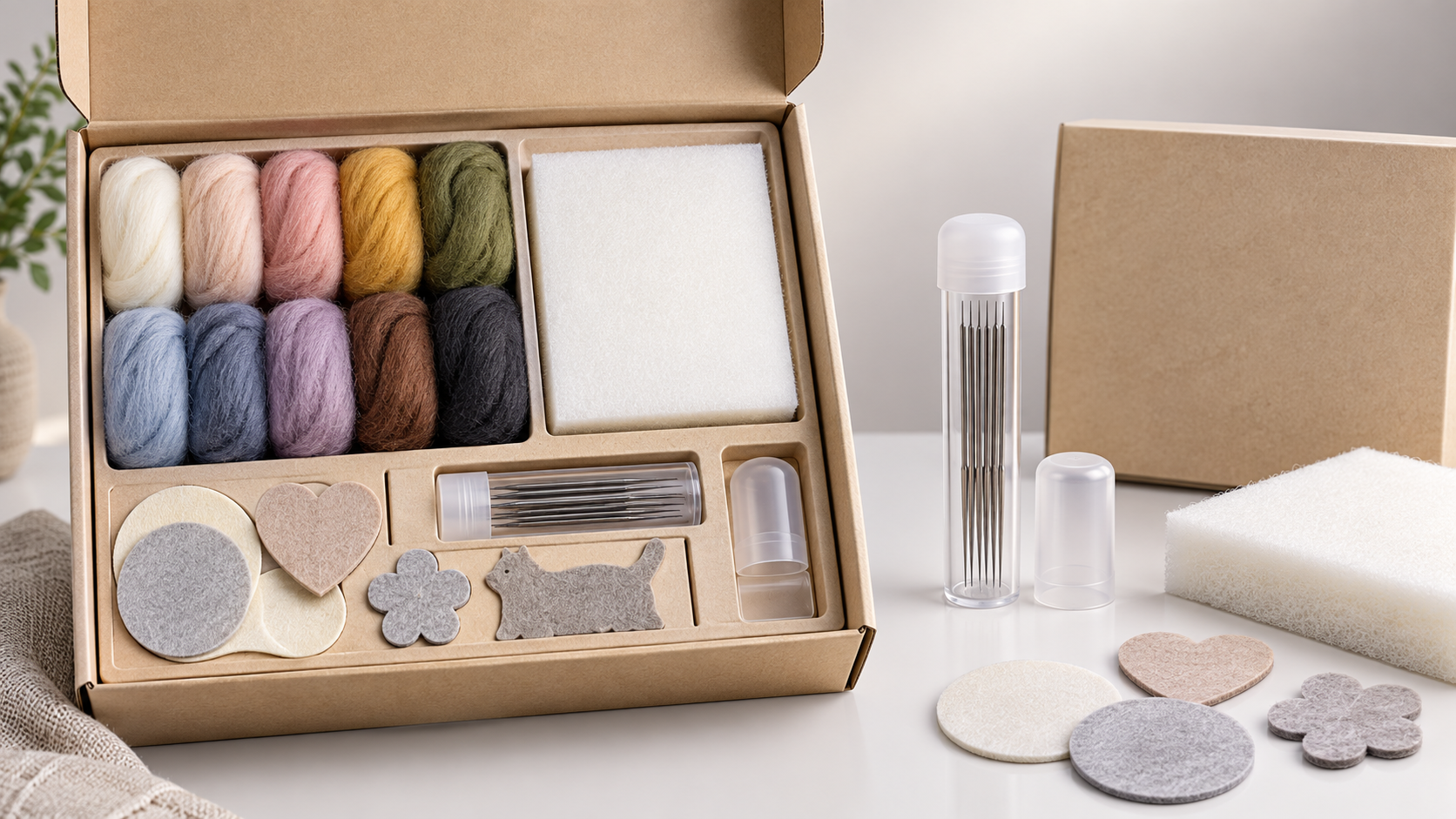
Needle Felting Kit Safety Starts Before the Customer Opens the Box
A needle felting kit deserves the same level of packaging review as other sharp craft tools. The wool, foam pad, templates, and finished-project imagery may make it look like a gentle home decor activity, but the functional component is a barbed metal needle designed to catch and compress fibers. A puncture can occur quickly, particularly when a user reaches into loose packaging, handles an unprotected needle, or treats a multi-needle holder as a toy-like accessory.
For retailers, the practical question is not simply whether the kit contains a warning. It is whether the product presentation, age grading, physical protection, and written information work together. A warning cannot compensate for a needle that can migrate through a thin carton, fall loose when the package is opened, or be mistaken for a harmless decorative component.
Safety review should therefore begin with the complete retail unit: the primary pack, internal retention method, retail display condition, opening sequence, instructions, and any replacement needles sold with the kit.
Classify the risk before writing the warning
Needle felting kits often combine several hazard profiles. The felting needle itself creates a sharp-point risk. Broken needle fragments can create an additional handling and disposal issue. Small accessories, such as needle caps, eyes, beads, buttons, or miniature embellishments, may require separate assessment where a kit is intended for younger users. Wool fibers, adhesives, dyes, or included decorative parts can also affect the product's material and chemical review.
These risks should not be collapsed into one broad statement such as “use with care.” That language is too vague to guide either the purchaser or the user. A retailer needs the supplier to identify which parts are sharp, which parts are small, who is expected to use the kit, and what adult supervision is expected to accomplish.
Age grading is especially important. A craft kit marketed with child-oriented illustrations, simple language, or classroom-style projects may be perceived as suitable for younger users even when the needle makes that inappropriate. The declared age range should reflect the actual task: repeated downward insertion of a sharp, brittle tool into a work surface. It should also align with the product's intended market and the applicable toy, craft-material, consumer-product, and labeling requirements in that market.
Quality teams should avoid assuming that a “not for children” statement resolves the issue. Product imagery, display placement, online category selection, and retailer merchandising can all undermine that message. If a kit is designed for adults or older supervised users, the retail presentation should consistently support that positioning.
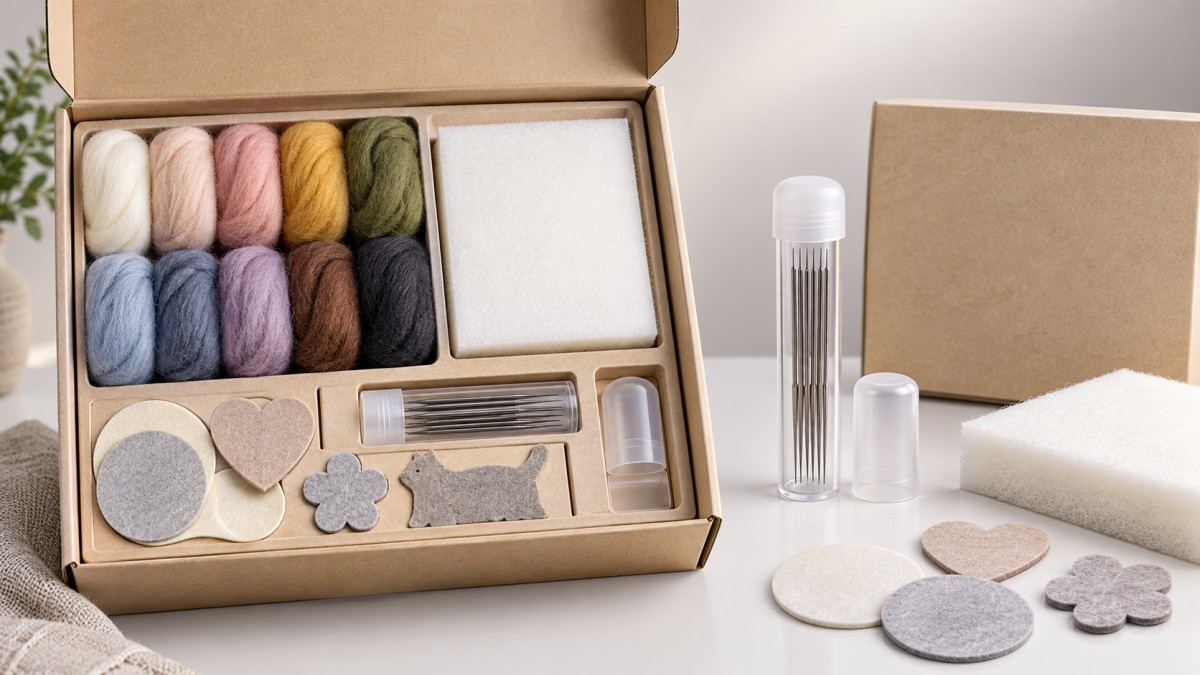
Protect the needle as a physical component, not just an accessory
The first packaging test is straightforward: can a sharp point contact the customer during normal storage, shelf handling, checkout, opening, or return processing? If the answer is possible, the internal pack needs improvement.
Felting needles should be retained in a rigid or purpose-designed protective format. Depending on the kit configuration, this may be a fitted needle tube, a secure blister, a guarded holder, or another closed compartment that prevents movement and shields exposed points. A thin paper sleeve is usually a weak solution when it can split, slide off, or be crushed in transit. Loose needles placed in a polybag with wool are particularly risky because the user may reach into the bag without recognizing the hazard.
Retention must remain effective after normal distribution stresses. A safety review should inspect not only a fresh sample but also units after carton compression, vibration, drops, and repeated handling. The needle should not become detached inside the pack, penetrate the outer carton, or sit beneath an opening flap where fingers naturally enter.
Multi-needle tools require their own review. If the kit includes a handle with replaceable needles, the tool should arrive with a cap, guard, or protective storage position. If a cap can detach easily and become a small part, its retention and age implications should be assessed separately. The package should also make clear whether replacement needles are included, where they are stored, and how they are accessed.
Warnings must describe the hazard and the behavior expected
Effective warnings are visible before the customer opens the kit and are repeated where the user needs them. The outer package handles point-of-sale communication. The instruction sheet handles safe setup, use, storage, and disposal. A warning hidden beneath internal tissue paper or printed only in an online listing is not enough for a sharp-tool kit.
Wording should be direct, specific, and consistent with the actual contents. In many cases, the warning set should address the following points:
- The kit contains sharp felting needles or sharp functional points.
- The product is intended only for the stated age group, with adult supervision where applicable.
- Users should work on a suitable felting pad or protected surface and keep fingers away from the needle path.
- Needles must be stored in their protective container after use and kept away from young children.
- A damaged, bent, or broken needle should not be used; fragments should be handled carefully and disposed of safely.
- Instructions should be read before use, particularly where needles need to be installed, removed, or replaced.
The phrase “sharp needle” should not be softened into decorative language such as “craft pin” when the component can puncture skin. Likewise, a package should not promise that a kit is “safe” without defining the intended conditions. Properly protected packaging and clear directions reduce foreseeable risk; they do not remove the inherent need for careful handling.
Warnings also need to be legible in the market where the product is sold. Font size, contrast, placement, language, and permanence matter. Retailers should confirm that mandatory warnings remain readable after barcode labels, price stickers, promotional sleeves, or translation labels are applied. A well-written warning covered by a retailer-applied label has failed operationally.
Instructions should prevent the common failure points
For a needle felting kit, instructions are part of the safety control system. They should explain how to unpack the needle without touching the point, how to place material on the felting surface, and how to hold the work so hands remain outside the stabbing path. A simple diagram can help, but the text must still communicate the safe sequence clearly.
There should also be guidance on needle breakage. Felting needles are slender and may break if they are inserted at an angle, forced through dense material, or twisted while embedded in the wool. Users should be instructed to work vertically, avoid excessive force, and stop using a needle that is bent or damaged. If the kit includes a replacement procedure, the steps should identify how to remove and install the needle without exposing the user to unnecessary contact.
Retail quality teams should compare the instruction sheet with the actual product. If the leaflet tells users to place a protective cap on the tool, every production unit must contain that cap and it must fit. If the instructions show a foam work pad, but the kit ships without one, the packaging should not imply that the activity can be performed safely on any household surface.
Review the pack as it will appear in a retail channel
Compliance documentation is important, but it does not replace a physical pack review. Before approval, inspect samples taken from normal production rather than a hand-prepared prototype. Confirm the bill of materials, component count, safety data where relevant, applicable test records, labeling artwork, and language versions. The documentation should identify the sharp component and match the finished package exactly.
A practical receiving inspection can focus on a few repeatable questions:
Online retail creates an additional control point. The listing should preserve the same age and sharp-tool messaging shown on the physical package. Product photos that show needles inserted into wool can be useful, but they should not depict unsafe hand placement. Marketplace content, storefront images, and downloadable instructions should be treated as part of the product communication, especially when customers purchase without handling the box first.
Where retailers most often lose control
Problems often emerge after the original package design has been approved. A supplier may substitute a needle sleeve, reduce the thickness of an internal tray, move the warning to make room for seasonal graphics, or add decorative components without updating the age assessment. Retailers should treat each of these as a controlled change rather than a minor production adjustment.
Mixed assortments need close attention as well. A boxed craft collection can contain multiple project types, yet the sharpest component should determine the handling precautions for the full unit. It is not sufficient for one inner project bag to carry a warning if the outer assortment is sold as a single consumer product and gives no indication of the needle hazard.
The safest retail outcome comes from aligning product design with the real use environment. When the needle is securely retained, warnings are unmistakable, instructions address the moment of risk, and age positioning matches the activity, the kit is easier for store teams to receive, merchandise, and sell responsibly. That is the standard worth applying before a needle felting kit reaches the shelf.
Leave A Message
If you are interested in our products and want to know more details, please leave a message here, we will reply you as soon as we can.

We specialize in supplying home decor, handicrafts, and daily necessities.


