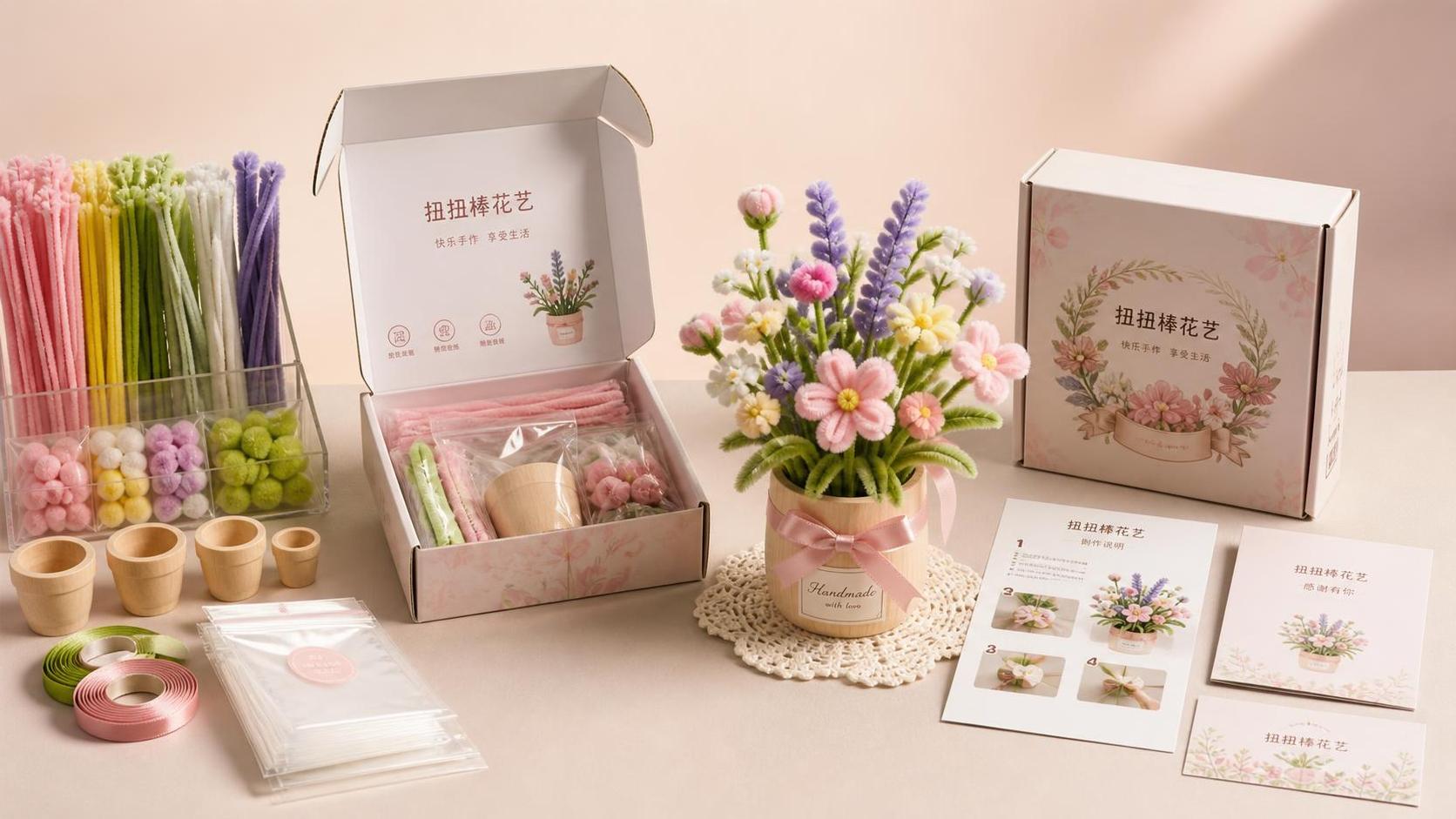
An OEM pipe cleaner craft kit manufacturer in China must translate an idea into a repeatable, retail-ready activity set. A finished kit is judged by far more than the appearance of the completed project. The wire must bend smoothly without exposing sharp ends, colors must stay consistent across components, instructions must match the actual contents, and the packed set must remain orderly after transport. When the kit is intended to sit alongside home decor crafts or seasonal gift items, its presentation also needs to feel considered enough for display-oriented retail environments.
Pipe cleaners, often called chenille stems, are simple materials with tightly connected production details. A typical stem combines a central wire with polyester, nylon, or similar textile fibers twisted around it. Wire gauge affects stiffness, shape retention, and the force required to bend the stem. Fiber density affects softness and coverage. A sparse pile can reveal the inner wire after repeated bending, while excessive fiber may make small twists bulky and difficult to secure. These details should be agreed during development rather than judged only from a single finished sample.
Defining the kit before sampling
The most useful starting point is a clear component map. It identifies every stem color and length, pom-pom size, adhesive element, eye, bead, backing card, instruction sheet, and outer package required for one unit. This avoids a common production error: approving a photographed craft design without defining the count and specification of the loose materials needed to recreate it.
A practical component map separates consumable craft parts from decorative or functional accessories. For example, a flower-making kit may include green stems for leaves and structure, brighter stems for petals, a short length of ribbon, and a small pot-shaped base. If the base is intended to support the completed item as desk decor, its opening diameter and weight need attention. A base that looks suitable in a product image may tip after the stems and embellishments are added.
Dimensions should be stated in measurable terms. Stem length, wire diameter where relevant, pom-pom diameter, card thickness, bag dimensions, and finished package dimensions all affect packing efficiency and product usability. Color instructions benefit from approved physical swatches or clearly named references. Screen-based colors are useful for concept work, but they can vary by display and are not a sufficient standard for production approval.
Material decisions affect the crafting experience
Pipe cleaner kits often combine soft textile materials with small molded, paper, wooden, fabric, ceramic, or handwoven accents. The right combination depends on the intended project. A flexible animal figure requires stems that can form compact loops and hold small curves. A wall hanging or a decorative floral arrangement may prioritize visual fullness, longer stems, and components that remain attractive from a distance.
For exposed wire ends, the design should specify the finishing method. The end may be folded inward, concealed under a pom-pom, covered by another component, or positioned where it will not be touched during normal assembly. A vague instruction to “twist tightly” is not enough. Tight twisting can leave a pointed end facing outward, especially when a project contains multiple short segments. Prototype review should include repeated handling, disassembly where applicable, and inspection of the finished craft from all sides.
Glue is another area where concept and factory execution can diverge. Some kits include adhesive dots, double-sided foam pieces, liquid glue bottles, or no adhesive at all. The choice changes the packaging layout and the instruction sequence. Liquid adhesive can create leakage considerations and may require a different packing approach. Adhesive dots must be sized for the surface and load they are expected to hold. A decorative felt piece may stay in place with a small dot; a weighted wooden accent may not.
Paper instructions also need to reflect the actual materials. If a stem is supplied at 30 cm but the illustration shows two equal 15 cm sections, the cutting step must be explicit. If color substitutions are allowed because a palette is seasonal, the instruction artwork should identify components by both color and symbol or item number. This reduces confusion when closely related shades are packed together.
From concept sample to production sample
Sampling usually works best in stages. The first stage confirms the craft idea, proportions, and color direction. It can use readily available materials and may not represent final packaging. The next stage should use intended materials, counts, and print files. At this point, the craft needs to be assembled strictly from the contents of one proposed retail unit. Extra stems or substitute parts kept nearby can hide a packing shortfall.
A production sample should answer practical questions that photographs cannot: Does the wire recover after forming? Do pom-poms shed fibers? Is a printed instruction readable at its final size? Does the inner bag tear when components shift? Can small parts migrate into another compartment? Does the outer carton protect the kit without crushing decorative accessories?
For kits with multiple projects, separating materials by project can improve the opening experience, but it adds packing steps and increases the chance of a wrong assortment. A shared-material format is more compact, although instructions must clearly show how many pieces are needed for each design. There is no universal better option. The deciding factor is whether the proposed arrangement remains intuitive once the package is opened and components are spread on a table.
Packaging needs a working tolerance
Craft kits are often packed with lightweight components that shift easily. An apparently neat layout can become disordered after vibration, stacking, and changes in carton orientation. Small bags, paper bands, trays, and backing cards can each control movement, but they must be matched to the component type. Loose chenille stems may be held by a paper tie or placed in a sleeve; small round elements generally need a sealed bag; flat instruction sheets benefit from a position that prevents folding around bulkier items.
Outer packaging should allow a sensible tolerance around the actual component volume. Too much empty space causes movement and a flat-looking retail presentation. Too little space bends stems, creases cards, and puts pressure on dimensional accessories. When a kit includes handmade-style elements, such as a small yarn figure or a fabric embellishment, a protective insert may be warranted because a compressed surface can be difficult to restore neatly.
The package should state only what has been confirmed. Project count, component count, material description, and age-related wording all need to match the approved contents and applicable market requirements. Claims such as “easy,” “safe,” or “non-toxic” should not be treated as decorative copy; they require a defined basis and should be reviewed against the final materials and destination-market obligations.
Quality control is built into the assembly sequence
Final inspection is stronger when it follows the way the kit is actually packed. Incoming materials can be reviewed for shade, size, odor, surface condition, and visible contamination. During kitting, component counting should be tied to the packing layout rather than handled as an informal estimate. A weight reference can identify a noticeably incomplete pack, but it cannot replace count verification when several small pieces have similar mass.
- Stem bundles should be checked for length variation, uneven fiber coverage, loose twists, and ends that extend beyond the pile.
- Printed sheets need a comparison with approved artwork, including step order, language, part labels, and any warnings that belong on the final version.
- Decorative parts such as wood pieces, fabric shapes, or molded plastic elements need attention to splinters, fraying, flashing, sharp edges, and color transfer.
- Sealed component bags should be examined for closure strength and the presence of the full assortment, particularly when several projects share nearly identical small parts.
Carton marking is also part of product control. Carton quantity, gross weight, dimensions, handling marks when needed, and item identification should align with the shipping documents and physical contents. An incorrect carton quantity creates avoidable receiving issues even when every retail package inside is correct.
Customization without losing production clarity
OEM development can cover the project theme, stem palette, component combination, printed insert, gift-ready format, and packing configuration. Customization works best when changes are grouped around a stable craft construction. Altering every material, color, accessory, and packaging feature at once makes it difficult to identify the cause of a problem during sampling.
For instance, an encouragement-themed desk item may use soft yarn alongside pipe cleaner details, a small message card, and a compact display format. The emotional character of the design comes from its proportions and expression as much as from its text. A reference such as Positive Crochet Salamander Birthday Gifts for Women Men Teacher Appreciation Mothers Day Graduation Gift Adult Kids Son Mom Dad Daughter Sister Friend Coworkers Self Care Emotional Inspirational Support illustrates how a handmade yarn figure, a pun card, and a small decorative function can be combined for occasions including birthdays, graduation, teacher appreciation, or everyday encouragement. When adapting this type of concept into a kit, the assembly complexity must remain appropriate for the intended format. A finished handmade item and a do-it-yourself kit do not share the same material count, instruction burden, or quality risks.
Seasonal assortments require additional discipline. Color changes may appear minor, yet they can alter stem availability, pom-pom matching, print accuracy, and carton separation. Each variation should have a distinct bill of materials and artwork reference. Relying only on a collection name can cause similar designs to be packed with the wrong card, accent color, or instruction sheet.
Freight planning begins with the packed unit
Pipe cleaner craft kits are usually light, so package dimensions and carton utilization can influence freight planning as much as material weight. Bulky display boxes, oversized inserts, and loosely arranged stem bundles consume volume quickly. Packaging development should therefore consider the retail opening experience and master-carton efficiency together.
Moisture exposure can affect paper inserts, uncoated boxes, textile components, and certain adhesives. Long transit routes may call for appropriate inner protection and dry packing practices based on the product construction and shipping conditions. Cartons should be stacked in a way that avoids deforming the retail packs at the bottom. A kit with an attractive front panel but weak sidewalls can arrive with visible compression even if its internal craft components remain usable.
A dependable OEM pipe cleaner craft kit depends on exact definitions carried through every stage: the craft construction, material behavior, counted contents, instruction artwork, package tolerance, and carton arrangement. When these details are resolved before full production, the final set is easier to assemble, inspect, pack, transport, and present as a thoughtful home decor craft item.
Leave A Message
If you are interested in our products and want to know more details, please leave a message here, we will reply you as soon as we can.

We specialize in supplying home decor, handicrafts, and daily necessities.


