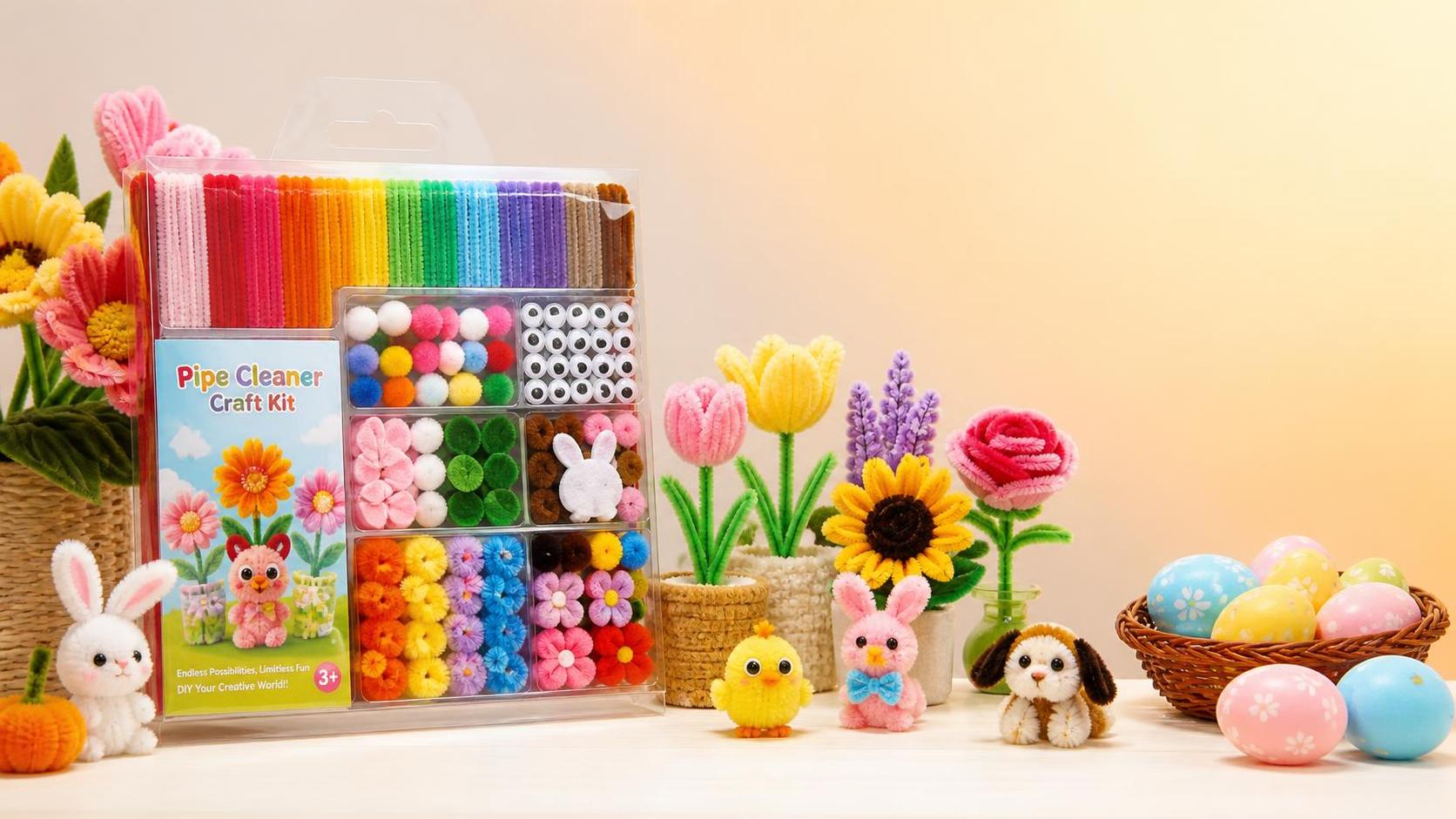
Wholesale Pipe Cleaner Craft Kits can be a reliable DIY category when the buying decision starts with the right questions: how many units can be ordered, what the quote actually includes, and how the kit will look once it reaches a shelf or doorstep. A low unit price means little if the contents are inconsistent, the packaging is weak, or the assortment does not match the age group and retail channel.
Pipe cleaner kits work because they are simple to understand. Customers can twist, bend, connect, and decorate without specialist tools. For home activity ranges, holiday displays, classroom projects, party favors, and small seasonal gift lines, that accessibility is a real commercial advantage. Still, “simple” should not be mistaken for “easy to source.” The details behind component selection, color consistency, packing method, and MOQ planning decide whether a wholesale program is profitable or difficult to manage.
Wholesale Pipe Cleaner Craft Kits: Start With the Product Brief
Before asking for a quotation, define what the finished kit is meant to do. A basic pack of assorted chenille stems is not the same product as a guided craft kit with eyes, pom-poms, felt shapes, glue dots, printed instructions, and a retail header card. Suppliers need that distinction early because each added component affects assembly time, sourcing risk, packaging volume, and minimum order quantity.
A practical brief should answer a few straightforward questions:
- What age range is the kit designed for?
- Will customers make one featured project, several small projects, or create freely?
- Is the product intended for everyday craft use, a school activity, a party, or a seasonal promotion?
- What components must be included, and which ones are optional?
- Does the item need a branded box, a polybag with header card, a paper band, or bulk packing?
- Are there destination-market labeling, testing, warning, or language requirements to confirm?
This sounds basic, but incomplete briefs are one of the most common reasons wholesale samples and final orders drift apart. A buyer may approve a colorful sample without confirming the exact stem length, wire thickness, number of colors, or accessory count. Later, the supplier prices a different interpretation of the kit. A clear component list prevents that problem.
For a compact craft kit, it is useful to specify the contents in measurable terms: for example, the number of pipe cleaners by color, the count and size of pom-poms, the type of eyes, the instruction sheet size, and the individual retail packing format. It also helps to state what is not acceptable, such as loose glitter, fragile decorations, sharp wire ends, or heavily mixed color lots.
MOQ Is Not Just a Number
MOQ, or minimum order quantity, is often treated as the first negotiation point. It should be treated as a production planning question instead. A supplier may be able to offer a lower MOQ for a standard assortment packed in an existing format, while a custom-color kit with a printed box and unique instruction booklet may require a higher quantity to make production viable.
The important distinction is between an MOQ per design, per colorway, per packaging style, and per total order. A buyer may hear that the MOQ is manageable, then discover that each seasonal theme or box design must meet that threshold separately. Ask for the MOQ breakdown in writing before developing too many variations.
For first-time orders, a focused range is usually more sensible than a broad collection. One well-defined everyday kit and one seasonal version can test demand without spreading the order across too many low-volume SKUs. Once sell-through is understood, additional themes, colors, and pack sizes can be introduced with more confidence.
There are situations where a lower MOQ is not the best result. If it forces manual assembly, mixed substitute components, or expensive packaging setup per unit, the final landed cost may become uncompetitive. A slightly larger order based on a proven design can produce a better unit cost and a more consistent retail product.
How Wholesale Pricing Is Really Built
There is no dependable universal price for a pipe cleaner craft kit. Pricing depends on the bill of materials, labor, packaging, order quantity, inspection requirements, freight method, and the commercial terms used in the quotation. Any supplier that gives a very precise price before confirming these basics is likely giving an estimate that will change later.
The biggest cost driver is usually not the pipe cleaner itself. It is the combined complexity of the kit. A pack with standard stems has a different cost structure from a set that includes multiple small accessories, sorting by color, individual instruction sheets, sealed retail packaging, barcodes, and a custom printed carton.
Packaging has a larger impact than many buyers expect. A printed color box can improve shelf appeal and protect the contents, but it may involve artwork setup, minimum print runs, carton dimensions, and more warehouse space. A clear bag with a header card may be more economical for an entry-level line, especially when the colorful materials are meant to remain visible. Neither is automatically better. The right choice depends on the intended price point and where the product will be sold.
When comparing supplier quotations, make sure the same scope is being compared. Check:
- Component count and exact materials
- Individual packing and master carton packing
- Printed inserts, labels, barcode application, and warning labels
- Sampling charges and revision limits
- Quality-control process and acceptable defect standard
- Shipping term, port, and freight responsibility
A quote that appears cheaper may exclude assembly, retail labeling, or export cartons. That is not necessarily misleading, but it is not a useful comparison until every line is clarified.
Packaging Should Match the Way the Kit Is Bought
Pipe cleaner crafts are tactile and visual. Packaging should make the contents easy to understand in a few seconds. Parents and gift buyers often want to see that the kit has enough materials to complete the pictured project. Craft-focused customers may care more about color range and quantity. A retailer with limited shelf space may prioritize a compact hanging format.
For a guided project, show a finished example clearly and state the main contents without crowding the front panel. For an open-ended activity set, communicate the variety of colors and materials. Avoid promising a result that cannot be made with the contents inside. If scissors, glue, or adult help are required, that should be addressed clearly in the instructions and packaging review.
Seasonal programs need extra discipline. A festive craft kit purchased late in the season has a short selling window, so artwork approval, sample confirmation, production time, and freight booking should be planned backward from the retail delivery date. The same principle applies to Christmas home activity assortments. A complementary product, such as Christmas Gel Window Clings - Xmas Santa Claus Snowman Snowflake Penguin Christmas Tree Gift Window Stickers for Kids, can help create a cohesive holiday craft-and-decor display. Its reusable soft TPR material and bright window-friendly designs suit homes, classrooms, and Christmas parties, while pipe cleaner kits add a hands-on making activity. They work well together as a coordinated seasonal assortment, not as interchangeable products.
Do not over-package a value-focused kit. Excessive layers of plastic, oversized boxes, and elaborate inserts can make a simple activity feel overpriced while increasing freight volume. On the other hand, under-protecting a kit with small parts may lead to crushed packs, missing components, or poor shelf presentation. Good packaging is proportionate: protective enough, informative enough, and aligned with the retail price.
Material and Assembly Checks That Prevent Complaints
Pipe cleaners are often called chenille stems, but specifications still vary. The stem length, density of the fuzzy pile, wire flexibility, end treatment, shedding behavior, and color appearance all influence the customer experience. A stem that is too soft may not hold a shape. One that is too stiff can be hard for younger users to bend. Exposed or poorly finished wire ends are an obvious quality concern.
Ask to inspect a representative sample rather than judging from a component photo. Make a few of the intended projects. See if the stems keep their shape, if accessories fit as planned, and if the packed quantity is sufficient. This simple exercise often reveals a problem with the instructions or material count before mass production begins.
For kits containing small pieces, confirm the intended age grading and applicable market requirements with the appropriate qualified testing or compliance partners. Requirements differ by destination and product design, so they should not be assumed from a previous order. It is also wise to agree on a pre-shipment inspection approach: count accuracy, color assortment, package sealing, print quality, barcode scanability, and carton condition are more useful checks than a vague request for “good quality.”
In actual retail programs, missing pieces can create more customer dissatisfaction than an imperfect color shade. A kit may look attractive in photographs, but it fails its purpose if a child cannot finish the featured project because an essential accessory is absent. Component counting and sealing deserve attention.
Choosing a Supplier for Repeat Orders
The best sourcing relationship is not built on a single attractive sample. It depends on whether the supplier can keep materials, assembly standards, and delivery communication stable as the program grows. This matters especially for home decor and seasonal gift ranges, where a late shipment may miss the selling period entirely.
Ningbo is a practical sourcing base for mixed home and craft assortments because it connects production capabilities with export experience. Our company operates two certified factories: one focused on handicrafts and another specializing in wooden and fabric crafts. We also work with certified partner manufacturers in ceramics, plastics, and handwoven products that serve major European and American retail chains. That network supports coordinated sourcing for home decor crafts, handicrafts, and daily necessities when a range includes more than one material category.
For pipe cleaner craft kits, this broader supply chain can be useful when the project requires fabric embellishments, wood components, plastic accessories, paper packaging, or a matching seasonal decoration. It does not mean every kit needs every material. Keeping a design focused is often the better commercial decision. The value lies in being able to source compatible components through a stable process rather than assembling a product from disconnected suppliers.
Before placing a production order, confirm the approved sample, final packing artwork, production timeline, carton marks, payment terms, and inspection standard. Keep the final reference version documented. Verbal approvals are easy to misunderstand when colors, accessories, and packaging are changing at the same time.
Questions Buyers Commonly Ask
Can a wholesale order include several designs?
Usually, yes, but the MOQ may apply to each design or packaging variation. It is better to ask how designs can be mixed within a total order than to assume every SKU can be produced in a small quantity.
Should I choose a custom printed box for a first order?
Choose it when brand presentation and shelf impact are central to the product strategy. For a market test or lower-priced range, a professionally designed header card or band can be more flexible and reduce setup exposure.
What should be approved before mass production?
Approve the physical sample, component list, final artwork, packing layout, and shipping carton details. If the kit includes instructions, assemble the project from those instructions before approval.
Is the cheapest quote usually the best buying option?
No. A lower quote can be suitable when the specification is genuinely equivalent. It is risky when it relies on fewer components, weaker packaging, lower assembly control, or terms that leave important costs outside the price.
Wholesale Pipe Cleaner Craft Kits perform best when they are treated as finished retail products, not just bags of inexpensive craft materials. Define the activity, control the component list, ask how the MOQ applies, compare complete quotes, and choose packaging that supports the intended channel. Those steps create a more dependable program and give customers a kit they can actually enjoy using.
Leave A Message
If you are interested in our products and want to know more details, please leave a message here, we will reply you as soon as we can.

We specialize in supplying home decor, handicrafts, and daily necessities.


