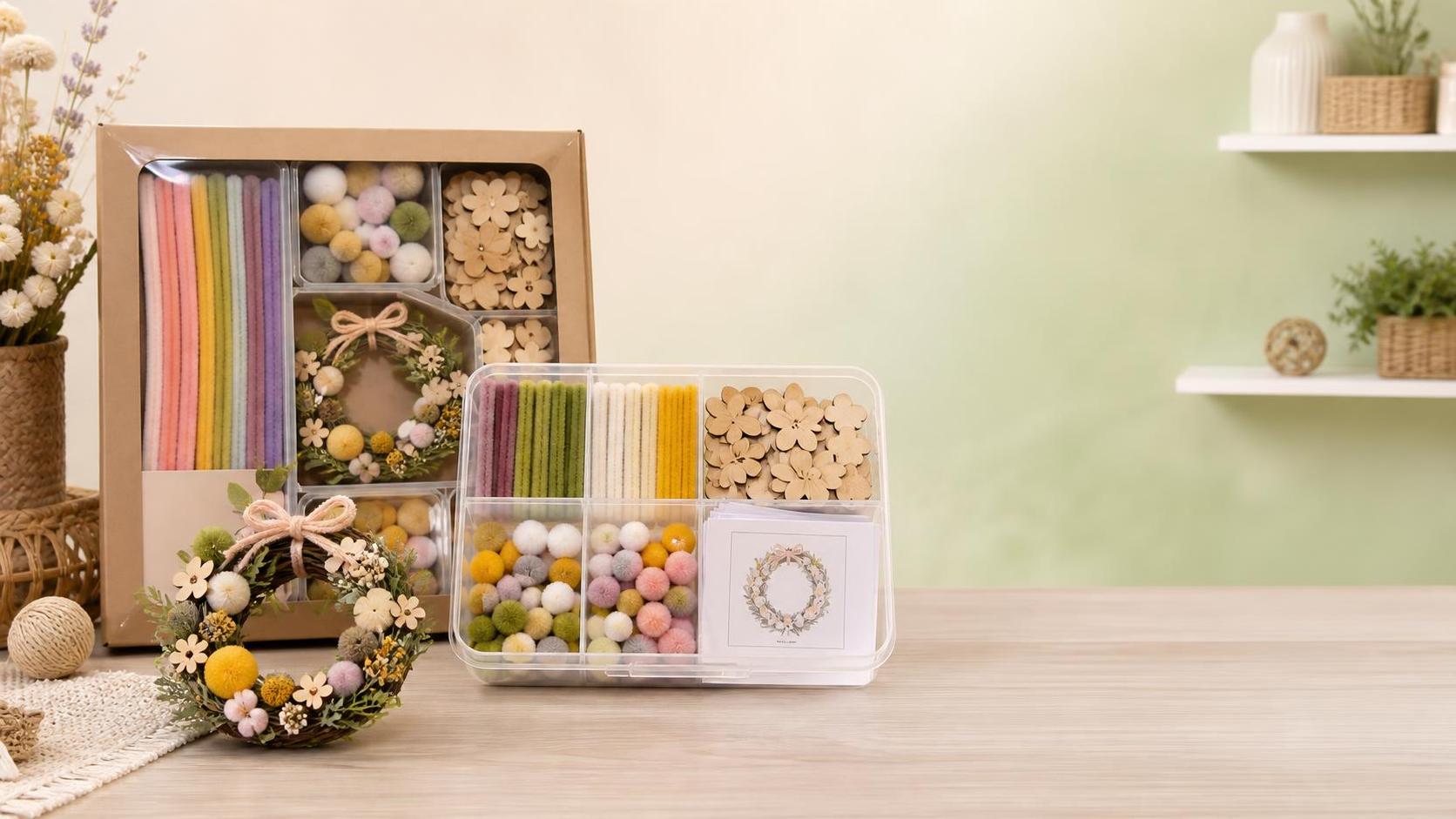
A craft kit can look perfectly assembled on a worktable and still fail its first retail test before a shopper ever opens it. This often happens when pipe cleaners, pom-poms, wooden pieces, glue accessories, or instruction sheets shift inside the package, become tangled, or are hidden behind packaging that gives no clear sense of the finished project. In a busy store aisle, people usually make quick decisions. If the kit looks disorganized, fragile, or difficult to understand, it can be passed over even when the craft activity itself is appealing.
The problem becomes more frustrating when packaging is treated as an afterthought. A retailer may receive kits that are attractive in bulk cartons but awkward to stack, difficult to hang, or too easily crushed during handling. For home décor and handicraft assortments, packaging also needs to support the mood of the project. A cheerful children’s animal kit, a seasonal garland activity, and a rustic home decoration set should not all be packed the same way. Choosing suitable Pipe Cleaner Craft Kit Packaging Options for Retail starts with understanding what the customer needs to see, what the materials need to survive, and how the product will actually be displayed.
Start with the moment a shopper picks up the kit
Before selecting a box, bag, or container, it helps to picture the retail interaction. A shopper may notice the kit from several feet away, pick it up with one hand, turn it over, and decide whether it is suitable for a gift, a rainy-day activity, a party project, or a seasonal display. Packaging has only a short time to answer practical questions: What can I make? Are the materials included? Is this appropriate for the intended user? Will the finished item look like something I want in my home?
Pipe cleaners are lightweight, flexible, and colorful, but those qualities create packaging challenges. They can bend out of shape, catch on other components, or look sparse when laid flat in a large box. Small accessories can disappear behind a busy printed design. If a kit includes wooden shapes, beads, felt, ribbons, or decorative pieces, the package must prevent the heavier items from pressing into softer materials during transport.
A useful first step is to separate the kit into three packaging roles:
- The visual layer: the part that introduces the project and helps the shopper recognize its theme.
- The protection layer: the structure that keeps wire stems, paper instructions, and small craft components orderly.
- The retail layer: the format that works on a shelf, pegboard, display bin, or gift table.
When one package tries to perform all three roles with a single thin plastic bag, problems usually appear. The bag may be economical, but it may not show the project well or keep materials neat. On the other hand, a rigid gift box may look polished but create unnecessary volume for a simple low-component activity. The right choice depends on the project’s complexity and its expected retail environment.
When a clear window box makes sense
Window boxes are often useful when the colors and textures of the materials are part of the appeal. Bright pipe cleaners, soft pom-poms, shaped wooden cutouts, and patterned fabrics can create an immediate impression behind a transparent front panel. This approach works especially well for kits where the shopper benefits from seeing that the contents are plentiful and coordinated.
However, a clear window should not reveal a loose pile of components. The internal arrangement matters as much as the box itself. Pipe cleaners can be grouped with a paper band, positioned in a shallow tray, or secured in separated sections. Smaller parts may be placed in a labeled inner pouch rather than scattered across the bottom. If the kit contains a finished-sample image, place it where it is visible without blocking the actual materials.
Window packaging is particularly practical for medium-sized kits that will sit face-forward on shelves. It is less suitable when the project contains very fine loose pieces that do not present well visually, or when the components need stronger moisture and dust protection. In those cases, the front can still use a small viewing area, while the rest of the contents remain enclosed in interior packets.
Keep the front panel focused
One common mistake is trying to put every instruction, component list, age note, decorative pattern, and project photo on the front. The result can feel crowded and make the kit harder to understand. A better approach is to let the front communicate the craft theme, the finished outcome, and one or two clear material cues. Detailed instructions, assembly notes, and safety information can move to the back or an insert.
This matters for home décor craft ranges because the project may be chosen partly for its visual style. A rustic floral activity should feel different from a bright party craft, even if both include pipe cleaners. The package colors, type treatment, and material arrangement should support that difference instead of relying on generic craft graphics.
Reusable tubs solve a different retail problem
For family activity kits, classroom-style assortments, and multi-project sets, reusable storage tubs can be more useful than decorative boxes. Their main advantage is not simply durability. They give the buyer a place to put leftover materials after the first activity is completed. Pipe cleaners are easy to reuse, but only if they remain separated from sticky items, loose glitter, and small embellishments.
A transparent or semi-transparent tub can also help shoppers see the quantity of materials without opening the package. This is helpful for kits intended for repeated crafting rather than one finished object. Dividers, removable inner cups, or individually packed project bundles can prevent the tub from becoming a mixed assortment before it reaches the shelf.
There are trade-offs. Tubs take up more space in transit and may be less effective for shallow shelving. They can also look overly utilitarian if the printed label does not explain the creative purpose of the contents. Use this format when storage is a genuine part of the product experience, not merely because a plastic container seems more protective.
For a broader home decorating assortment, reusable packaging can also support a project that remains visible after the craft session. For example, a retail presentation that includes complementary seasonal items can help a shopper imagine where the finished piece will go. A vertical porch or entryway theme may sit naturally near an item such as Wooden Large Vertical Love Grows Here Porch Decor, Garden Welcome Standding Sign Garden Decor Sign, Welcome Wall Sign for Yard Porch Farmhouse Door Decoration. Its rustic wood construction, soft green background, white wood-grain appearance, double-sided design, and pre-attached hanging rope suit a welcoming seasonal décor setting. The craft kit does not need to imitate the sign; it simply needs packaging that helps the shopper understand the shared decorating mood.
Flat packs can work, but only when the project is designed for them
Flat paperboard packs are appealing because they are easy to stack, hang, and organize in compact retail areas. They work best when pipe cleaners can be aligned flat and the remaining components are lightweight. A folded instruction sheet, die-cut board, small sealed bag of accessories, and a header card can create a tidy format for simple projects.
The weakness of flat packaging is that it can make a kit appear less substantial than it is. This is especially true if the pipe cleaners are the largest visible component and the smaller decorative materials are hidden. To avoid that impression, show the completed craft prominently and make the included materials easy to identify. A modestly sized kit can still feel intentional if the presentation is organized.
Flat packs are also a poor choice for projects with bulky pom-poms, fragile formed elements, or wooden pieces that could create pressure points. If the package must remain flat, consider whether a shallow blister, reinforced backing, or folded side gusset is needed. The package should not arrive bent, with pipe cleaners permanently creased or decorative components rubbing against the printed front.
Gift-ready packaging should remove uncertainty
Some craft kits are purchased as gifts, especially around holidays, birthdays, or home entertaining seasons. Gift-ready packaging does not require elaborate decoration. It needs to feel complete and intentional. A sturdy lidded box, a sleeve over a rigid tray, or a well-designed carton with a carry-friendly shape can help the product look suitable for immediate giving.
For these kits, avoid forcing the buyer to guess whether tools or instructions are missing. If the activity requires scissors, paint, or glue that is not included, say so clearly. If everything needed for the project is inside, make that visible without making exaggerated claims. The goal is to prevent disappointment at the moment the package is opened.
A gift-oriented kit also benefits from a calm internal layout. Rather than filling the box with loose colorful pieces, bundle materials by project stage: base pieces together, decorative elements together, and instructions on top. This arrangement makes the kit feel easier to begin and reduces the chance that a gift recipient opens it to find a confusing mixture of supplies.
Choosing paper-based packaging without losing function
Paperboard cartons, sleeves, and kraft-style envelopes are often considered when a retailer wants a less plastic-heavy presentation. They can be a sensible choice, but paper packaging should be evaluated by function rather than appearance alone. A thin uncoated carton may fit a natural craft theme, yet it can scuff easily in a high-contact retail area. A paper bag may work for a simple bundled activity but may not offer enough structure for components that must stay flat.
For an eco-conscious direction, several practical decisions matter more than decorative claims. Reduce unnecessary empty space. Use an insert only when it keeps materials in place. Choose a package shape that fits the product rather than forcing the product to fit an oversized carton. If a plastic inner bag is needed to prevent small parts from escaping or to keep moisture-sensitive materials protected, it should be treated as a functional part of the pack, not hidden behind vague messaging.
Paper packaging can be especially effective for rustic, garden-inspired, or handmade-looking craft concepts. Natural textures, restrained printing, and a visible project image can create a warm presentation. Still, test whether the package holds up when stacked, handled repeatedly, and placed near other products with sharper corners or heavier weight.
A practical way to compare Pipe Cleaner Craft Kit Packaging Options for Retail
Instead of choosing the most attractive sample first, compare options against the problems the kit must solve. Lay out the components exactly as they will be packed. Include instructions, labels, any hanging hardware, and all inner bags. Then examine each format under ordinary handling conditions: lifting, stacking, turning, hanging, and opening.
During this review, pay attention to the points where the kit can fail quietly. Does the instruction sheet curl around the pipe cleaners? Can a shopper pull one item loose through an opening? Does the package still look orderly after being turned upside down? Can store staff place it on a peg or shelf without improvised handling? These small details often determine whether the packaging feels dependable.
Do not let the package promise a project that is hard to begin
Retail packaging should set realistic expectations. If the front shows a detailed finished decoration, the instructions inside should guide the maker toward that same result with understandable steps. If the craft involves bending pipe cleaners into shapes, show enough of the process to make the complexity clear. A package can be colorful and aspirational without being misleading.
It is also wise to match the package opening method to the activity. A kit designed for a quick afternoon project should not require cutting through several layers of difficult sealing. A reusable tub should be easy to close again. A gift box should open neatly without tearing the printed surface. These details may seem minor during sampling, but they influence the first impression of the entire kit.
The most reliable packaging choice is rarely the one with the most decoration or the strongest material alone. It is the format that keeps pipe cleaners and accessories orderly, shows the intended craft clearly, fits the retail display, and feels appropriate for the type of home décor or handicraft project inside. When those elements are considered together, packaging stops being a final wrapping decision and becomes part of how the craft kit is understood and used.
Leave A Message
If you are interested in our products and want to know more details, please leave a message here, we will reply you as soon as we can.

We specialize in supplying home decor, handicrafts, and daily necessities.


