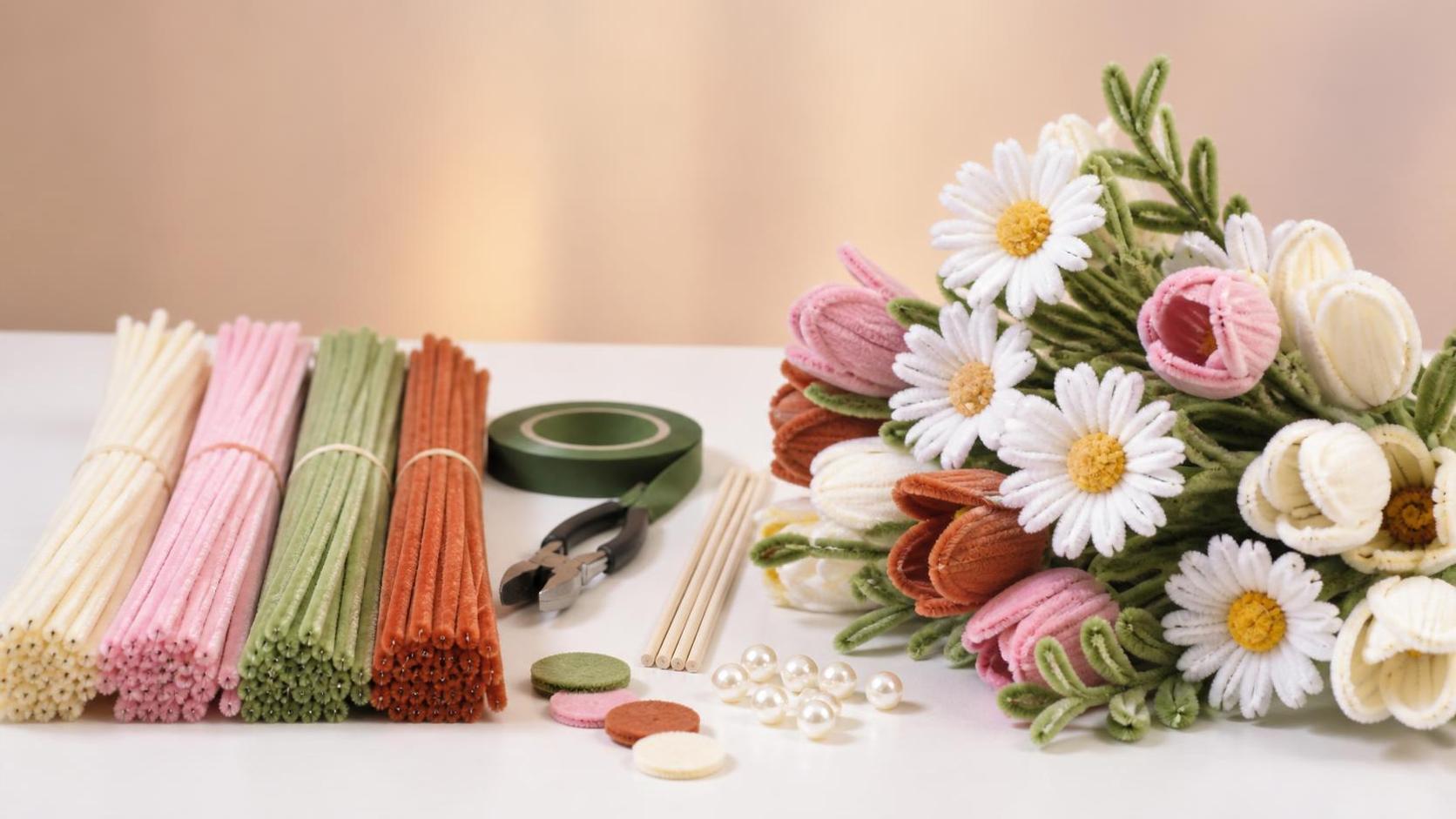
To make a pipe cleaner flower craft, the essential materials are simple: pipe cleaners in suitable colors, a cutting tool, a stem wrap or connector material, and a center detail such as beads or felt. The exact list changes with the flower style, because a daisy, rose, tulip, or lavender stem does not use the wire in quite the same way. In home decor work, the material choice affects shape retention, surface neatness, and how the finished flower looks under indoor light.
Pipe cleaners themselves are the starting point, but they are not all the same. Standard craft pipe cleaners usually combine a thin flexible wire core with polyester or acrylic fiber flocking. Thicker stems often hold petal loops better, while thinner ones bend more easily for small blossoms, filler flowers, or leaf veins. A common mistake is to choose very soft stems for large petals. They may look fine at first and then open unevenly or sag after repeated handling. For arrangements meant to stay upright in a vase, medium to firm wire cores are generally easier to work with.
Color selection matters more than many people expect. Bright primary tones suit children’s projects and playful seasonal decor, but interior decoration often benefits from quieter shades such as cream, dusty pink, sage, terracotta, muted yellow, and soft white. Green should also be chosen carefully. Very vivid green can make the stem look artificial under warm indoor lighting, while olive or medium leaf green often blends more naturally with fabric, wood, ceramic, or glass surroundings.
Core materials that are usually needed
Pipe cleaner flowers are often made with a short supply list, yet each item serves a practical purpose rather than being optional decoration.
- Pipe cleaners: for petals, leaves, stems, buds, and wrapping details. It helps to keep at least two green tones and several flower colors on hand.
- Scissors or wire-capable craft snips: regular paper scissors may struggle if the wire core is dense. Clean cuts reduce sharp ends.
- Floral tape: useful when several stems must be joined into one thicker stem or when a twisted wire section needs a neater surface.
- Beads, pom-poms, felt circles, or wrapped coils: these can finish the flower center. The right center detail changes the style dramatically.
- Craft glue: mainly for attaching non-wire parts such as fabric petals, bead centers, or decorative coverings. Hot glue holds quickly, while white craft glue may be enough for lightweight accents if drying time is acceptable.
- Stem support materials: floral wire, wooden skewers, or thin dowels can reinforce tall flowers that would otherwise bend.
If the flowers are intended for wreaths, table arrangements, or wall decor, a base material is also needed. That could be foam, grapevine, wrapped wire rings, fabric-covered boards, or simple glass jars filled with support filler. Without a stable base, handmade flowers tend to rotate or collapse at awkward angles.
Materials that improve appearance
Many finished pieces look more polished when extra surface materials are added. Ribbon can wrap a bouquet handle, linen or cotton scraps can soften the transition between stem and bloom, and crepe paper can form petals that are difficult to shape with pipe cleaners alone. Felt is especially useful because it hides twisted joints cleanly. A small felt circle under the bloom can cover where petals meet and make the top view more balanced.
Leaf material is another detail that changes the result. Leaves can be made from green pipe cleaners only, but mixed construction often looks better. Pipe cleaner stems with felt or fabric leaves give a fuller profile and reduce the sparse look that sometimes appears when every part is made from the same fuzzy material. For decorative arrangements placed beside wood trays, ceramic vases, or woven baskets, that texture contrast can make the piece feel less like a classroom craft and more like a finished home accent.
Some crafters also add tiny embellishments such as pearl beads, metallic thread, lace trims, or miniature bells for seasonal themes. These are not structural materials, so they should be used with restraint. Too many hard ornaments on a flexible flower can distort the head and make storage harder.
Tools and handling details that affect the result
Although the question focuses on materials, tool choice directly affects how those materials perform. Needle-nose pliers can help close loops neatly and tuck in wire ends. A ruler is useful when several stems must match in height for a bouquet or windowsill arrangement. Finger protection may be needed when working with large quantities, because repeated twisting can irritate the skin and exposed wire tips can scratch.
The finish also depends on how tightly the pipe cleaners are twisted. Over-twisting compresses the fibers and exposes more of the metallic core, which can make petals look thin and uneven. Under-twisting creates loose shapes that shift during transport or display. A moderate twist usually gives the cleanest result, especially when the flower is handled more than once.
For seasonal decor, pipe cleaner flowers are often paired with other removable decorative elements. A spring bouquet near a window, for example, can sit alongside lightweight surface decorations such as Christmas Gel Window Clings - Xmas Santa Claus Snowman Snowflake Penguin Christmas Tree Gift Window Stickers for Kids in another season, where soft TPR material and reusable adhesion suit smooth glass without permanent fixing. The connection is practical rather than stylistic: both types of decor rely on lightweight materials, easy placement, and simple seasonal changeover.
Choosing materials by flower type
A rose usually needs more pipe cleaners than a simple daisy because the bloom is built from layered curves rather than open loops. Tulips often work well with fewer pieces but need cleaner shaping and a firmer stem so the flower head stays upright. Lavender or baby's breath can be made from short cut segments attached along a wrapped wire stem, which means extra floral tape or glue may be necessary.
Sunflowers and peonies raise another issue: scale. Large flower heads made entirely from pipe cleaners can become heavy at the top. In that case, a stronger center wire, a wooden skewer insert, or a clustered base wrapped in floral tape helps keep the stem straight. Without reinforcement, the flower may lean after standing in a vase for a few days.
For small decorative bunches, the material list can stay minimal. For larger arrangements intended to sit on shelves, dining tables, or entry consoles, support and finishing materials matter much more than color variety alone.
Common material problems
Low-density pipe cleaners may shed fibers and leave thin spots where the wire shows through. This is especially noticeable in pale colors such as white, blush, or light yellow. If consistency matters, it is better to compare density by touch rather than relying only on packaging descriptions.
Glue can also create problems. Hot glue applied too heavily forms visible ridges between petals. Some solvent-based adhesives may stain pale felt or leave glossy marks on fabric accents. Test pieces are helpful whenever mixed materials are used, particularly if the flower includes both synthetic fibers and absorbent fabric.
Storage is another material issue that gets ignored. Pipe cleaner flowers flatten if packed tightly under weight. If the stems are intended for repeated seasonal use, individual sleeves, shallow boxes, or divided trays help preserve the petal shape. Dust can settle into the fuzzy fiber, so long-term display pieces may need occasional light cleaning with a soft brush or low-pressure air.
Transport conditions also matter. High heat may soften certain glued parts, and moisture can affect wrapped paper or fabric additions. The wire core itself usually stays usable, but the decorative surface can lose its finish if it rubs against rough packaging.
When mixed materials make more sense
Some flowers simply look better when pipe cleaners are only part of the build. A stem and leaf structure made from green chenille wire can support fabric petals, felt sepals, wooden tag accents, or ceramic mini pots. In home decor settings, this mixed-material approach often gives a more balanced visual result because the fuzzy texture is present without overwhelming the whole piece.
The same idea appears in other seasonal craft displays. A shelf arrangement might combine handmade flowers, ribbon garlands, and smooth-surface accents such as Christmas Gel Window Clings - Xmas Santa Claus Snowman Snowflake Penguin Christmas Tree Gift Window Stickers for Kids on nearby glass. Each material works best in its own place: pipe cleaners for shaped volume, soft TPR for removable window decoration, and fabric or wood for grounding elements.
In practice, the materials needed for pipe cleaner flower craft are not limited to chenille stems alone. The most reliable combination usually includes well-made pipe cleaners, a cutting and shaping tool, stem wrapping or reinforcement, and a small set of finishing materials chosen for the flower style. Once those basics are right, the flowers are easier to shape, easier to display, and far more convincing as decorative pieces.
Leave A Message
If you are interested in our products and want to know more details, please leave a message here, we will reply you as soon as we can.

We specialize in supplying home decor, handicrafts, and daily necessities.


