How to Assess Wire Thickness from a Pipe Cleaner DIY Kit Supplier
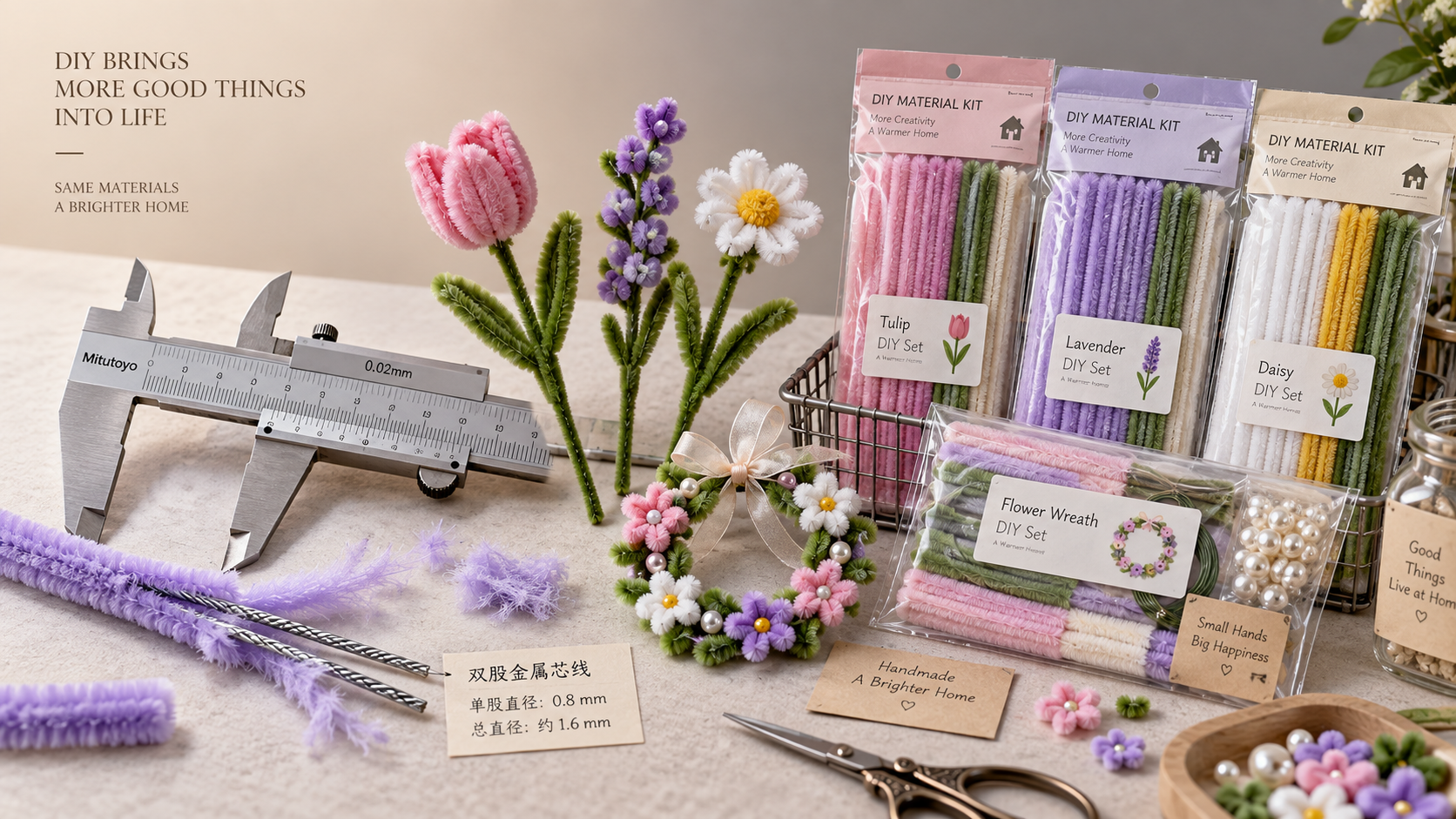
Wire thickness is easy to overlook in a pipe cleaner DIY kit, especially when the product is photographed as a colorful bundle rather than a construction material. For technical assessment, however, the wire core affects nearly everything that happens after the package is opened: whether a child can bend it without excessive force, whether a flower stem stays upright, whether an animal shape holds its legs in position, and whether repeated twisting exposes a sharp wire end.
A capable pipe cleaner diy kit supplier should be able to discuss wire thickness as a controlled specification, not merely describe the stems as “soft,” “strong,” or “flexible.” Those words may be useful for merchandising, but they do not give an assessor enough information to compare samples, define an incoming inspection standard, or decide whether the material suits a particular home décor craft project.
Start with the Wire Core, Not the Finished Stem Diameter
The visible diameter of a pipe cleaner includes polyester fiber, chenille pile, adhesive, and sometimes a dense twisted wrap around the wire. It should not be confused with the diameter of the metal core. Two stems can look equally thick on a product card while behaving very differently because one contains a heavier wire or a different wire construction.
Ask the supplier to identify the core structure clearly. A standard pipe cleaner is commonly made by twisting fibers between two metal wires, but some variants use a single core, a multi-strand core, or a denser construction designed for stronger shaping. The assessment request should cover:
- nominal wire diameter or gauge for each core wire;
- the number of wires in the stem;
- wire material and any surface treatment;
- finished stem diameter and pile length;
- tolerance limits for the wire core and finished product;
- any planned changes to fiber density, wire source, or twisting method.
Gauge alone can cause confusion because gauge systems are not universal. If a supplier uses AWG, confirm that AWG is actually the measurement reference. If the factory works in millimeters, request the metric diameter as well. For inspection records, a value such as “core wire diameter in mm” is generally clearer than an unqualified phrase such as “medium gauge.”
How to Measure a Sample Properly
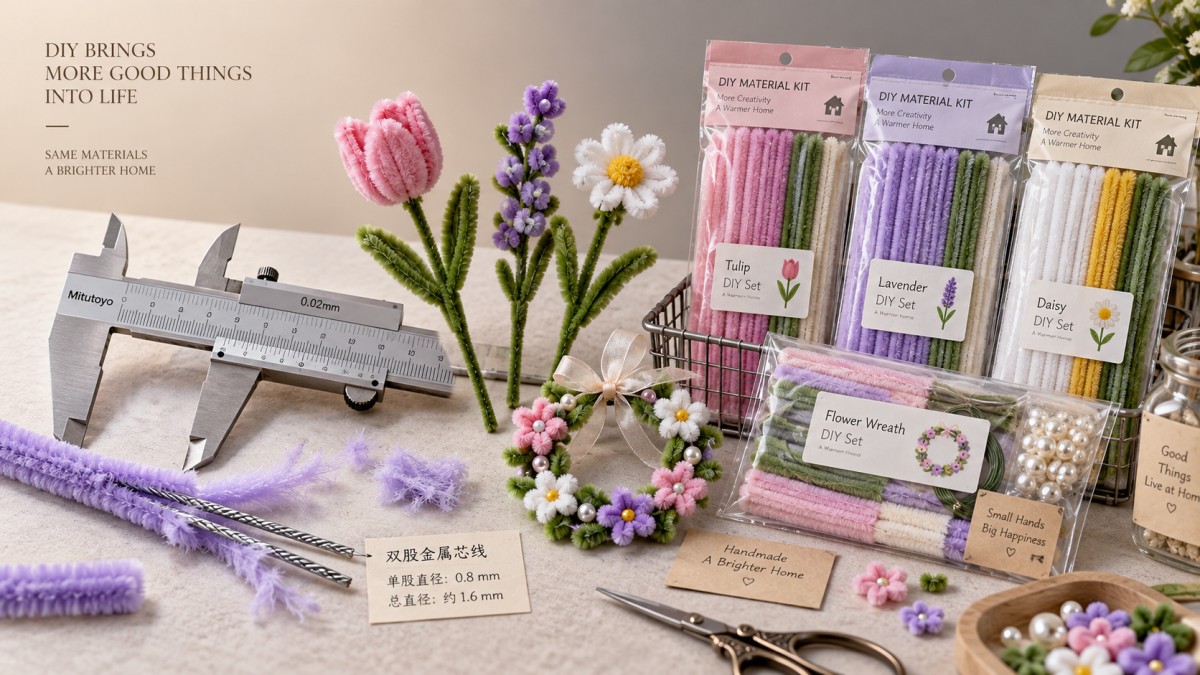
A visual check is not enough. The wire must be exposed without stretching or nicking it. Cut a short section from the middle of the stem, carefully remove the fiber, separate the twisted metal wires if applicable, and measure each wire with a suitable micrometer or caliper. Measuring only the twisted pair will produce a misleading result because the apparent width depends on the twist pitch and how tightly the wires sit together.
Take measurements from more than one location and from more than one bag or carton. A single stem can be unusually thick or thin, particularly if the lot includes material from different production runs. The useful question is not simply whether one sample matches a quoted value. It is whether the variation remains within the agreed tolerance across the shipment.
For a pre-production approval, retain a labeled reference sample. This is more practical than relying on a catalog photo or a broad verbal description. It gives both sides something physical to compare when a later order feels softer, weaker, or harder to bend than expected.
Thickness Must Be Judged Alongside Bend Behavior
A thicker wire is not automatically better. In a preschool activity kit, an overly stiff stem can be frustrating to bend and may create more force at the cut end if the coating becomes damaged. In contrast, a lightweight wire may be perfectly appropriate for pom-pom accessories or flat decorative outlines, but unsuitable for freestanding flowers, wreath accents, miniature baskets, or characters that need to remain posed.
The most informative practical check is a controlled hand-forming test using the intended project. Form a loop, twist two stems together, bend a right angle, then straighten and rebend the same area several times. Watch for three things: permanent deformation that occurs too easily, wire breakage near the twist, and fiber shedding that leaves too much metal exposed. These observations connect the specification to actual use, which a number on a purchase order cannot do by itself.
For home décor kits, it helps to separate projects by load demand. A simple wall collage may only need the stem to retain a gentle curve. A three-dimensional centerpiece has different requirements: it may need a firmer core, denser chenille coverage, and a design that avoids putting all bending stress at one short point. When the kit includes beads, wood pieces, or heavier ornaments, assess the combined assembly rather than the pipe cleaner in isolation.
Do Not Treat Tensile Strength as a Substitute for Flexibility
Suppliers sometimes provide a tensile-strength statement, but tensile strength and shaping performance are not interchangeable. Tensile testing concerns resistance to pulling force; craft use usually involves bending, torsion, repeated twisting, and occasional compression. A wire can resist pulling well yet still feel brittle during repeated folds. Conversely, a more ductile wire may twist smoothly but lack the stiffness required to support a decorative form.
If test documentation is available, review what was actually tested: bare wire, finished stem, or a completed kit component. Check the sample condition, test method, lot reference, and whether the document corresponds to the material being supplied. A generic report from an unrelated material grade does not prove that the current production lot will perform the same way.
Coating Quality Matters as Much as Core Diameter
Wire thickness becomes a safety issue when the protective fiber layer is inconsistent. Sparse pile near the ends, poor trimming, loose twist points, or exposed sharp metal can turn a normally simple craft component into a complaint risk. Inspect both ends of the pipe cleaner, not only the center section that looks best in a sample photograph.
Color can also hide problems. Dark chenille may conceal thin fiber coverage, while metallic or glitter finishes can mask loose construction until the stem is bent. Assessors should bend samples under normal lighting and examine the inside of the bend. That is where the fiber opens and where a weak wrap is most likely to show.
The same disciplined approach applies to adjacent items in a seasonal craft range. For example, reusable window decorations made from soft TPR are evaluated less by wire behavior than by surface adhesion, removal, and storage stability. A product such as 6 Sheets Fall Gel Window Clings for Glass Windows, FallThanksgiving Clings Gel Stickers,Hello Fall Leaves,Pumpkin for Autumn Holiday Window Decor is intended for smooth surfaces in homes, classrooms, and Thanksgiving party settings. It illustrates why material-specific checks matter: a non-toxic, reusable gel cling requires a different inspection logic from a wire-based DIY component, even when both belong in an autumn home décor assortment.
What to Expect from a Reliable Supply Partner
A supplier should be willing to turn the agreed construction into a usable specification sheet: core wire size, stem length, finished diameter, color range, packaging count, and acceptable tolerance. Just as importantly, it should be clear about which details can vary between batches. In handmade or mixed-material product categories, the practical risk often lies in uncontrolled substitutions rather than in the original sample.
For buyers assembling broader home décor and handicraft assortments, supplier coordination also matters. A Ningbo-based sourcing network with dedicated handicraft production, wooden and fabric craft capability, and established relationships across ceramics, plastics, and handwoven products can simplify cross-category development. Yet the benefit is only real when each material has its own inspection criteria. A stable supply chain does not remove the need to verify the wire inside a pipe cleaner.
Before approving production, request a representative sample set, measure the exposed core, conduct project-specific bend tests, inspect the ends and fiber coverage, and record the accepted construction in writing. That process is modest, but it catches the differences that product photos and broad descriptions tend to miss. For pipe cleaner DIY kits, the right wire thickness is not a universal number; it is the thickness that delivers the intended shape, handling feel, and safety margin consistently from one shipment to the next.
Leave A Message
If you are interested in our products and want to know more details, please leave a message here, we will reply you as soon as we can.

We specialize in supplying home decor, handicrafts, and daily necessities.


