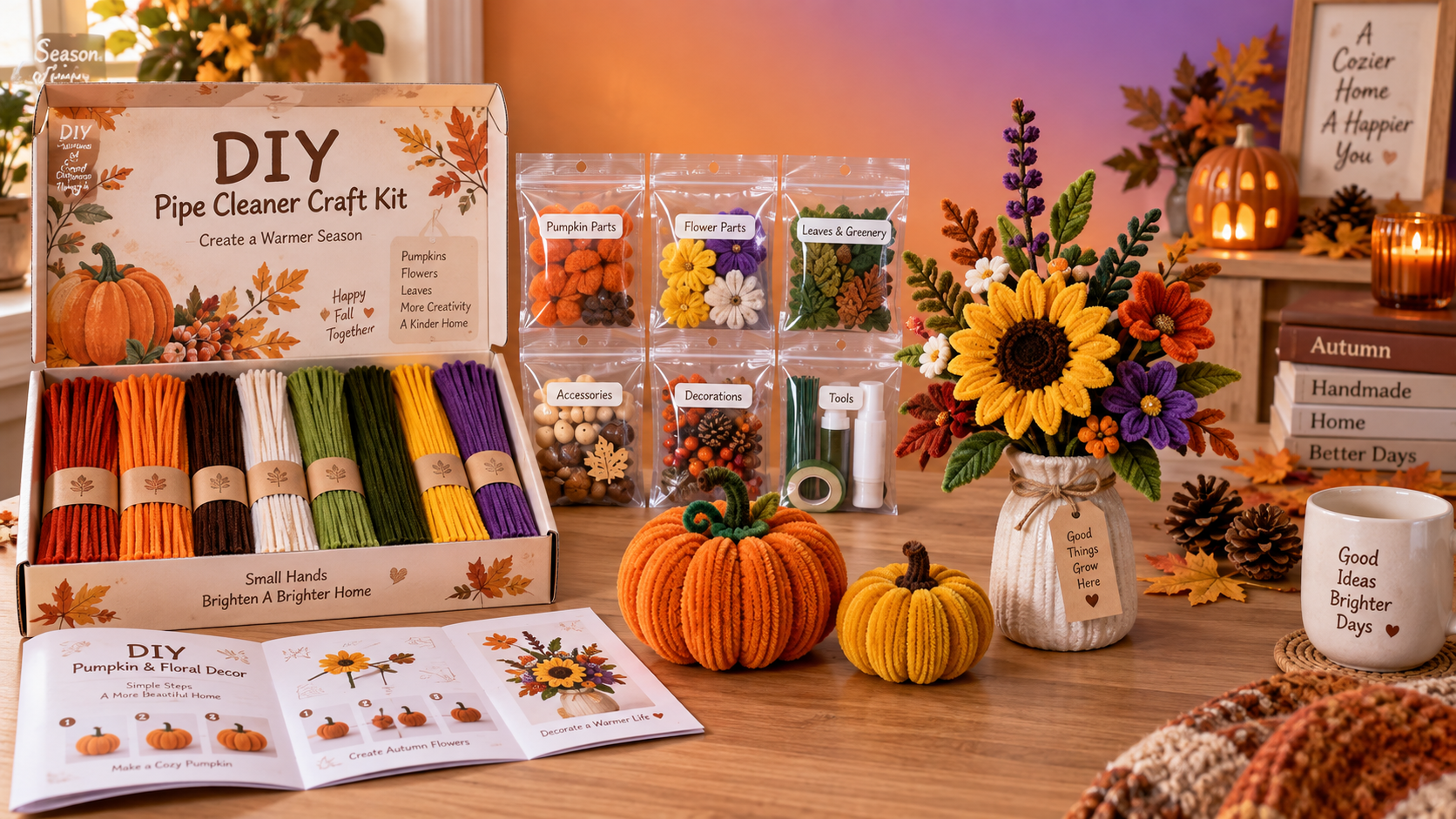
Retailers should use a pipe cleaner DIY kit supplier when the product needs to do more than provide loose craft materials. A kit makes sense when the buyer needs a clear activity, a shelf-ready format, repeatable quality, and replenishment that can follow a seasonal or promotional calendar. It is particularly relevant for home decor retailers that sell family activities, holiday displays, children's craft ranges, party goods, or small gifts with an immediate use case.
Pipe cleaners are inexpensive and familiar, but that does not automatically make a DIY kit an easy purchase. The retail value comes from the project design, component balance, packaging, and execution. A box containing several colors of pipe cleaners may be difficult to differentiate from a basic craft pack. A well-developed kit, by contrast, gives the customer a recognizable result: a table decoration, hanging ornament, miniature character, floral accent, or seasonal display piece.
A supplier is worth engaging when a retailer needs that product development and supply coordination rather than simply buying commodity materials.
Use a specialist supplier when the assortment needs a defined retail role
The first question is not whether pipe cleaner crafts are popular in the abstract. It is whether the kit has a specific role in the assortment. Retailers often get better results when the item solves one of four merchandising needs: filling a low-price impulse area, supporting a themed seasonal collection, extending a children's activity range, or adding an interactive element to home decoration sales.
For example, a spring or Christmas display may need a quick craft item that families can complete at home. A Halloween range may need products that give shoppers more than a one-time visual decoration. In these cases, a pipe cleaner kit can support the theme while providing an activity that is easy to understand from the front of the pack.
It is less suitable when the retailer's customer expects premium finished decor, has little tolerance for assembly, or shops primarily for highly durable decorative objects. Pipe cleaner projects are tactile, lightweight, and accessible, but their appeal rests on creativity and participation. They should be selected as an activity-led product, not presented as an alternative to a finished ceramic, wood, fabric, or metal home accessory.
A capable pipe cleaner DIY kit supplier should help translate that merchandising purpose into a practical product format. This includes selecting a project that can be completed within a reasonable time, deciding which accessories are necessary, and avoiding a kit that looks generous in a product photo but produces an unclear or disappointing final result.
The kit design matters more than the raw material count
Retail buyers can easily compare the number of pipe cleaners, pom-poms, eyes, felt shapes, or glue dots listed on a package. That comparison is useful, but it is not a reliable measure of value. A kit with many components may create packing complexity, assembly errors, and customer confusion. One with too few pieces can leave little margin for mistakes, particularly where children are expected to follow the activity.
The more useful review is project feasibility. Ask the supplier to show the intended finished item, the component list per kit, and the assembly sequence. A buyer should be able to see whether each component has a purpose and whether the project can be completed with the contents supplied.
- Clear outcome: The pack should communicate what the customer can make without requiring a long explanation.
- Appropriate difficulty: Bending and shaping pipe cleaners is simple, yet layered designs, very small parts, or repeated twisting can make an activity unsuitable for the proposed user group.
- Balanced contents: The quantity of each color and accessory should match the design, including a reasonable allowance where an item may be misplaced or bent incorrectly.
- Packaging discipline: Loose pieces, weak inner bags, or instructions that do not match the actual contents can turn a low-cost item into a returns problem.
- Visual consistency: The finished sample, package image, and written instructions should all show the same project and color direction.
Retailers should also consider how much open-ended creativity they want to offer. A highly prescribed kit is easier to merchandise because the result is obvious. A more flexible kit can have wider age appeal and may encourage repeat purchase, but it needs better visual guidance so customers do not mistake it for a basic material bundle.
Seasonal programs are a strong reason to consolidate with one supplier
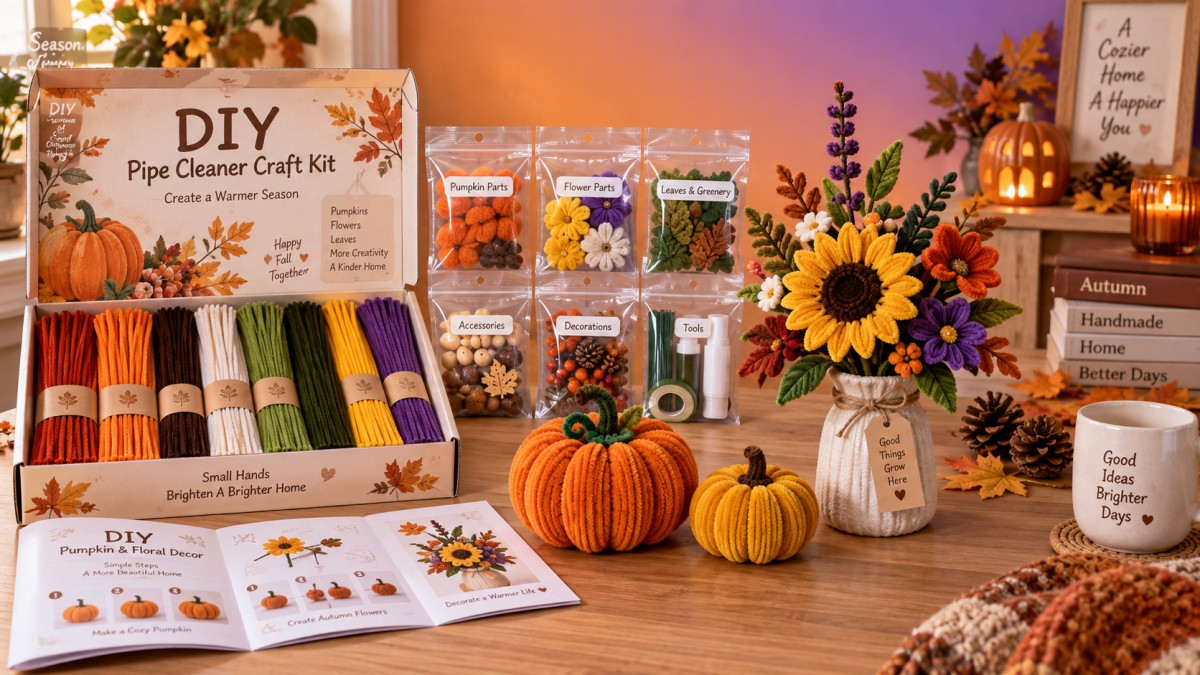
Seasonality is where a pipe cleaner DIY kit supplier can add more value than a factory producing only one component. Home decor and party assortments frequently combine products with different material requirements: paper packaging, fabric elements, wooden bases, plastic accessories, decorative stickers, and craft wire or chenille stems. Coordinating these items separately can increase approval work and create inconsistencies in color, pack count, or delivery timing.
For a Halloween assortment, a retailer may combine hands-on craft kits with quick decorating products for windows, walls, and party spaces. A complementary item such as Halloween Window Gel Clings Ghost Pumpkin Bat Witch Cat Boo Blood Decal Stickers for Halloween Home Party Window Decorations illustrates the advantage of thinking in collection terms. The six-sheet reusable TPR decoration is designed for smooth surfaces such as windows and glass, while a pipe cleaner activity serves a different part of the shopping mission. One creates an immediate visual effect; the other creates an activity and a keepsake. They can sit in the same seasonal presentation without competing for the same use.
This kind of cross-material assortment requires attention to details that are easy to overlook during early selection. Colors need to work together across products. Packaging dimensions must suit the display fixture. Delivery dates must leave time for store allocation before the peak selling window. If an assortment relies on several small suppliers, a delay in one accessory can hold up a complete retail program.
Retailers with recurring seasonal launches should therefore assess whether a supplier has dependable access to the supporting materials, not only pipe cleaners. Factories and partner networks that work across handicrafts, wood, fabric, plastics, ceramics, and handwoven products can be useful where a buyer wants coordinated ranges rather than isolated SKUs.
Assess quality through handling, packing, and repeatability
Low unit value does not remove the need for quality review. In fact, minor quality failures are highly visible in a DIY kit because the shopper handles every part. Pipe cleaners that shed fibers, have exposed wire ends, vary substantially in thickness, or lose shape too easily can undermine the activity. Accessories can create similar problems when they are poorly cut, inconsistent in color, or packed in incomplete quantities.
Request samples in the actual retail configuration whenever possible. Reviewing only loose materials will not reveal whether the packaging protects the contents, whether component bags remain sealed in transit, or whether the instruction sheet is readable at its intended size. The sample review should include an attempt to make the project as instructed. The goal is not to judge artistic taste; it is to identify whether the customer journey is coherent from opening the pack to completing the item.
For products intended for children, buyers should define the relevant market, age positioning, labeling needs, and required product-testing documentation early in the sourcing process. A supplier's statement that materials are safe is not a substitute for the retailer's compliance requirements. This is especially important where kits contain small decorative pieces, adhesives, wire-core materials, or components sourced from different production partners.
Choose for replenishment capability, not just a first-order sample
A polished sample can obscure the harder commercial question: can the supplier reproduce the same kit after the first order? Retailers should ask how color matching, component sourcing, packaging printing, and quality checks are managed across repeat production. A kit that depends on several small accessories may be more vulnerable to substitution than a simple item made from one material.
Useful discussions include minimum order quantities by design, whether mixed designs can share packaging runs, the lead time for reorders, and the process for approving substitutions. Buyers should be wary of suppliers that treat an accessory change as trivial. Replacing an eye shape, ribbon shade, adhesive format, or instruction image can alter the finished result and generate store-level complaints if the package has not been updated.
Retailers do not need a pipe cleaner DIY kit supplier for every craft item. They need one when the range depends on a coherent project, controlled components, seasonal coordination, and reliable follow-through after the sample stage. When those conditions are present, the supplier becomes part of the assortment-development process rather than a source of inexpensive stems in assorted colors.
Leave A Message
If you are interested in our products and want to know more details, please leave a message here, we will reply you as soon as we can.

We specialize in supplying home decor, handicrafts, and daily necessities.


